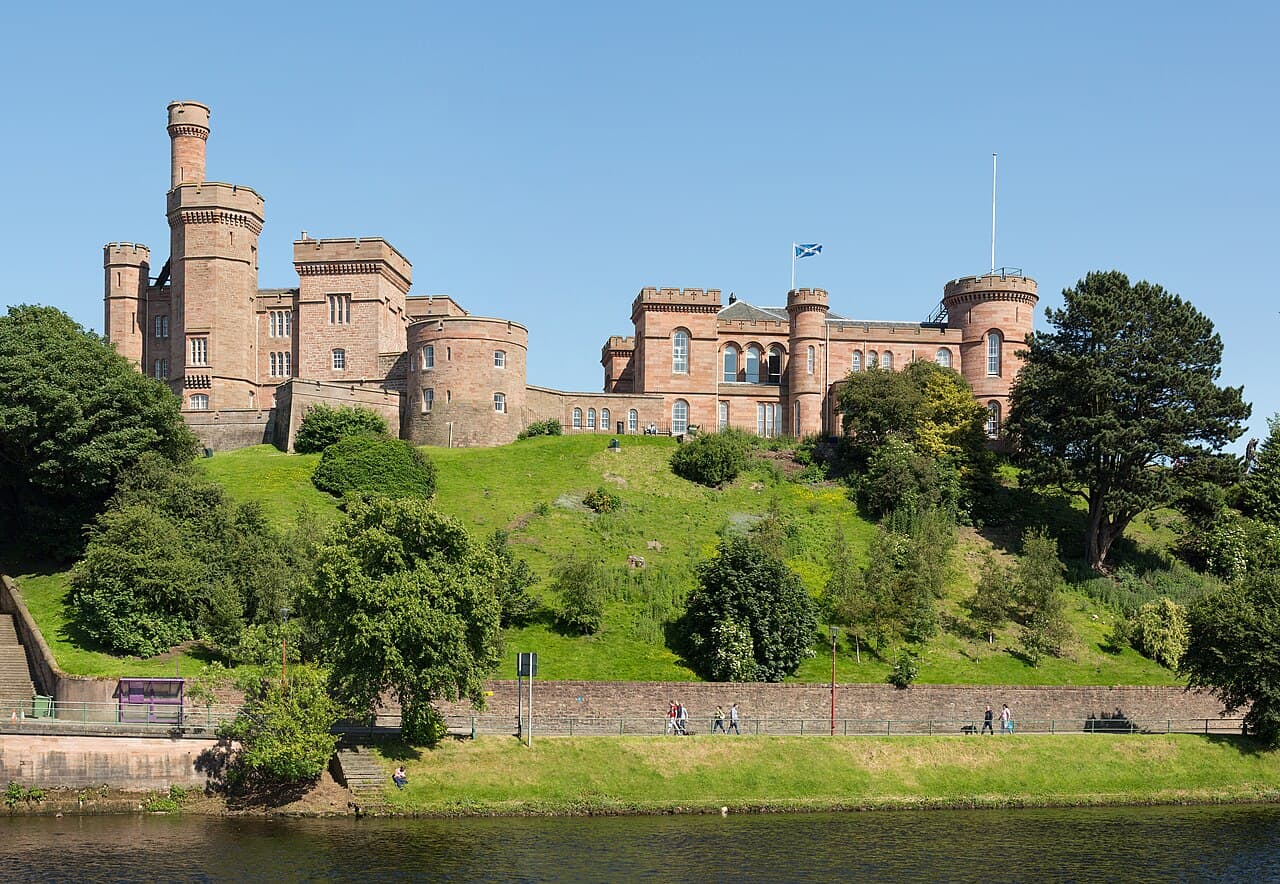
Inverness Castle
Inverness Castle is a prominent red sandstone fortress situated on a cliff overlooking the River Ness in Inverness, Scotland. The castle occupies a site with a rich history dating back to the 11th century, originally established as a defensive structure attributed to Malcolm III of Scotland. The current building, constructed in 1836, stands as a symbol of the region's turbulent past and evolving architectural styles.
The origins and early history of Inverness Castle
The earliest known castle on this site was a wooden fortification built around the mid-11th century, likely by Malcolm III. This initial structure was part of a network of fortresses intended to consolidate royal power in the Scottish Highlands. The original castle was strategically located to control the vital crossing of the River Ness and to oversee the surrounding lands.
This early wooden castle was destroyed during the Wars of Scottish Independence, specifically in 1307, when King Robert I of Scotland (Robert the Bruce) ordered the dismantling of fortifications that could be used by his enemies. The destruction was part of a broader strategy to weaken English-aligned strongholds in Scotland.
Throughout the 15th century, Inverness Castle remained a focal point of political and military activity in the Highlands. In 1428, King James I detained numerous Highland clan chiefs at Inverness Castle, many of whom were executed, an event that intensified clan conflicts. The castle withstood attacks, including a notable siege during which Clan Donald attempted to capture it but failed.
Reconstruction and sieges in the 16th century
In 1548, a new stone castle was completed under the direction of George Gordon, 4th Earl of Huntly, who also served as its constable until 1562. This iteration featured a robust tower and improved defensive works, reflecting the architectural advancements of the period.
The castle was involved in significant conflict during the Siege of Inverness in 1562, when Clan Munro and Clan Fraser, supporters of Mary, Queen of Scots, seized the fortress after the governor refused the queen entry. The governor was executed following the castle's capture, highlighting the intense political rivalries of the era.
Military significance and decline through the 17th and 18th centuries
Inverness Castle continued to play a role in military and administrative affairs throughout the 17th and 18th centuries. It was involved in the Jacobite uprisings, including the destruction inflicted by Jacobite forces in 1746. Following the first Jacobite rebellion, the castle was extended and reinforced by General George Wade in 1725, who was responsible for improving military infrastructure across the Highlands.
Despite royal orders for repairs in 1619, the castle fell into disrepair at various points, reflecting the shifting political landscape and reduced military importance as newer fortifications and administrative centers emerged.
The 19th-century reconstruction and architectural features
The present Inverness Castle was constructed in 1836 by the renowned architect William Burn, replacing earlier structures on the same site. Built in a style that evokes medieval fortifications, the castle features castellated towers, battlements, and a symmetrical seven-bay frontage facing south.
The main building is complemented by a north block, completed in 1848 by Thomas Brown II, originally serving as a prison and later converted into a courthouse. The north block maintains architectural harmony with the main castle, constructed from matching red sandstone and featuring similar castellated elements.
The castle grounds are enclosed by walls with bastions designed by Joseph Mitchell, adding to the site's defensive character. A historic well, restored in 1909, lies between the two main buildings, preserving a feature likely used by earlier castle inhabitants.
Current use, cultural significance, and visitor information
Today, Inverness Castle houses the Inverness Sheriff Court and previously served as the meeting place for the Inverness-shire County Council until 2020. The castle grounds remain open to the public, although the interior is generally not accessible due to its judicial functions.
The castle holds cultural importance as the setting for Shakespeare's Macbeth, enhancing its status as a Scottish landmark. Its image has appeared on the reverse of a Royal Bank of Scotland £50 note, further cementing its iconic place in Scottish heritage.
The castle grounds feature a statue of Flora MacDonald, a celebrated Jacobite heroine, erected in 1899. This statue, along with the remaining historic artillery pieces, connects visitors to the castle's rich military and cultural past.
Inverness Castle's commanding position overlooking the River Ness and proximity to Loch Ness underscores its strategic significance throughout Scottish history, offering panoramic views that have long been valued for defense and governance.
Frequently asked questions (FAQ)
- How do I get to Inverness Castle?
- Inverness Castle is conveniently located in the heart of Inverness, easily accessible by public transport, including buses and trains. If you're driving, there are parking facilities nearby, though it can get busy during peak tourist seasons. Walking from the city center is also a pleasant option, as the castle is just a short stroll along the scenic banks of the River Ness.
- What is the historical significance of Inverness Castle?
- Inverness Castle has stood on its site since the 11th century, playing a crucial role in Scotland's history, particularly during the Wars of Scottish Independence. It was strategically positioned to control the surrounding area and has served as a fortress, a royal residence, and now a courthouse. The castle's rich history is reflected in its architecture and the stories of the many notable figures associated with it.
- When was Inverness Castle built?
- The current structure of Inverness Castle was completed in 1836, replacing an older castle that had fallen into disrepair. The original castle was built in the 11th century, but over the years, it has undergone various renovations and restorations. The castle's architecture combines elements of Gothic and Scottish Baronial styles, making it an iconic landmark in Inverness.
- Can I visit Inverness Castle?
- Yes, Inverness Castle is open to visitors, offering stunning views of the city and the River Ness from its viewpoint. However, please note that the interior of the castle is not open to the public as it currently functions as a courthouse. Visitors can enjoy the surrounding gardens and take photographs of the castle's impressive exterior.
- Why is Inverness Castle a popular tourist attraction?
- Inverness Castle is popular for its breathtaking views, rich history, and beautiful architecture. Visitors are drawn to its picturesque setting and the opportunity to learn about the castle's significance in Scottish history. Additionally, its central location makes it an ideal starting point for exploring other attractions in Inverness.
- Is it possible to tour the inside of Inverness Castle?
- Currently, the interior of Inverness Castle is not open for public tours, as it operates as a courthouse. However, visitors can explore the grounds and enjoy the panoramic views from the castle's viewpoints. Plans for future accessibility to the interior may be developed, so it's worth checking for updates before your visit.
- What are the opening hours for Inverness Castle?
- Inverness Castle is open year-round, but the opening hours may vary depending on the season. Typically, the castle grounds are open from early morning until late evening, allowing visitors ample time to appreciate the views. It's advisable to check the official website for the most current hours before planning your visit.
- What are the ticket prices for Inverness Castle?
- There is no admission fee to enter the grounds of Inverness Castle, making it a budget-friendly attraction for visitors. However, due to its status as a courthouse, there are no guided tours available, which keeps costs minimal. Always verify if there are any special events that may require tickets or fees.
- What is the best time to visit Inverness Castle?
- The best time to visit Inverness Castle is during the spring and summer months when the weather is mild and the gardens are in full bloom. This season also offers longer daylight hours, allowing for extended visits. Autumn can be beautiful as well, with vibrant foliage, but be prepared for cooler temperatures and occasional rain.
- Are there nearby attractions to visit after Inverness Castle?
- Yes, there are several attractions near Inverness Castle that you can explore, including the picturesque River Ness and the historic Inverness Cathedral. The nearby Inverness Museum and Art Gallery offers insights into the local culture and history. Additionally, you can take a short drive to Loch Ness and the famous Urquhart Castle, which are must-see destinations in the region.
Photo gallery

Information
Website
Visit websiteSources & official resources
Verify the information above using these authoritative references.
Loading map...
Visitor reviews
No reviews yet. Been here? Write the first review and help other travelers!
Write the first reviewVisited this castle? Share your experience
Your review helps other travelers and adds first-hand knowledge to our encyclopedia.


