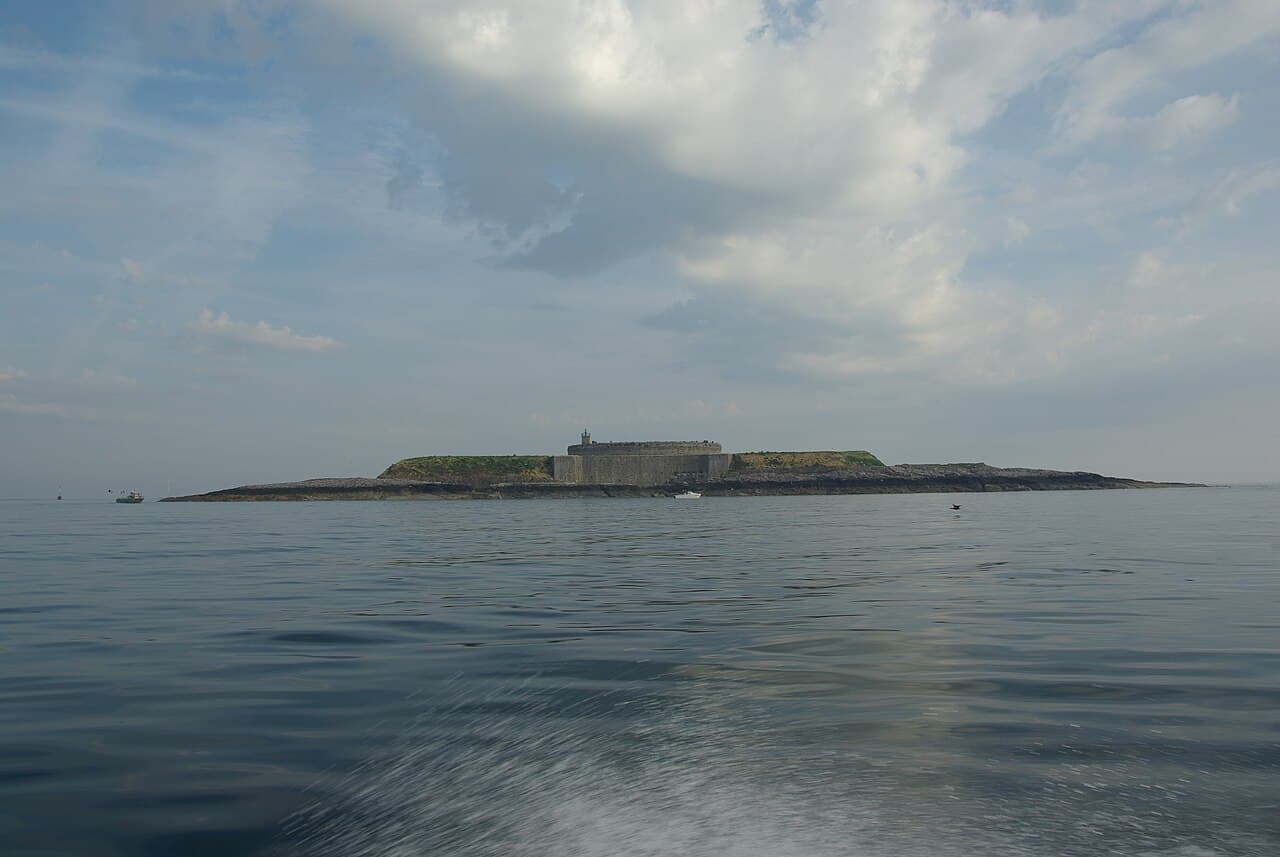
Îles Saint-Marcouf — France castle

Îles Saint-Marcouf

Îles Saint-Marcouf fortifications in Normandy, France

Îles Saint-Marcouf are two small, uninhabited islands located off the coast of Normandy, France, in the Baie de la Seine region of the English Channel. These islands lie approximately 6.5 km (4.0 mi) east of the Cotentin Peninsula coast near Ravenoville and about 13 km (8 mi) from the island of Tatihou and the harbour at Saint-Vaast-la-Hougue. The islands consist of the larger île du Large and the smaller île de Terre, separated by 500 m (1,600 ft) of water. Together, they cover a total area of approximately 1,400 hectares (3,500 acres) and reach a maximum elevation of 10 m (33 ft).

Historical significance and early occupation

The islands are named after Saint Marcouf, a 6th-century saint born in Bayeux, renowned for his reputed ability to cure scrofula, a form of tuberculosis. Saint Marcouf died on the islands on 1 May 588 CE. The islands hosted a monastic community from the early medieval period until the 15th century, reflecting their religious importance during the Middle Ages. This monastic presence contributed to the islands' role as a spiritual refuge and place of pilgrimage.

Military architecture and fortifications

Due to their strategic location controlling access to the Baie de la Seine and the approaches to Normandy, the Îles Saint-Marcouf were fortified extensively, particularly during the 18th and 19th centuries. The islands feature a bastioned fortress design, a style of military fortification characterized by angular bastions projecting from the curtain walls, allowing for defensive crossfire and better protection against artillery.

The fortifications include thick stone walls, bastions, ramparts, and defensive ditches. These defenses were designed to repel naval attacks and to secure the islands against enemy landings. The bastioned layout reflects the influence of military engineers such as Vauban, who revolutionized fortress design in France during the 17th century, although the specific construction phases on the islands occurred later.

During the Napoleonic Wars, the islands served as a key defensive position guarding the French coast against British naval incursions. The fortifications were maintained and upgraded through the 19th century, adapting to advancements in artillery and naval warfare.

Lighthouse and modern additions

On the larger île du Large, a lighthouse was constructed in 1948. This lighthouse remains a prominent feature of the island, aiding navigation in the busy shipping lanes of the English Channel. It stands as a modern complement to the historical military structures.

Geographical and environmental context

The islands' low elevation and proximity to the mainland have made them vulnerable to erosion and changing sea levels. Their uninhabited status today helps preserve their natural environment and the integrity of the historic fortifications.

The surrounding waters are rich in marine biodiversity, and the islands form part of a protected area that balances heritage conservation with ecological preservation.

Visiting Îles Saint-Marcouf

Access to the islands is limited due to their protected status and military heritage. Visitors interested in military history and coastal fortifications may find the islands intriguing, though arrangements for visits typically require special permission or guided tours. The islands offer a rare glimpse into coastal defense systems of the 18th and 19th centuries, combined with a unique natural setting.

Frequently asked questions (FAQ)

How do I get to Îles Saint-Marcouf?
You can reach Îles Saint-Marcouf by taking a boat from the nearby coastal town of Barfleur. The journey offers stunning views of the coastline and surrounding waters, making it a delightful experience for visitors.
What is the historical significance of Îles Saint-Marcouf?
Îles Saint-Marcouf holds historical importance due to its strategic location in the English Channel, which was pivotal during various military conflicts. The islands served as a base for naval operations and played a role in the defense of the French coastline.
When was Îles Saint-Marcouf constructed?
The fortifications on Îles Saint-Marcouf were built in the 17th century, primarily to defend against English and Dutch naval threats. The structures showcase the military architecture of the time and reflect the historical tensions in the region.
Can I visit Îles Saint-Marcouf year-round?
Visiting Îles Saint-Marcouf is typically best during the spring and summer months when the weather is more favorable for boat trips. However, access may be limited during the winter due to rough seas, so it’s advisable to check local schedules before planning your visit.
Why is the architecture of Îles Saint-Marcouf noteworthy?
The architecture of Îles Saint-Marcouf is noteworthy for its well-preserved military fortifications and unique design that reflects the military engineering techniques of the 17th century. Visitors can explore various structures that illustrate the historical context and strategic significance of the islands.
Is it possible to explore the islands on foot?
Yes, visitors can explore Îles Saint-Marcouf on foot, enjoying scenic walks around the fortifications and natural landscapes. However, it’s important to wear appropriate footwear and be cautious of the terrain, as some areas may be rugged.
What are the ticket prices for visiting Îles Saint-Marcouf?
Ticket prices for boat trips to Îles Saint-Marcouf can vary, typically ranging from €10 to €20 for adults, with discounts available for children and seniors. It's best to check with local tour operators for the most current pricing and any package deals.
What are the opening hours for Îles Saint-Marcouf?
Îles Saint-Marcouf does not have traditional opening hours, but boat services operate during specific times, usually from late spring to early fall. It’s recommended to check the boat schedule beforehand to plan your visit effectively.
Are there any nearby attractions to visit after Îles Saint-Marcouf?
Yes, after visiting Îles Saint-Marcouf, you can explore nearby attractions such as the picturesque village of Barfleur and the historic town of Cherbourg. These locations offer rich cultural experiences and beautiful coastal scenery, making them ideal for a full day of exploration.

Photo gallery

Îles Saint-Marcouf
Click to view

Photo by Jeremy14650•CC BY-SA 3.0

1 photo • Click any image to view in full screen

Information

Bastioned Fortress

Loading map...

Visitor reviews

No reviews yet. Been here? Write the first review and help other travelers!

Write the first review

Visited this castle? Share your experience

Your review helps other travelers and adds first-hand knowledge to our encyclopedia.

Write a review

(5/5)

0/2000 characters

Your review will be visible after admin approval

Nearby castles

16.9 km

St. Pierre-du-Mont Castle

Saint Pierre-du-Mont, France

St. Pierre-du-Mont Castle, also known locally as Château de St. Pierre-du-Mont or simply Château St. Pierre, is a historic Renaissance castle located near the village of Saint Pierre-du-Mont in the Calvados department of Normandy, France. This castle, dating back to the 16th century, exemplifies the architectural and social characteristics of Norman noble estates from the late Renaissance period. Architectural features and defensive elements The castle's most distinctive feature is its entrance gate, which is flanked on the right by a machicolated defensive tower. This type of tower, with openings between the supporting corbels, was a common defensive design intended to allow defenders to drop projectiles or boiling substances on attackers below. The presence of such a tower on a manor gate is typical of fortified Norman manors of the late 16th century, reflecting the need for security during a period marked by regional conflicts and social unrest. Notably, the upper part of this tower once housed a dovecote, a feature that symbolized nobility and privilege until the French Revolution. Dovecotes were often integrated into noble residences as a sign of status, as the right to keep pigeons was restricted to the aristocracy. This dovecote would have served both practical and symbolic roles, providing a source of meat and fertilizer, as well as marking the estate's noble standing. Historical context and ownership At the beginning of the 17th century, the estate was owned by François du Mesnil, a member of a noble family. The du Mesnil family adhered to the Reformed religion, which was significant in the context of the religious tensions in France during the 16th and 17th centuries. However, following the Revocation of the Edict of Nantes in 1685, which ended the religious tolerance previously granted to Protestants, the family returned to Catholicism. By the late 18th century, the castle passed through marriage to the De Frotté family. A notable member of this family was a Marquess who served as a prefect during the first half of the 19th century. This connection highlights the castle's continuing importance as a noble residence and administrative center through changing political regimes in France. Location and significance during World War II St. Pierre-du-Mont Castle is situated very close to Pointe du Hoc, a prominent site of the D-Day landings during World War II. Pointe du Hoc was heavily bombed and saw intense fighting due to its strategic position overlooking the English Channel. Remarkably, despite its proximity to this major battleground, the castle itself was not destroyed during the bombings. This survival adds a layer of historical significance to the site, linking it to both Renaissance heritage and 20th-century military history. Current use and visitor experience Today, the castle operates as a Bed and Breakfast, welcoming visitors who wish to experience its historic ambiance and the scenic Normandy countryside. Guests can appreciate the castle's Renaissance architecture, the fortified entrance gate, and the surrounding landscape steeped in history. Its proximity to important World War II sites makes it an attractive location for tourists interested in both medieval and modern history. Architectural style and preservation The castle is a representative example of Renaissance architecture in Normandy, characterized by its blend of defensive medieval features and the emerging aesthetic of the Renaissance period. The preservation of the machicolated tower and dovecote is particularly notable, as these elements illustrate the dual function of noble residences as both fortified structures and symbols of status. The castle remains in a well-preserved state, allowing visitors to appreciate its historical and architectural significance firsthand. Significance in Norman noble culture St. Pierre-du-Mont Castle reflects the lifestyle and social structure of the Norman nobility from the late Renaissance through the post-Revolutionary period. The dovecote and fortified gate signify the privileges and defensive needs of noble families during times of religious and political upheaval. The castle's ownership history, including the du Mesnil and De Frotté families, provides insight into the region's aristocratic lineage and the shifting religious landscape in France. Overall, St. Pierre-du-Mont Castle offers a rich tapestry of architectural, historical, and cultural elements. Its survival through centuries of change, including the turbulence of the French Wars of Religion, the Revolution, and World War II, makes it a valuable heritage site in Normandy.

Renaissance (15th–17th c.)
Details
18.7 km

Château du Tourps

Anneville-en-Saire, France

Château du Tourps in Anneville-en-Saire, France, is a site with a layered history that stretches back to the mid-12th century. Originally constructed in the medieval period, the château has witnessed significant historical events, including destruction and sieges that reflect the turbulent eras of French history. Medieval origins and early history The earliest records of Château du Tourps date to the mid-1100s, placing its origins firmly in the high medieval period. This initial fortress would have been typical of medieval defensive architecture, likely featuring stone walls and basic fortifications designed to assert control over the surrounding territory. The château was strategically important enough to be targeted during conflicts, notably suffering destruction at the hands of the English army in 1346 during the Hundred Years' War. This event marked a significant moment in the château's history, as it was burnt down, leading to a period of decline. Siege during the wars of religion In 1591, Château du Tourps was again drawn into conflict during the French Wars of Religion, a series of civil wars primarily between Catholics and Huguenots. The château endured a siege, indicating its continued strategic or symbolic importance even after its partial destruction in the 14th century. The wars of religion were marked by widespread violence and upheaval, and many such castles and fortresses were focal points of military action. Decline and ruin in the 17th century Following the wars, the château fell into disuse and by the late 1600s, it was largely in ruins. This decline was common among many medieval fortifications that lost their military relevance due to changes in warfare technology and political stability. The ruins would have remained a visible reminder of the site's historical significance but no longer served a defensive function. 18th-century reconstruction as a private mansion In the 18th century, a new phase in the château's history began with the construction of the current private mansion on the site. This building reflects the architectural styles and residential needs of the post-Renaissance period, moving away from military architecture towards more comfortable and stylistically refined living quarters. The mansion likely incorporates elements typical of the period, such as symmetrical design, classical proportions, and decorative details, although specific architectural features require further detailed study. Architectural and historical significance While the original medieval château no longer stands in its entirety, the site of Château du Tourps offers insights into the evolution of French castle architecture and the shifting functions of such sites over centuries. From a medieval fortress to a post-Renaissance private residence, it embodies changes in military technology, social structures, and architectural tastes. Its history of destruction and siege also reflects broader historical conflicts that shaped the region. Visiting and current status Today, Château du Tourps remains a private property, and access may be restricted. Visitors interested in French medieval and post-Renaissance architecture can appreciate the site's historical context and its transformation over time. The château's setting in Anneville-en-Saire provides a picturesque backdrop typical of the Normandy region, with its rich history and cultural heritage.

Post-Renaissance (17th–18th c.)
Details
19.1 km

Château d'Amfreville

Amfreville, France

Château d'Amfreville is a historic castle located in Amfreville, France, with origins tracing back to the late 12th century. It was originally established by Richard de Reviers in the late 1100s as a fortified structure designed for defense and residence. The castle was constructed as an enclosed fortress surrounded by a moat, a common defensive feature during the medieval period, intended to protect against invaders and provide a secure stronghold. Medieval origins and architectural evolution The initial construction of Château d'Amfreville dates from the late medieval period, with the earliest fortifications reflecting the military architectural styles of the 12th and 13th centuries. The castle's gate tower, which still stands today, was built in the 14th century and serves as one of the most significant surviving elements of the original medieval fortress. This tower would have functioned as a key defensive point controlling access to the castle grounds. Over the centuries, the castle underwent several transformations. In the 17th century, the main building was rebuilt as a manor house, reflecting a shift from purely military functions to more residential and administrative uses. This reconstruction introduced architectural elements characteristic of the period, emphasizing comfort and style alongside defense. Further modifications occurred in the 18th century, when most of the annex buildings were constructed or remodeled. These additions contributed to the castle's transition into a more complex estate, accommodating the evolving needs of its inhabitants. Architectural features and layout The castle's original design as an enclosed castle with a moat highlights its strategic importance. The moat would have been a water-filled ditch encircling the castle, serving as a formidable obstacle to attackers. The surviving 14th-century gate tower is a prominent feature, showcasing medieval defensive architecture with thick stone walls, narrow windows for archers, and battlements. The manor house rebuilt in the 17th century likely features elements typical of that era, such as larger windows, more ornate facades, and interior spaces designed for comfort and social functions rather than defense. The annex buildings from the 18th century would have supported the estate's domestic and agricultural activities. Historical context and significance Château d'Amfreville's establishment in the late 1100s places it within the broader context of medieval fortifications in Normandy, a region marked by frequent conflicts and the need for strong defensive structures. The castle's evolution from a fortified stronghold to a manor house reflects the changing political and social landscape of France from the Middle Ages through the early modern period. The survival of the gate tower offers valuable insight into medieval military architecture, while the later additions demonstrate the adaptation of such sites to new functions and styles over time. Current condition and visitor experience Today, Château d'Amfreville retains key elements of its medieval and early modern past, particularly the well-preserved gate tower. The manor house and annex buildings illustrate the architectural transitions spanning several centuries. Visitors can appreciate the layered history of the site, from its defensive origins to its residential transformation. The castle's location in Amfreville provides a picturesque setting typical of Normandy's historic landscapes, contributing to its cultural and heritage value.

Late Medieval (14th–15th c.)
Details
