Ida Grove

Ida Grove castles and castellated structures in Iowa

Ida Grove, located in Iowa, is a unique American town renowned for its collection of castle-inspired structures, earning it the nickname "Castletown USA." This distinctive architectural theme was primarily the vision of Byron Godbersen (1925-2003), a local industrialist and founder of Midwest Industries. Godbersen's fascination with medieval castles influenced the design of several buildings and structures throughout the town, which were constructed by his employees. These creations have become a defining feature of Ida Grove's cultural and architectural identity.

The vision of Byron Godbersen and the birth of Castletown USA

Byron Godbersen, who led Midwest Industries—a company specializing in marine and small farm equipment—was the driving force behind Ida Grove's castle-themed architecture. His passion for the aesthetics of medieval castles inspired him to incorporate castellated elements such as battlements, turrets, and stone-like facades into various structures within the town. This personal vision transformed Ida Grove from a typical small Midwestern town into a place with a distinctive architectural character.

Godbersen’s approach was unique in that he employed his workforce to build these structures, blending industrial capability with creative architectural design. The result is a collection of buildings that, while not medieval in origin, evoke the grandeur and romanticism of European castles.

Notable castle-inspired structures in Ida Grove

The castellated bridge on the golf course

One of the most iconic features is the castellated bridge located on the local golf course. This structure incorporates castle battlements and stonework that mimic the defensive architectural elements of traditional castles. It serves both a practical purpose and as a visual landmark, enhancing the thematic atmosphere of the town.

Ida Grove Skate Palace

The Ida Grove Skate Palace is another prominent example of the castle motif. Designed with turrets and castle-like façades, the Skate Palace is available for rental during certain times of the year, allowing visitors to experience a recreational space within a castle-inspired setting. This building exemplifies how the castle theme has been adapted for modern use while retaining its medieval stylistic cues.

Town entrance gates and other structures

The entrance to Ida Grove is marked by castle-style gates that welcome visitors with a strong visual statement of the town’s unique identity. Additionally, even an aircraft hangar has been designed with castellated features, demonstrating the extensive reach of Godbersen’s vision throughout the community. While many of these buildings are privately owned and not open for public tours, their exteriors contribute significantly to the town’s charm and tourism appeal.

Architectural style and classification

Although Ida Grove’s castle structures are modern creations, they draw heavily from medieval castle architecture, particularly the castellated style characterized by battlements, towers, and fortified walls. These elements are applied in a decorative rather than defensive manner, reflecting a romanticized interpretation of castle design rather than historical authenticity.

The buildings are best classified as modern constructions with castellated architectural features, serving more as thematic landmarks than true fortifications. This places them outside traditional castle typologies but firmly within a unique category of castle-inspired architecture in the American Midwest.

Historical and cultural significance

Ida Grove’s castle-themed architecture stands as a testament to individual creativity and community identity. Byron Godbersen’s vision has left a lasting legacy that distinguishes the town within the region. These structures not only enhance local pride but also attract visitors interested in unusual architectural phenomena and Americana cultural landmarks.

The nickname "Castletown USA" reflects the community’s embrace of this identity, promoting tourism and economic activity centered around the unique castle motif. While not castles in the traditional sense, these buildings contribute to the cultural fabric of Ida Grove and offer insight into how medieval architectural themes can be reimagined in a contemporary American context.

Visiting Ida Grove and practical information

Visitors to Ida Grove can view most of the castle-inspired structures from public areas, although many buildings are privately owned and not accessible for interior tours. The Ida Grove Skate Palace is an exception, offering rental opportunities at certain times of the year for those wishing to experience the interior space.

Ida Grove is conveniently located approximately 60 miles east of Sioux City, Iowa, and about 100 miles north of Omaha, Nebraska, making it accessible for day trips or weekend visits. The town’s unique architectural theme provides a distinctive attraction for travelers interested in American small-town culture and castle-inspired design.

Additional attractions and nearby points of interest

While Ida Grove’s castles are the primary draw, visitors can also explore the surrounding Iowa countryside and nearby towns, which offer a variety of historical sites, parks, and cultural experiences. The blend of rural charm and unique architecture makes Ida Grove a noteworthy destination in the Midwest.

Frequently asked questions (FAQ)

What is the best way to see the castle-inspired structures in Ida Grove?
Most castle-inspired buildings in Ida Grove can be viewed from public areas as many are privately owned. The Ida Grove Skate Palace offers rental opportunities for interior visits during certain times of the year.
Who was Byron Godbersen and what was his role in Ida Grove's castles?
Byron Godbersen was the founder of Midwest Industries and the visionary behind Ida Grove's castle-themed architecture. He inspired the design and construction of many castle-like structures in the town.
Where is Ida Grove located in relation to major cities?
Ida Grove is located about 60 miles east of Sioux City, Iowa, and 100 miles north of Omaha, Nebraska, making it accessible for day trips from these cities.
Are the castle structures in Ida Grove historically authentic medieval castles?
No, the castle structures in Ida Grove are modern constructions inspired by medieval castle architecture, featuring decorative castellated elements rather than serving as true fortifications.
Can visitors tour the interiors of the castle buildings in Ida Grove?
Most buildings are privately owned and not open for interior tours. However, the Ida Grove Skate Palace is available for rental at certain times, allowing visitors to experience the interior.

Loading map...

Visitor reviews

No reviews yet. Been here? Write the first review and help other travelers!

Write the first review

Visited this castle? Share your experience

Your review helps other travelers and adds first-hand knowledge to our encyclopedia.

Write a review

(5/5)

0/2000 characters

Your review will be visible after admin approval

Nearby castles

122.7 km

Grey Castle House

Martinez, United States of America

Grey Castle House, located in Martinez, California, is a distinctive modern residence that draws inspiration from the architectural language of traditional castles. Often called The Castle House, this property stands out in the suburban landscape due to its unique fusion of medieval castle motifs and contemporary design elements. It is an exemplary model of how castle architecture can be reinterpreted for modern living while maintaining the grandeur and charm associated with historic fortresses. Architectural features and design elements The design of Grey Castle House prominently features a crenellated perimeter wall, evoking the defensive battlements typical of medieval castles. This wall not only provides privacy but also establishes a commanding presence that distinguishes the property from its neighbors. A notable tower and turret with conical roofs rise above the main building, contributing to the silhouette reminiscent of a traditional castle and offering expansive views of the surrounding landscape. The interior design continues the theme by combining historic castle aesthetics with modern comforts. The residence includes luxurious amenities such as an outdoor swimming pool, a fully equipped gym, and a Finnish sauna, blending wellness and leisure with the romantic ambiance of castle living. The rooms are designed with thematic touches that recall the atmosphere of a fortress while ensuring contemporary functionality and comfort. Location and environment Grey Castle House is situated overlooking Briones Park, a large natural area that provides a serene and picturesque backdrop. The park's greenery complements the stately appearance of the castle-inspired home, enhancing its appeal as a tranquil retreat within the city of Martinez. This location offers residents and guests a peaceful environment while still being accessible to the amenities of the San Francisco Bay Area. Accommodation and guest experience Beyond serving as a private residence, Grey Castle House offers unique lodging experiences through platforms like Airbnb. Guests can stay in themed rooms such as the Royal Room and the Cinderella Room, each crafted to immerse visitors in a castle-like atmosphere. These accommodations provide a blend of historical fantasy and modern luxury, appealing to travelers seeking a distinctive and memorable stay. Cultural significance and architectural interpretation Although Grey Castle House lacks the centuries-old history of traditional castles, it represents a modern reinterpretation of castle architecture. The design pays homage to medieval fortresses through its use of characteristic elements like battlements, towers, and turrets, adapted for contemporary use. This fusion highlights the ongoing influence of castle motifs in residential architecture and reflects a cultural fascination with historic styles reimagined for the 21st century. The property's visibility on social media and rental platforms has elevated its status as a local landmark and a point of interest for visitors and architecture enthusiasts. It exemplifies how historic architectural themes can be integrated into modern homes to create unique living environments that celebrate both tradition and innovation. Visiting grey castle house Visitors interested in experiencing Grey Castle House can book stays through Airbnb, where detailed listings provide information on availability, amenities, and pricing. Located in Martinez, the house is easily accessible for those exploring the wider San Francisco Bay Area. While it primarily functions as a private residence and rental property, its distinctive castle-like appearance draws attention from tourists and architecture fans alike, making it a notable site within the region.

Contemporary (20th–21st c.)
Details
126.3 km
Fort Armstrong — United States of America castle

Fort Armstrong

, United States of America

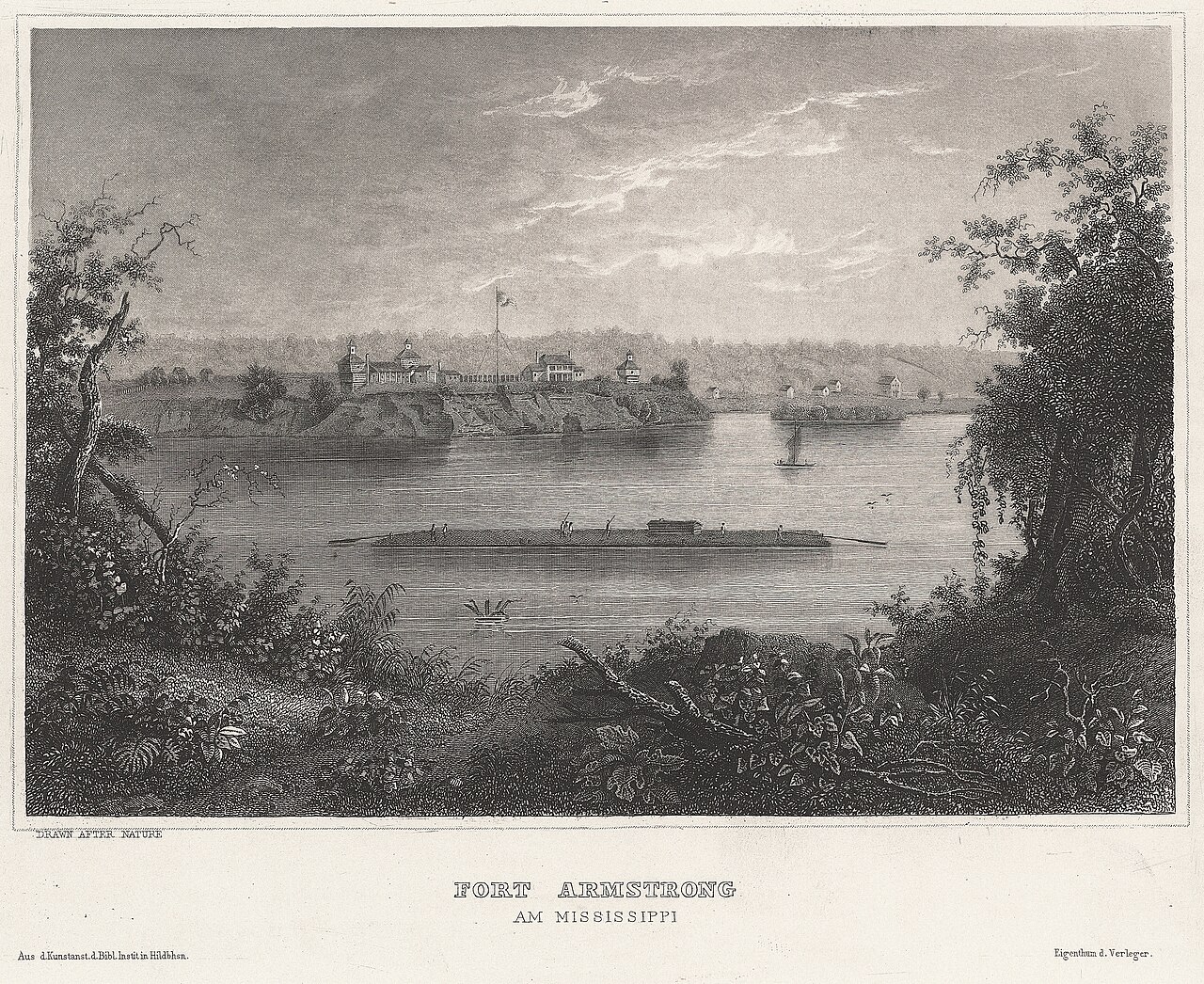
Fort Armstrong was a significant military bastioned fortress constructed in the early 19th century on Rock Island in the Mississippi River, near the present-day Quad Cities area spanning Illinois and Iowa. Built between 1816 and 1817, it formed a crucial part of the United States' western frontier defenses established in the aftermath of the War of 1812. Its strategic location at the foot of Rock Island placed it just five miles from the main village of the Sauk and Meskwaki (Fox) tribes along the Rock River in Illinois, underscoring its role in controlling and monitoring Native American activity in the region. Architectural design and construction The fort was constructed primarily of stone and timber, encompassing a square layout approximately 300 feet on each side. It featured three large blockhouses positioned prominently at its corners, designed to provide overlapping fields of fire and enhanced defensive capabilities. These blockhouses were robust, multi-story wooden structures with firing ports, typical of frontier military architecture of the period. The bastioned design allowed defenders to cover the walls with enfilading fire, a common feature in early 19th-century American fortifications aiming to deter attacks. Construction began in May 1816 and was completed by the following year, reflecting the urgency and importance placed on securing the western frontier. The fort's layout included defensive walls, barracks for troops, storage facilities, and other military buildings necessary to support a garrisoned force. Military role and historical significance Fort Armstrong served as a key military headquarters during the Black Hawk War of 1832, a conflict between the United States and Native American tribes led by the Sauk leader Black Hawk. The fort's garrison typically consisted of two companies of United States Army regulars, tasked with maintaining peace and protecting settlers in the region. Its presence was instrumental in the U.S. government's efforts to pacify Native American resistance and assert control over Illinois and surrounding territories. After the Black Hawk War, as the perceived threat from Native American tribes diminished due to forced relocations and treaties, the fort's strategic importance waned. By 1836, the U.S. Army abandoned Fort Armstrong, reflecting the shifting frontier and the reduced need for such a military installation in the area. Legacy and current status While Fort Armstrong no longer stands as it did in the 19th century, its historical footprint remains significant for understanding early American frontier defense strategies and Native American relations. The fort's site on Rock Island is part of the broader historical landscape of the Quad Cities region, which today includes parks, museums, and heritage sites commemorating this period. Replicas of the fort's blockhouses have been constructed to give visitors a sense of the original fortifications and military life during its operational years. These reconstructions serve educational purposes and help preserve the memory of Fort Armstrong's role in American history. Geographical and cultural context Situated on Rock Island, the fort was strategically placed to control navigation along the Mississippi River and to monitor the nearby Native American villages. The location allowed the U.S. Army to project power into the western frontier and to secure vital transportation and communication routes. The fort's proximity to the Sauk and Meskwaki villages highlights the tension and conflict inherent in the U.S. expansionist policies of the era. Fort Armstrong was both a military stronghold and a symbol of the changing dynamics between Native American tribes and the growing United States.

Modern (19th–20th c.)
Details
158.1 km

Stone Tower at Eagle Point Park

Clinton, United States of America

The Stone Tower at Eagle Point Park in Clinton, Iowa stands as a charming example of a small-scale structure inspired by medieval castle architecture. This tower, accessible to the public, is not a defensive fortress but rather a scenic lookout that captures the imagination with its historic style and commanding presence. Architectural features and design The tower resembles a miniature medieval castle keep with its robust stone construction and crenellated parapets that evoke the defensive battlements typical of high medieval fortifications. Its compact size and design suggest it was built primarily for aesthetic and recreational purposes rather than military defense. Constructed using locally sourced stone, the tower's masonry work highlights the craftsmanship typical of early 20th-century revivalist architecture that sought to emulate romanesque and gothic elements. The thick stone walls and narrow slit windows enhance the tower's fortress-like appearance, while the open rooftop platform provides visitors with sweeping, unobstructed views. Historical context and significance While the exact construction date of the Stone Tower is not widely documented, it is generally understood to be a product of the early 20th century, reflecting the era's fascination with medieval revival architecture in public parks and recreational spaces. This style was popular in the United States as part of the broader romantic neo-gothic movement, which celebrated medieval aesthetics through ornamental and picturesque structures. Eagle Point Park itself is a historic park in Clinton, known for its scenic overlooks and natural beauty along the Mississippi River. The Stone Tower serves as a focal point within the park, enhancing the visitor experience by offering a unique vantage point to appreciate the surrounding landscape. Visitor experience and accessibility The Stone Tower is open to the public and easily accessible within Eagle Point Park, located at 3923 N 3rd St, Clinton, IA 52732. Visitors can climb the tower to enjoy panoramic views of the Mississippi River valley and the cityscape of Clinton. The tower's location on elevated terrain provides an excellent perspective for photography, sightseeing, and appreciating the natural and urban environment. The park and tower are popular destinations for locals and tourists alike, offering walking trails, picnic areas, and other recreational facilities. The tower's medieval-inspired design adds a cultural and architectural point of interest that complements the park's natural attractions. Cultural and heritage value Though not a historic fortress, the Stone Tower at Eagle Point Park holds cultural significance as a symbol of early 20th-century architectural trends in public park design. It reflects the American penchant for romanticizing European medieval architecture and integrating it into community spaces for leisure and education. Its preservation and continued use as a public lookout point contribute to the heritage value of Eagle Point Park, making it a cherished landmark within Clinton. The tower stands as a testament to the blending of natural beauty and architectural creativity in urban park settings.

Post-Renaissance (17th–18th c.)
Details