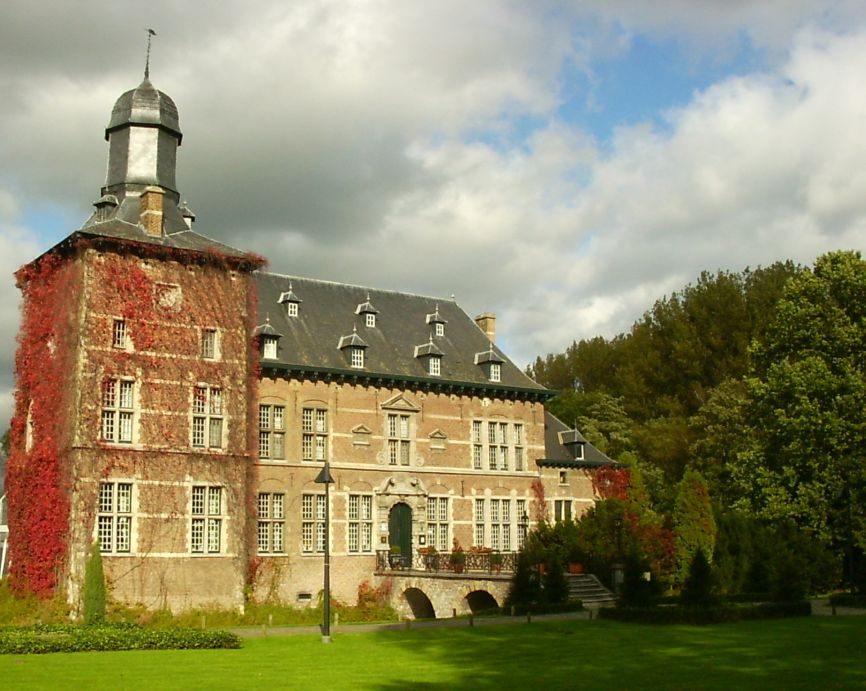
Hoepertingen Castle
Hoepertingen Castle in Belgium is a historic estate with origins dating back to the late 15th century. The earliest known reference to its predecessor appears in records from 1476, indicating the site's long-standing significance in the region. The castle as it stands today was constructed in the 17th century by Jan-Willem van Scharenberg, reflecting the architectural trends of the Renaissance period.
Architectural design and style
The castle is characterized by its distinctive U-shaped layout, a common design in Renaissance architecture that allowed for a central courtyard and enhanced defensive capabilities. One of the castle's most notable features is the corner tower, which originally served as a keep. This tower would have been the stronghold of the castle, providing a last line of defense and a vantage point over the surrounding lands.
In 1763, Hoepertingen Castle underwent significant restoration, adopting elements of the Classicist style. This restoration introduced refined architectural details that softened the fortress-like appearance of the original Renaissance structure, aligning the castle more closely with the aesthetic preferences of the 18th century. The blend of Renaissance and Classicist elements gives the castle a unique character that reflects its historical evolution.
Historical context and ownership
The van Scharenberg family played a central role in the castle's history, with Jan-Willem van Scharenberg commissioning the 17th-century construction. The family's influence in the region was marked by their stewardship of the estate and their involvement in local governance. The castle's strategic location in Hoepertingen, Belgium, placed it within an area of historical significance, where many noble families established residences that combined both defensive features and residential comfort.
Structural features and layout
The U-shaped design of Hoepertingen Castle encloses a courtyard that would have served multiple purposes, including social gatherings, administrative functions, and possibly agricultural activities related to the estate. The corner tower remains a prominent feature, evidencing the castle's medieval origins despite later modifications.
The castle's walls and overall form suggest a transition from purely defensive architecture to a more residential and representative function, typical of castles evolving through the Renaissance into the early modern period. The Classicist restoration likely introduced symmetrical elements and decorative motifs, enhancing the castle's visual appeal while maintaining its structural integrity.
Preservation and current status
Today, Hoepertingen Castle stands as a well-preserved example of a Renaissance castle with Classicist influences. Its partially restored condition allows visitors and historians to appreciate the layers of architectural history embedded within its walls. The castle's enduring presence contributes to the cultural heritage of the Limburg region in Belgium, offering insight into the architectural and social developments from the late medieval period through the 18th century.
Visiting and cultural significance
While specific visiting hours and public access details are limited, Hoepertingen Castle remains an important landmark for those interested in Belgian history and Renaissance architecture. Its combination of a medieval keep, Renaissance design, and Classicist restoration makes it a valuable study subject for architectural historians and enthusiasts alike.
Frequently asked questions (FAQ)
- When was Hoepertingen Castle originally built?
- The current Hoepertingen Castle was constructed in the 17th century by Jan-Willem van Scharenberg, although its predecessor was mentioned as early as 1476.
- What architectural styles are present in Hoepertingen Castle?
- Hoepertingen Castle features a combination of Renaissance architecture from its original 17th-century construction and Classicist elements introduced during a restoration in 1763.
- What is the layout of Hoepertingen Castle?
- The castle has a distinctive U-shaped layout with a corner tower that was originally a keep, typical of Renaissance design with defensive features.
- Is Hoepertingen Castle open to the public?
- Specific information about public access and visiting hours for Hoepertingen Castle is limited, so it is recommended to check local sources before planning a visit.
- What is the condition of Hoepertingen Castle today?
- Hoepertingen Castle is partially restored, preserving both its Renaissance origins and Classicist restoration features, allowing appreciation of its historical architectural evolution.
Information
Loading map...
Visitor reviews
No reviews yet. Been here? Write the first review and help other travelers!
Write the first reviewVisited this castle? Share your experience
Your review helps other travelers and adds first-hand knowledge to our encyclopedia.