Herburt Castle
Herburt Castle stands as a remarkable example of a Renaissance hill castle with a rich history deeply intertwined with the political and military developments of Eastern Europe. Located near the village of Dobromyl in Ukraine, this fortress was originally established by the Polish nobility and has witnessed centuries of conflict, cultural evolution, and architectural transformation.
The castle's origins date back to the mid-15th century when Mykola Herburt, a huntsman from Lviv, founded a wooden stronghold on the steep hill known as Slipa Hora (Blind Mountain). This initial fortification was strategically placed to oversee the surrounding landscape, taking advantage of the natural elevation for defense. However, the wooden structure was destroyed by fire during a Tatar raid in 1497, exposing the area to further threats.
In 1566, following the grant of self-governance rights under the Magdeburg Law by King Sigismund II Augustus, Stanisław Herburt initiated the construction of a more durable stone fortress on the same site. This marked a significant shift from wooden fortifications to a robust stone complex designed to withstand the increasing military pressures of the period. Over the following decades, the castle underwent extensive development, culminating in a major reconstruction completed by Jan Szczęsny Herburt in 1614. This phase introduced prominent Renaissance architectural elements and enhanced the fortress's defensive capabilities.
Architectural features and layout
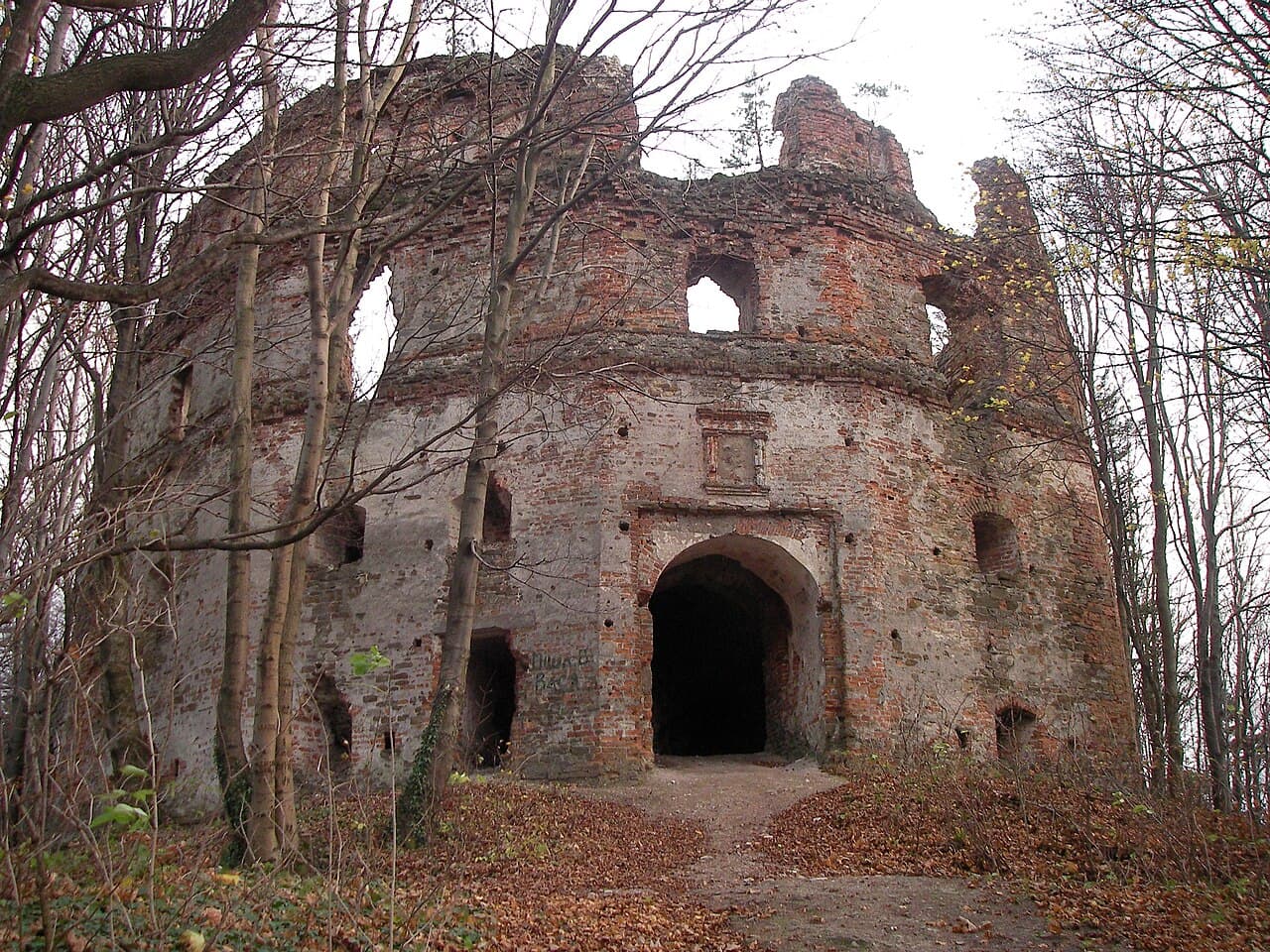
Herburt Castle is perched on a steep, forested hill rising approximately 554 to 560 meters above sea level. The castle's layout follows the natural contours of the ridge, forming an elongated oval or horseshoe shape roughly 80 to 85 meters long and 25 meters wide. The defensive walls are constructed from thick stone and brick, with some sections exceeding two meters in thickness, underscoring the fortress's primary military function.
The complex is divided into two main sections: an upper and a lower part. The lower section, built under Jan Szczęsny Herburt's direction, features characteristic Renaissance elements such as attics and once boasted frescoes depicting allegories of civic virtues. These artistic touches highlight the dual purpose of the castle as both a military bastion and a symbol of noble prestige and cultural aspiration.
Among the surviving structures, a prominent four-tiered gate bastion integrates remnants of former residential quarters. The main entrance is marked by an octagonal gate tower that controlled access through a stone-vaulted corridor, a defensive feature designed to slow and expose attackers. Additional remains include fragments of defensive walls and foundations of three other towers, indicating a well-planned network of fortifications.
Within the courtyard, a preserved well shaft approximately three meters deep provided essential water supply during sieges. Above the gate, traces of a decorative Renaissance portal and a coat of arms once asserted the noble heritage and authority of the Herburt family.
Historical significance and events
Throughout the early 17th century, Herburt Castle was a hub of political activity and intrigue. It housed a printing press and functioned as a local center of learning, reflecting its role beyond mere military defense. In 1622, ownership passed to the influential Koniecpolski family, further cementing the castle's status within the noble power structures of the region.
The castle endured multiple sieges and attacks, notably a raid in 1657 led by Prince George Rákóczi, who allied with Swedish forces during the Thirty Years’ War. Despite these assaults, the fortress was never captured by force, a testament to its formidable defenses and strategic position.
Following the partitions of Poland in the late 18th century, the castle came under Austrian control. The Austrian administration ordered the dismantling of many old fortresses to prevent their military reuse. In 1784, part of the southern defensive walls of Herburt Castle was dismantled to supply materials for constructing a nearby Basilian monastery. Nevertheless, the fortress was never fully demolished.
By the late 19th century, conservation efforts by Austrian authorities focused on halting further destruction. These efforts preserved much of the northern sections of the castle ruins, stabilizing the site and safeguarding its historical legacy.
Preservation and current condition
Today, Herburt Castle remains a partially preserved ruin, with significant portions of its walls, towers, and gatehouse still standing. The site offers visitors a glimpse into the military architecture of the Renaissance period combined with the cultural ambitions of the Polish nobility. Its location on a steep hill provides commanding views over the surrounding landscape, including nearby towns such as Przemyśl and Sambir.
The castle's defensive features—thick bastions, robust walls, and a secure gatehouse with stone vaulting—highlight its design as a resilient military stronghold. The remnants of residential quarters and artistic elements like frescoes and decorative portals emphasize its role as a noble residence and center of local authority.
Visitors to Herburt Castle can explore the remains of the gate bastion, the octagonal tower, and the courtyard well, each bearing witness to the fortress's long and turbulent history. Conservation efforts continue to protect the ruins from further decay, ensuring that this emblem of Eastern European heritage endures for future generations.
Architectural context and style
The castle exemplifies the transition from medieval wooden fortifications to stone Renaissance military architecture in Eastern Europe. The incorporation of Renaissance stylistic features such as attics and frescoes alongside formidable defensive elements reflects the dual priorities of defense and representation prevalent among the Polish nobility during the 16th and 17th centuries.
The octagonal gate tower and stone-vaulted entrance corridor are notable architectural features designed to enhance defense by controlling and restricting access. The thick walls and bastions demonstrate an understanding of siege warfare tactics of the era, while the artistic embellishments reveal the cultural sophistication of its owners.
Visiting Herburt Castle
While the castle is in ruins, it remains an important cultural and historical site in Ukraine. Its scenic hilltop location offers panoramic views and a tangible connection to the region's turbulent past. Visitors interested in Eastern European history, Renaissance architecture, and military fortifications will find Herburt Castle a compelling destination.
The site is accessible from the village of Dobromyl, and exploring the ruins provides insight into the architectural ingenuity and historical resilience of this fortress. Preservation efforts ensure that the castle's legacy continues to be appreciated by historians, tourists, and locals alike.
Frequently asked questions (FAQ)
- What is the historical significance of Herburt Castle?
- Herburt Castle, located in Dobromyl, Ukraine, dates back to the 14th century and is an important example of medieval architecture in the region. It served as a defensive stronghold and residence for nobility, reflecting the rich history of the area and its strategic importance during various conflicts.
- When was Herburt Castle built?
- Herburt Castle was constructed in the 14th century, with its foundational elements believed to have been established around 1360. Over the centuries, it has undergone several renovations, preserving its historical character while adapting to the needs of its occupants.
- Is it possible to visit Herburt Castle?
- Yes, Herburt Castle is open to visitors, allowing them to explore its historic grounds and learn about its fascinating history. Guided tours are often available, providing deeper insights into the castle's architectural features and its significance in Ukrainian heritage.
- What are the opening hours for Herburt Castle?
- Herburt Castle typically operates from 10 AM to 6 PM during the tourist season, which runs from May to October. It is advisable to check the specific opening days and hours prior to your visit, as they may vary based on local events or holidays.
- Can I take photographs inside Herburt Castle?
- Yes, visitors are generally allowed to take photographs throughout the castle grounds. However, it’s recommended to respect any guidelines provided by the staff regarding photography in specific areas, particularly in rooms with historical artifacts.
- What are the ticket prices for visiting Herburt Castle?
- Ticket prices for Herburt Castle are quite reasonable, typically ranging from 50 to 100 UAH for adults, with discounted rates available for students and children. Group discounts may also be offered, making it an affordable option for families and educational visits.
- When is the best time to visit Herburt Castle?
- The best time to visit Herburt Castle is during the late spring and early autumn months, from May to September, when the weather is pleasant and the surrounding landscape is vibrant. This period also coincides with local festivals and events that enhance the visitor experience.
- Are there any nearby attractions to visit along with Herburt Castle?
- Yes, nearby attractions include the picturesque Dobromyl Park and several historical churches in the area. Exploring the charming town of Dobromyl offers additional cultural insights and opportunities to enjoy local cuisine.
- How do I get to Herburt Castle?
- Herburt Castle is accessible by car or public transportation from major cities in Ukraine, with regular bus services available to Dobromyl. Once in town, the castle is within walking distance from the main bus station, making it easy for visitors to reach.
Photo gallery

Photo by Adnyre•Public domain
Information
Loading map...
Visitor reviews
No reviews yet. Been here? Write the first review and help other travelers!
Write the first reviewVisited this castle? Share your experience
Your review helps other travelers and adds first-hand knowledge to our encyclopedia.