
Hauenstejn Castle
Hauenstejn Castle stands as a remarkable example of a Bohemian hill castle with a rich heritage dating back to the 13th century. Constructed during the high medieval period by either Přemysl Otakar II or his son Václav II, it was strategically positioned to guard vital royal routes and oversee the valuable mining operations in the Ore Mountains region. This fortress reflects the historical evolution of castle architecture and estate management through centuries of political and economic change.
Medieval origins and royal significance
The castle’s initial purpose was primarily defensive and administrative, serving as a stronghold to protect the kingdom’s interests in the resource-rich area near modern-day Stráž nad Ohří. The earliest documented owner, Mikuláš Winkler, was the burgrave of nearby Loket Castle, indicating Hauenstejn’s role within a network of royal fortifications. Shortly after its founding, ownership transferred to the monastery in Doksany, which later exchanged it with King John of Luxemburg in 1336, bringing the castle firmly under royal control.
During the reign of Charles IV, the castle’s domain was expanded, underscoring its strategic and economic importance. Throughout the 14th and 15th centuries, the castle frequently changed hands among various keepers but remained a royal possession. Its location and function made it a key asset in controlling the surrounding territory and protecting mining interests.
Renaissance transformation under the šlik family
In the 16th century, ownership passed to the wealthy Šlik family, renowned for their silver mining enterprises near Jáchymov. The castle suffered a significant fire around 1600, prompting a comprehensive renaissance-style reconstruction. The Šliks introduced architectural and functional enhancements, including the addition of a brewery and expanded agricultural facilities such as orchards and farm buildings. They also implemented an innovative wooden water conduit system to supply the estate, demonstrating early engineering ingenuity.
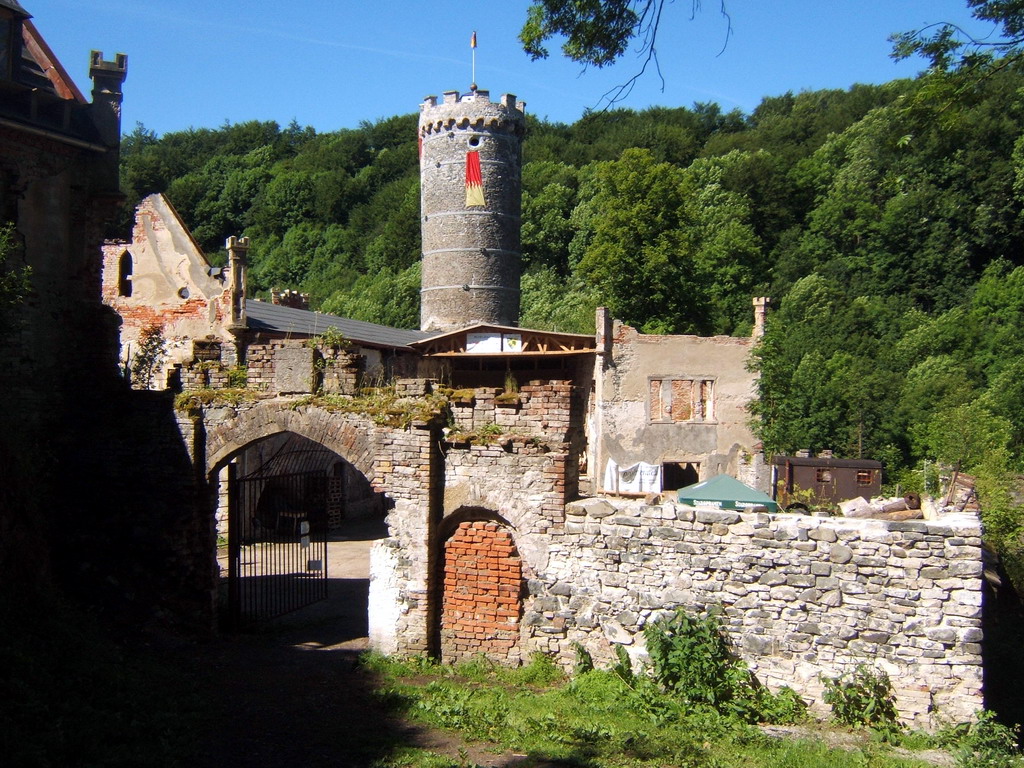
Photo by SehLax • CC BY-SA 3.0
Later ownership and romantic revival
Following the Šlik tenure, the castle became part of the Ostrov estate under the Saxe-Lauenburg ducal family in 1663. By 1689, it passed to the Baden family, who maintained it until the male line ended in 1771. Subsequently, the Habsburgs inherited the property, holding it until 1837 when it was sold to the Buquoy family.
The Buquoys initiated a significant 19th-century reconstruction in the Romantic and historicist styles, inspired by English and Bavarian castles. This period saw the castle transformed with aesthetic and architectural elements that emphasized picturesque qualities, including decorative battlements, towers, and revivalist motifs that romanticized the medieval past.
20th-century history and decline
During World War II, the castle was repurposed as a facility for the Hitler Youth and used for experimental research involving snakes, notably a serum developed to combat the adder, reportedly utilized by General Erwin Rommel in Africa. After the war, the castle was confiscated by the Czechoslovak state and served as accommodation for uranium miners and later youth organizations.
By 1958, the castle was condemned as unsuitable for habitation and closed. Years of neglect, environmental damage, and vandalism followed, leading to significant deterioration of the structure and grounds. The castle was transferred to the municipality of Krásný Les in 1992.
Restoration and cultural revival
In 1999-2000, Pavel Palacký, a descendant of the notable Czech historian František Palacký, purchased Hauenstejn Castle and initiated extensive restoration efforts. The ongoing rehabilitation seeks to preserve the castle’s architectural heritage and revitalize its cultural significance through public engagement.
The castle is accessible via two main paths: a shorter route passing through a reconstructed castle gate featuring historical design elements, and a longer path leading to the main courtyard with views of the castle tower and estate. Above the hill stands the Hornohradská Chapel, notable for its preserved original wooden bench and a wooden statue of St. Wenceslas, blessed at the Vatican in 2007.
Botanical garden and arboretum
Adjacent to the chapel is a botanical garden and arboretum established in 1971 by Ing. Jaroslav Hejtík. This curated collection includes a diverse range of deciduous and coniferous trees from Asia and North America, along with traditional and medicinal plants. The garden enriches the castle grounds by integrating natural beauty with historical ambiance.
Architectural features and estate layout
Hauenstejn Castle’s architectural evolution reflects its complex history. The original medieval fortress was adapted and expanded over centuries, incorporating renaissance elements after the early 17th-century fire and later romantic historicist features in the 19th century. The castle’s layout includes defensive walls, towers, a gatehouse, courtyards, and residential quarters.
The Renaissance reconstruction introduced practical estate buildings such as the brewery and farm structures, enhancing the castle’s self-sufficiency. The wooden water supply system was a notable technological innovation for its time, underscoring the estate’s sophistication.
Later Romantic renovations emphasized aesthetic appeal, with decorative battlements and revivalist architectural details that evoke a medieval atmosphere while incorporating modern comforts.
Cultural significance and visitor experience
Today, Hauenstejn Castle serves as a cultural venue hosting music festivals, night tours, summer camps, and international volunteer programs. These activities foster public appreciation of the castle’s heritage and contribute to its ongoing preservation.
The castle’s dramatic hilltop setting offers panoramic views of the Ore Mountains, enhancing its appeal as a historic and natural landmark. Visitors can explore the castle grounds, the chapel, and the botanical garden, experiencing a unique blend of history, architecture, and nature.
Frequently asked questions (FAQ)
- How do I get to Hauenstejn Castle?
- Hauenstejn Castle is located near Stráž nad Ohří in the Karlovy Vary Region of Czechia. Visitors can reach the castle by car or local transport to Stráž nad Ohří, followed by a walk up one of the two paths leading to the castle entrance.
- What architectural styles are visible at Hauenstejn Castle?
- The castle showcases a blend of architectural styles including its original medieval fortifications, Renaissance reconstructions after the 1600 fire, and 19th-century Romantic historicist renovations inspired by English and Bavarian castles.
- When was Hauenstejn Castle built?
- Hauenstejn Castle was originally constructed in the 13th century during the high medieval period, primarily to guard royal routes and mining areas in the Ore Mountains.
- Is Hauenstejn Castle open to visitors?
- The castle is privately owned and undergoing restoration. Public access may be limited, but cultural events such as music festivals and guided tours are held periodically. It is advisable to check ahead for visiting opportunities.
- What is the historical significance of Hauenstejn Castle?
- Hauenstejn Castle played a key role in protecting royal interests and mining operations in Bohemia from the 13th century onward. It was owned by notable families including the Šliks, Saxe-Lauenburg dukes, the Baden family, Habsburgs, and Buquoys, reflecting its importance in regional history.
Photo gallery

Information
Sources & official resources
Verify the information above using these authoritative references.
Loading map...
Visitor reviews
No reviews yet. Been here? Write the first review and help other travelers!
Write the first reviewVisited this castle? Share your experience
Your review helps other travelers and adds first-hand knowledge to our encyclopedia.