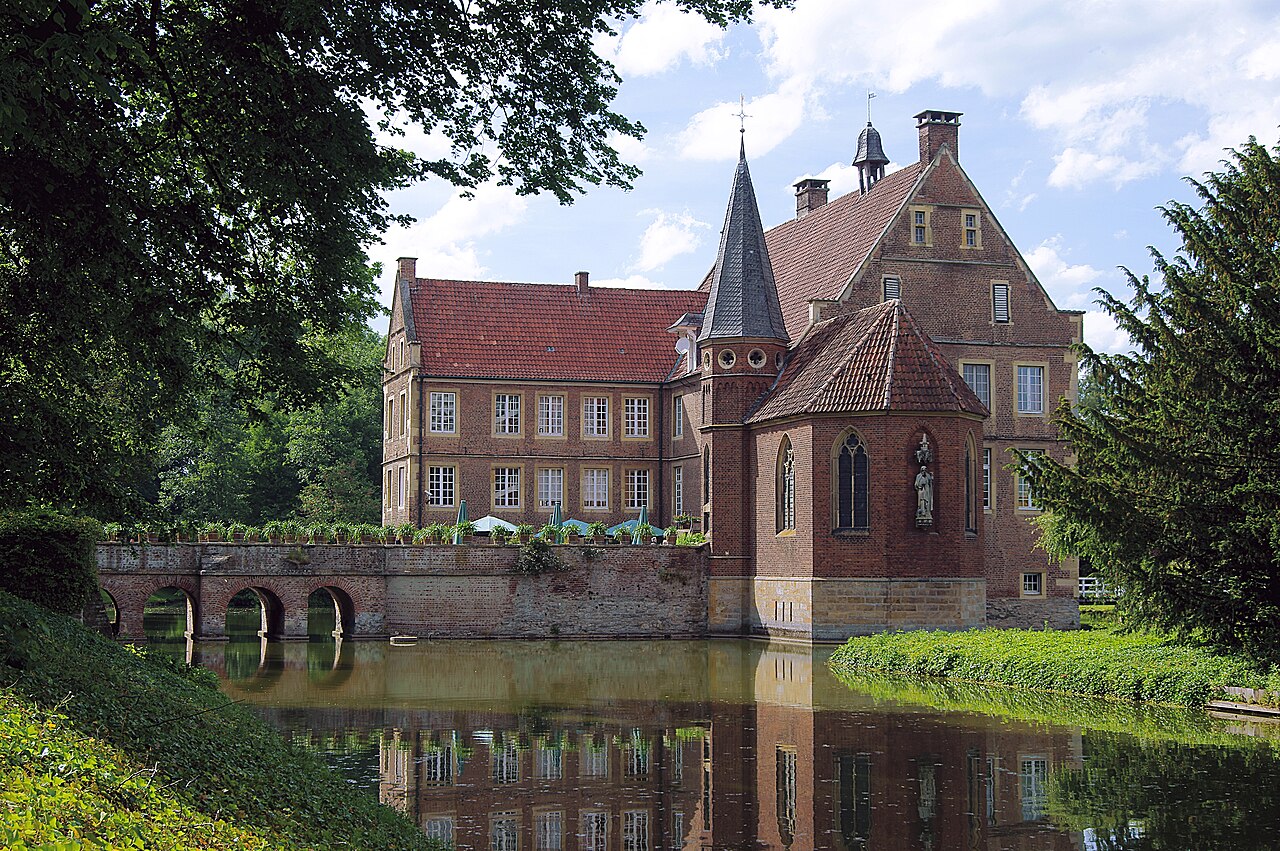
Haskenau
Haskenau is a historically significant motte castle located in Münster, Germany. This site offers a remarkable glimpse into the early medieval period and the evolution of fortifications in the region. Originally established on a raised earthwork, or motte, the castle's origins trace back to the Frankish era, with archaeological evidence such as pottery fragments dating from the Carolingian dynasty suggesting continuous occupation since that time.
The motte itself is a prominent feature, measuring approximately 30 meters in diameter and rising 5 to 6 meters above the surrounding landscape, which places it nearly 11 meters above the local water level. This elevation provided a strategic defensive advantage, typical of motte-and-bailey castles constructed during the high medieval period. The central mound was originally crowned by a wooden or stone castle, serving both military and residential purposes.
Early history and medieval significance
During the 12th century, the site saw the establishment of a significant castle on the motte, referenced in medieval documents under the name "Sconowe," which later evolved into Schönau or Hohenschönau. The castle functioned as a fortified residence, or "mansio," reflecting its dual role in defense and domestic life. By the early 13th century, Haskenau was inhabited by regional nobility, including Knight Hermann I of Münster around 1226, underscoring its importance in local feudal society.
Ownership of the castle changed in the 14th century when descendants of the original occupants pledged and eventually sold the property to the cathedral chapter of Münster in 1324. The bishops of Münster assumed responsibility for the estate's protection and revenue collection during the 15th century. Later, in the mid-15th century, the estate passed to Christina von Cleyhorst and subsequently to her son, Johann IV Droste zu Hülshoff. The castle remained in the Droste zu Hülshoff family for several generations, including Everwine II von Droste zu Handorf, a notable mayor of Münster.
Architecture and fortifications
The castle's defensive structures were typical of motte castles, with a central mound surrounded by a moat that served as a water barrier. An inner embankment approximately five meters wide reinforced the motte's defenses, creating a protected plateau for the castle buildings. Beyond this, an outer defensive wall enclosed a larger fortified area roughly 60 meters from the motte's center.
The outer bailey, or Vorwerk, formed part of the extended fortifications, with the southern segment dating back to the 13th century. Archaeological excavations have uncovered traces of a palisade fence, indicating that wooden defensive works complemented the stone and earth fortifications. The total fortified area covered about 2.5 hectares, a substantial size for a medieval estate focused on both defense and agricultural management.
Agricultural role and later use
Between the motte and the outer walls lay agricultural buildings and farmsteads, consistent with the castle's role in managing local farming activities. Historical records from the early 17th century describe the site primarily as a pig-fattening farm within the bishopric's lands, highlighting a transition from military fortress to agricultural estate.
Archaeological findings and preservation
Excavations at Haskenau have revealed pottery fragments spanning from the Carolingian period through to the 16th century, providing material evidence of the site's long-term occupation and use. Despite the absence of surviving architectural structures or decorative elements, the earthworks, moat, embankments, and defensive ditches remain clearly visible in the landscape, preserving the castle's outline.
A notable historical misconception from the 1930s suggested that the motte was a Roman burial mound linked to the Battle of the Teutoburg Forest. However, this theory was disproven by archaeological excavations in 1936. Since 1987, the site has been legally protected as a cultural monument, ensuring its preservation for future study and public education.
The legacy of haskenau
Today, Haskenau stands as an important archaeological and cultural site that offers insight into medieval fortification techniques and the socio-economic transformation of castles from military strongholds to agricultural estates. The surviving earthworks serve as a tangible reminder of the castle's historical significance in the Münster region and its role in the broader narrative of medieval German history.
Frequently asked questions (FAQ)
- How do I get to Haskenau Castle?
- Haskenau Castle is located in Münster, Germany, and is easily accessible by public transportation. You can take a bus or tram to the nearest stop, followed by a short walk to the castle grounds.
- What is the historical significance of Haskenau Castle?
- Haskenau Castle dates back to the 13th century and has played a vital role in the regional history of Münster. The castle has served various purposes over the centuries, including as a defensive structure and a noble residence, reflecting the rich heritage of the area.
- When was Haskenau Castle built?
- Construction of Haskenau Castle began in the early 1200s, with significant renovations occurring over the following centuries. Its architectural style has evolved, showcasing elements from different periods, making it a fascinating site for history enthusiasts.
- Can I take guided tours of Haskenau Castle?
- Yes, guided tours are available at Haskenau Castle, providing visitors with in-depth insights into its history and architecture. These tours are typically offered in multiple languages and can be booked in advance or on-site.
- Why is Haskenau Castle popular among tourists?
- Haskenau Castle is popular due to its stunning architecture, rich history, and beautiful surrounding gardens. Visitors are attracted to its picturesque setting and the opportunity to learn about the local heritage.
- Is it possible to visit Haskenau Castle year-round?
- Yes, Haskenau Castle is open to visitors throughout the year, although opening hours may vary seasonally. It is advisable to check the official website for the most current information before planning your visit.
- What are the ticket prices for Haskenau Castle?
- Ticket prices for Haskenau Castle are generally affordable, making it accessible for all visitors. Discounts are often available for students, seniors, and groups, so be sure to inquire when purchasing your tickets.
- What are the opening hours of Haskenau Castle?
- Haskenau Castle typically opens at 10 AM and closes at 6 PM, but hours may vary on holidays. Always check the official website for the most accurate and updated information before your visit.
- What are some nearby attractions to Haskenau Castle?
- In addition to Haskenau Castle, visitors can explore other historical sites and beautiful parks in Münster. Nearby attractions include the Prinzipalmarkt, the Botanical Garden, and the Münster Cathedral, all within a short distance.
Information
Website
Visit websiteSources & official resources
Verify the information above using these authoritative references.
Loading map...
Visitor reviews
No reviews yet. Been here? Write the first review and help other travelers!
Write the first reviewVisited this castle? Share your experience
Your review helps other travelers and adds first-hand knowledge to our encyclopedia.