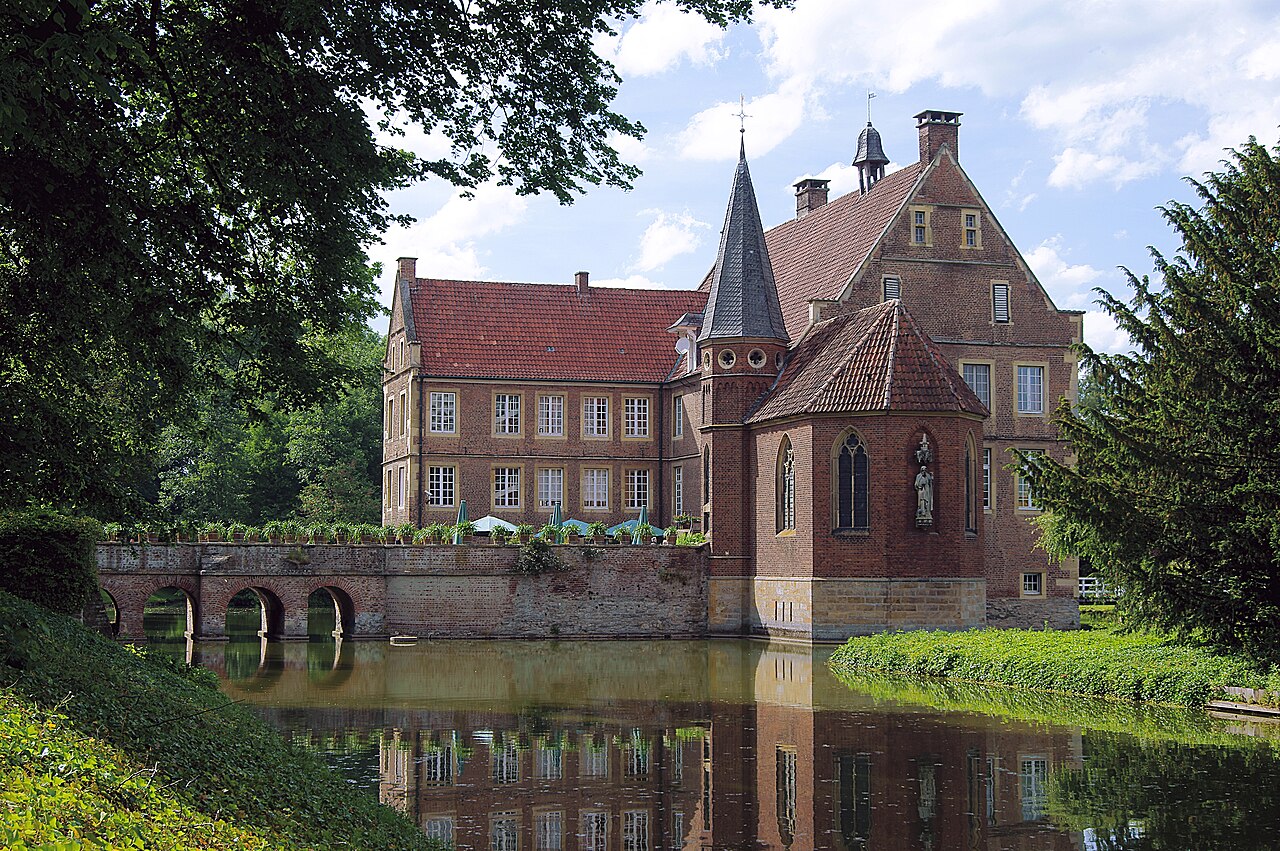
Burg Schöneflieth
Burg Schöneflieth stands as a noteworthy example of a medieval hill castle located near Greven in modern-day Germany. Established in the early 13th century, this castle's history is deeply intertwined with the regional power struggles between secular lords and ecclesiastical authorities. Its strategic position along the southern bank of the Ems River allowed it to control a vital northbound trade route originating in Münster, making it a significant site for toll collection and regional defense.
Early history and foundation
The origins of Burg Schöneflieth trace back to 1232, when Franco von Schonebeck, also known as Schöneflieth, established the initial fortification. The earliest written record dates from 1257, referring to the site as "Castellum dictum sconenvlete". Initially, the castle functioned as a robber baron's stronghold, a type of fortified residence used by feudal lords who exerted control over trade routes by imposing tolls and levies on merchants. This practice often led to conflicts with regional authorities, as it disrupted commerce and security.
Dietrich von Schonebeck, Franco's son, inherited the castle and continued the family's control. The castle's location was deliberately chosen for its commanding view over the river and trade route, enabling effective monitoring and toll collection from ferry crossings and merchants traveling through the area.
Conflicts and ecclesiastical control
The castle's role as a robber baron base brought it into direct conflict with the powerful Bishop Eberhard von Diest of Münster. In 1276, the bishop ordered the destruction of the castle's defensive structures to curtail the disruptive activities. Following this military action, ownership of the site was transferred to the cathedral chapter of Münster, marking a shift from a feudal stronghold to an ecclesiastical property.
From 1365 onward, the cathedral chapter undertook significant redevelopment, replacing the original motte with a more extensive two-island complex. This transformation reflected the changing needs of the castle, adapting it for use as a residence for cathedral canons and church officials who managed religious and administrative affairs.
Architectural evolution and layout
The castle's layout evolved considerably from its early 13th-century origins. The initial motte, a raised earthwork typical of early medieval fortifications, has left no visible traces today. However, archaeological evidence clearly shows the later two-island design developed in the mid-14th century.
The main island, roughly rectangular and measuring approximately 35 by 30 meters, was surrounded by a broad moat that enclosed the site on all sides except the southern approach. This moat, now dry, served as a critical defensive barrier. The castle's defensive perimeter was reinforced by partially preserved masonry walls, showcasing the robust construction techniques of the late medieval period.
Access to the castle was from the east via an earthen bridge about eight meters wide, which replaced earlier wooden drawbridges. This bridge connected the fortress to the surrounding landscape and was the sole entry point across the moat.
To the south of the main island lay the outer bailey or Vorburg, which included a castle pond and enclosed courtyard area. This space supported essential auxiliary functions such as stables, workshops, and storage facilities. Excavations in this area have uncovered foundations made of bricks and reused rubble stones, indicating phases of repair and reconstruction using recycled materials.
Further archaeological investigations in the northern part of the outer bailey revealed remains of a bridge support and a gate complex built in two phases. This gate controlled access to the outer bailey and formed part of the castle's extended defensive system. Additional foundations in the eastern outer bailey suggest the presence of other structures, though their specific purposes remain undetermined.
Historical significance and notable events
Burg Schöneflieth played a role in several important historical events. In 1534, during the Anabaptist uprising in Münster, cathedral canons sought refuge within its walls, demonstrating its continued use as a sanctuary. The castle's strategic importance was further underscored during the Thirty Years’ War, when Christian of Brunswick occupied it briefly in 1623.
One of the castle's most significant moments came in 1655 with the Treaty of Schöneflieth. This agreement between the city of Münster and Bishop Christoph Bernhard von Galen allowed the bishop to station troops within the city, marking a pivotal shift in the balance of power between secular and ecclesiastical authorities.
Decline and remains
By the late 18th century, the castle's importance declined. After the death of the last castle captain, the property was neglected and gradually dismantled. An attempted public auction in 1808 failed, but in 1812 four local merchants purchased the site for 36,000 francs with the intention of salvaging building materials. Stone removal continued until 1843, effectively ending Burg Schöneflieth's function as a fortress.
Today, visitors can observe the remains of masonry walls and earthworks that outline the castle's former layout. The dry moat and foundation remnants provide a tangible connection to the site's medieval past. These archaeological features reflect the castle's long history, from a robber baron's stronghold to a cathedral chapter residence and toll station.
Archaeological insights
Excavations have revealed important details about the castle's construction phases and defensive structures. The discovery of reused building materials in the outer bailey indicates practical adaptations over time. The two-phase gate complex and bridge supports highlight the castle's layered defensive system, designed to control access and protect the inner sanctum.
Visitor experience
While largely in ruins, the site offers a valuable glimpse into medieval castle architecture and the socio-political dynamics of the region. The visible stone walls and earthworks invite exploration and study, making Burg Schöneflieth a significant historical landmark in North Rhine-Westphalia.
Frequently asked questions (FAQ)
- What is the historical significance of Burg Schöneflieth?
- Burg Schöneflieth is a remarkable example of medieval architecture, showcasing the rich history of the region. Constructed in the 12th century, it served as a strategic fortification and residence for local nobility, playing a vital role in the area's defense and governance.
- When was Burg Schöneflieth built?
- Burg Schöneflieth was built in the 12th century, around the year 1150. It reflects the architectural styles and defensive needs of its time, making it an important historical landmark in Greven.
- Can I visit Burg Schöneflieth?
- Yes, Burg Schöneflieth is open to visitors, allowing you to explore its fascinating history and architecture. Guided tours are available, providing insights into the castle's past and its significance in the region.
- What are the opening hours for Burg Schöneflieth?
- Burg Schöneflieth is typically open to visitors from 10 AM to 5 PM, Tuesday through Sunday. It is advisable to check the official website or contact the castle for any seasonal changes in hours or special events.
- Is it possible to access Burg Schöneflieth with a wheelchair?
- While Burg Schöneflieth strives to be accessible, some areas may pose challenges for wheelchair users due to the castle's historical structure. It is recommended to contact the castle in advance to inquire about specific accessibility options available for visitors.
- What are the ticket prices for visiting Burg Schöneflieth?
- Ticket prices for Burg Schöneflieth are generally affordable, with adults paying around €8 and discounts available for students and seniors. Children under a certain age may enter for free, making it a great family outing.
- When is the best time to visit Burg Schöneflieth?
- The best time to visit Burg Schöneflieth is during the late spring and early autumn months when the weather is pleasant and the surrounding landscapes are beautiful. Additionally, special events and exhibitions often take place during these seasons, enhancing the visitor experience.
- What nearby attractions can I explore while visiting Burg Schöneflieth?
- While visiting Burg Schöneflieth, you can also explore the charming town of Greven, known for its historic buildings and lovely parks. Additionally, the picturesque Ems River is nearby, offering opportunities for scenic walks and outdoor activities.
Information
Website
Visit websiteSources & official resources
Verify the information above using these authoritative references.
Loading map...
Visitor reviews
No reviews yet. Been here? Write the first review and help other travelers!
Write the first reviewVisited this castle? Share your experience
Your review helps other travelers and adds first-hand knowledge to our encyclopedia.