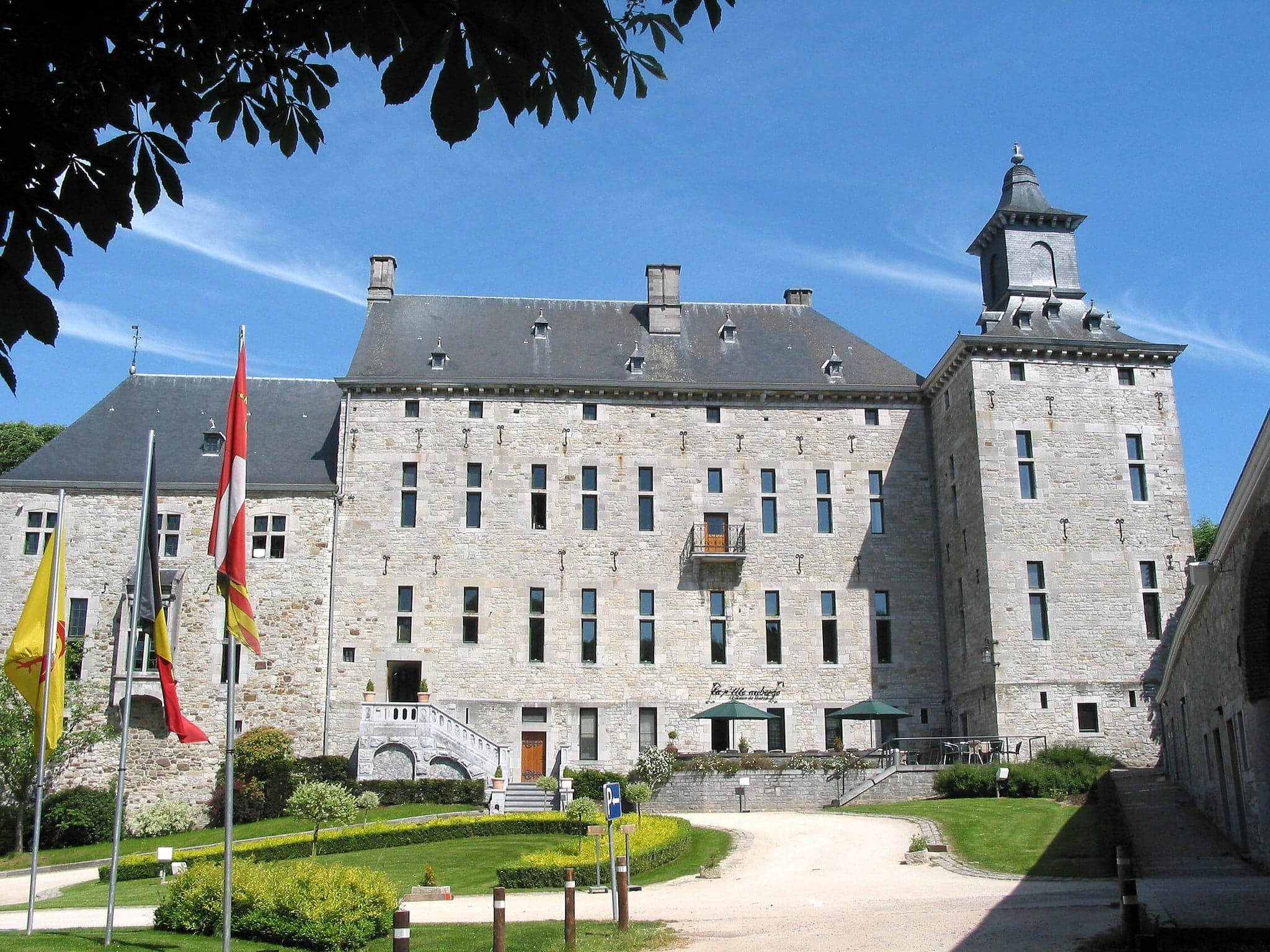
Harze Castle
Harzé Castle, located in Aywaille, Belgium, is a remarkable example of a 14th-century hill castle with a rich history spanning from the medieval period to the modern era. Built initially by the de Clermont family in the early 14th century, the castle occupies a strategically important site in the region of Liège. Over the centuries, it has witnessed numerous changes in ownership, architectural transformations, and significant historical events, including a pivotal role during World War II.
The castle's origins likely trace back to an earlier fortification from the 9th or 10th century, but the first documented construction dates from the early 1300s. The de Clermont family established the initial fortress, emphasizing the site's strategic importance in controlling local territories and trade routes. In the late medieval period, the castle underwent expansions and fortifications to adapt to evolving military needs.
Medieval origins and ownership transitions
Throughout the 14th and 15th centuries, Harzé Castle changed hands among noble families, reflecting the complex feudal dynamics of the region. In 1547, the castle passed to Jean de Ligne through his marriage to Margarete von der Marck, illustrating the common practice of consolidating power and property through marital alliances.
Subsequent owners included the von Eynatten and de Rahier families, who maintained the estate during the late medieval and early modern periods. The castle's current architectural form largely dates from the early 17th century, when Count Ernest de Suys undertook significant construction between 1632 and 1645 following his marriage to Ernestine de Lynden. The coats of arms of these families, dated 1647, remain prominently displayed above the main entrance, symbolizing their lasting legacy.
Architectural evolution and mosan style features
Harzé Castle is a fine example of the Mosan architectural style, characterized by a courtyard enclosed by round towers, a typical feature of fortified residences in the Meuse valley region. Two large towers from the original medieval fortress survive intact, testifying to the castle's defensive origins.
The north entrance is marked by two turrets added in the early 20th century by Edgar de Potter d’Indoye, bearing his coat of arms and reflecting the castle's continuous adaptation and embellishment. Between 1909 and 1924, Edgar de Potter d’Indoye led extensive restoration works that included the addition of semicircular arcades supported by Tuscan columns and windows with triple mullions, both characteristic of the Mosan style.
Interior enhancements from this period include the "Salle des Comtes" (Hall of the Counts), an oriel window projecting from the wall, and three additional windows on the original building, blending medieval and early modern architectural elements harmoniously.

Photo by 12019
Role during world war ii and military significance
During World War II, Harzé Castle played a strategic military role as the headquarters of the U.S. XVIII Airborne Corps under the command of Major General Matthew B. Ridgway during the Battle of the Bulge in late 1944. The castle hosted several prominent military leaders, including Field Marshal Bernard Montgomery on December 24, 1944, and General Dwight Eisenhower on December 28, 1944.
A commemorative plaque at the castle entrance honors these visits and highlights the castle's importance in Allied operations during one of the war's critical campaigns in the Ardennes region.
Modern use, preservation, and cultural significance
After the war, the castle remained in private hands until 1973, when the province of Liège acquired it. It was repurposed as a seminar center, event venue, and lodging facility, serving the public until 2020. In 2023, ownership transferred to Immobilière du Sart SRL, which is currently renovating the property with plans to reopen in 2025.
Harzé Castle is protected as a classified monument since 1965 by the Royal Commission for Monuments and Sites, ensuring the preservation of its architectural and historical integrity.
Museum of milling and baking
The castle grounds include a unique Museum of Milling and Baking, housed in the former farm buildings. This museum offers six exhibition rooms showcasing the development of milling and baking technologies from medieval water-powered mills to early 20th-century bakery workshops.
Visitors can observe operational machinery such as waterwheel-driven millstones, hydraulic levers, and gears, alongside tools related to baking, ice, and chocolate production dating from the Napoleonic era through the postwar period. This museum complements the castle's historical narrative by highlighting the region's traditional crafts and industries.
Architectural details and preservation status
The castle's combination of medieval fortifications and early modern renovations provides a comprehensive view of its architectural evolution. The well-preserved round towers, courtyard, and restored facades demonstrate the enduring Mosan style influence, while the early 20th-century additions reflect a sensitive approach to historic preservation.
Today, Harzé Castle functions as a hotel, restaurant, conference center, and wedding venue, blending historical ambiance with modern amenities. Its preservation status as a well-preserved site allows visitors to experience the layered history of this remarkable fortress in the heart of the Belgian Ardennes.
Frequently asked questions (FAQ)
- How do I visit Harzé Castle and what are its opening hours?
- Harzé Castle is open to visitors as a hotel and museum venue. The Museum of Milling and Baking typically operates during regular daytime hours, but it is advisable to check the castle's official website or contact the management for current opening times and any special events.
- What is the historical significance of Harzé Castle during World War II?
- During World War II, Harzé Castle served as the headquarters of the U.S. XVIII Airborne Corps under Major General Matthew B. Ridgway during the Battle of the Bulge. It hosted key military leaders like Field Marshal Bernard Montgomery and General Dwight Eisenhower, marking its importance in Allied operations.
- Can I explore the architectural styles and features of Harzé Castle?
- Yes, visitors can explore the castle's blend of medieval Mosan architectural elements, including round towers and a courtyard, alongside early 20th-century restorations featuring Tuscan columns and triple-mullioned windows. The interior also includes unique features like the "Salle des Comtes" and an oriel window.
- Is Harzé Castle accessible for events such as weddings and conferences?
- Harzé Castle currently operates as a hotel, restaurant, conference center, and wedding venue. It offers historic ambiance combined with modern facilities, making it a popular choice for special events in the region.
- Why is the Museum of Milling and Baking significant?
- The Museum of Milling and Baking at Harzé Castle showcases the technological evolution of milling and baking from medieval water-powered mills to early 20th-century workshops. It features operational machinery and artifacts that illustrate regional craftsmanship and industrial heritage.
Photo gallery


Information
Sources & official resources
Verify the information above using these authoritative references.
Loading map...
Visitor reviews
No reviews yet. Been here? Write the first review and help other travelers!
Write the first reviewVisited this castle? Share your experience
Your review helps other travelers and adds first-hand knowledge to our encyclopedia.


