Gostynin
Gostynin castle stands as a significant medieval bastioned fortress located in the town of Gostynin, Poland. Its origins trace back to the early 13th century, with archaeological evidence confirming an early medieval fortified settlement north of the modern town on the left bank of the Skrwa river, known as Łysa Góra. This early stronghold, featuring a defensive gord and a suburbium, was expanded around 1240 by the Masovian Duke Konrad I. The castle's strategic position and fortifications reflected the turbulent political landscape of Mazovia during the High Medieval period.
Early fortified settlement and the 13th-century origins
Initial fortifications on the site consisted of a defensive gord with wooden and earthworks structures, typical of early medieval Polish fortifications. The gord was destroyed in 1283 during conflicts between Konrad I's grandsons, Bolesław II of Płock and Konrad II of Czersk, when it was seized and burned by Ruthenian forces allied with Konrad II. Although the fortification was quickly rebuilt, it gradually lost its military and administrative significance.
Gothic castle construction in the 14th century
In the latter half of the 14th century, the Masovian princes constructed a new Gothic castle on a steep riverside promontory to the west of the town. The exact founder remains uncertain, with historical sources suggesting either Siemowit III or his son Siemowit IV, both important figures in Mazovian history. Originally, the castle began as a fortified tower serving both defensive and residential purposes. Around the turn of the 14th and 15th centuries, this tower was dismantled to allow for expansion.
Castle layout and fortifications
The expanded castle formed a quadrangle approximately 37 by 38 meters, enclosed by a stone curtain wall reinforced with buttresses at the corners. The southeast corner housed a square masonry tower measuring about 7 meters on each side. The interior buildings were predominantly wooden. North of the castle, separated by a dry moat, lay a suburbium or outer bailey laid out on a square plan about 80 meters per side, protected by a wooden-earth rampart. This area functioned as the economic and logistical support zone for the castle.
15th and 16th-century enhancements
During the mid-15th century, a significant stone residential building was constructed along the northern curtain wall. At the same time, the eastern curtain wall was pierced to create a new gatehouse featuring a low tower, a complex foregate, and a drawbridge spanning a water-filled moat. The castle was accessible via a causeway built over the river's floodplain. In 1462, the town of Gostynin was incorporated into the Kingdom of Poland by King Casimir IV Jagiellon, and the castle became the seat of a royal starosta (governor).
Early in the 16th century, under the direction of starosta Krzysztof Szydłowiecki, the castle underwent further expansion. A new building was erected along the southern wall, and the gatehouse was enlarged, reflecting Renaissance influences in the castle's architecture and functional adaptation to evolving military needs.
Historical significance and decline
Gostynin castle holds notable historical importance, having served as a royal residence and administrative center. In 1611, the castle became the prison of the deposed Russian Tsar Vasili IV Shuisky, who died there the following year. The castle suffered extensive damage during the Swedish Deluge ("Potop") in the mid-17th century, when it was devastated and burned. Although partially rebuilt, it never regained its former prominence.
Following the Second Partition of Poland in 1793, Prussian forces occupied Gostynin. The castle's furnishings were confiscated, and the walls were systematically dismantled. By the early 19th century, only fragments of the castle remained, including the tower with a chapel and some wall sections.
Adaptive reuse and modern history
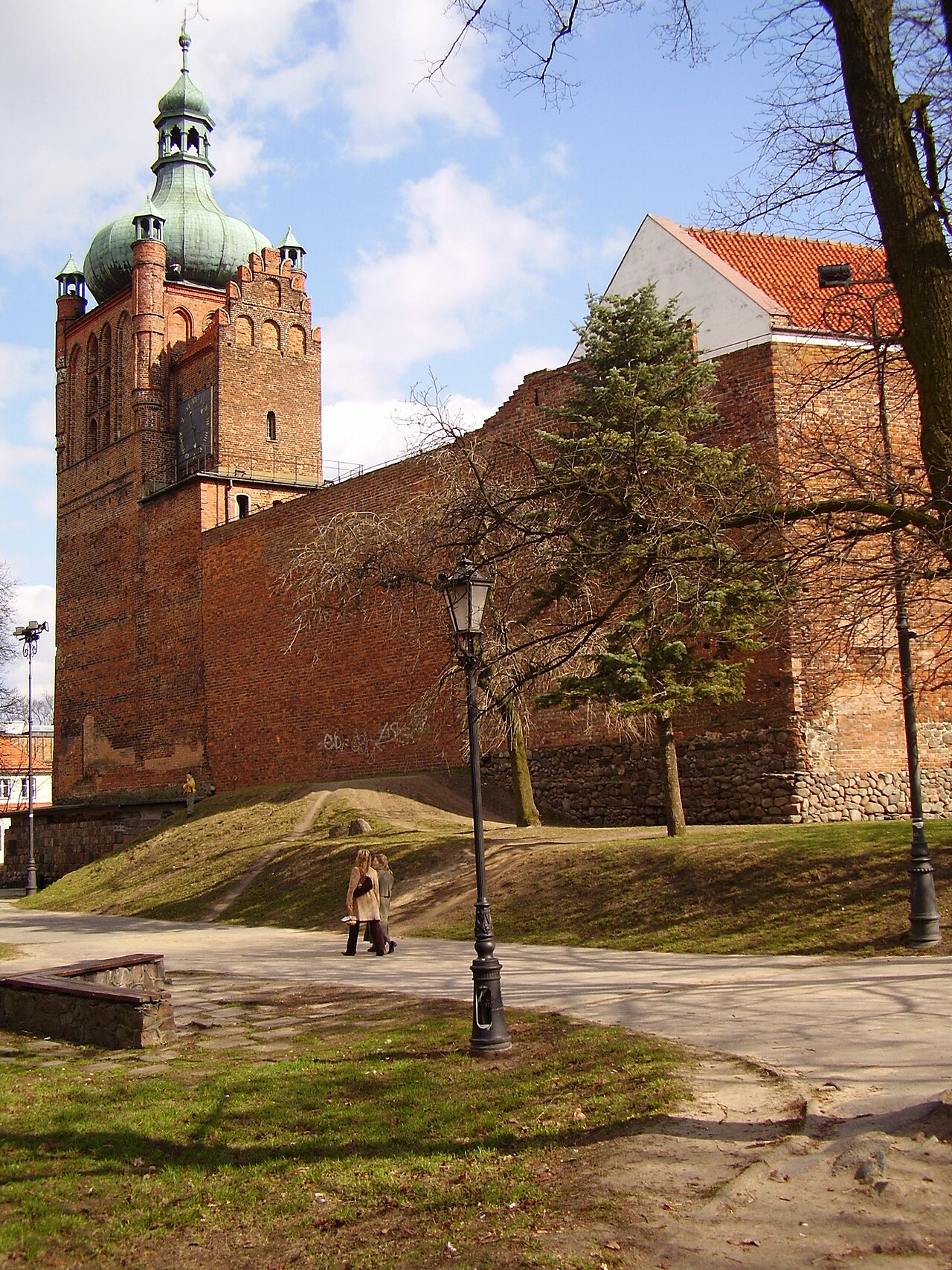
In 1824, the ruins were transferred to the local community to construct a Protestant church under the supervision of architect Hilary Szpilowski. Completed in 1830, this church incorporated the surviving castle tower and walls. After World War II, the building was used by the Roman Catholic parish until 1978, when a new church was built. Later, the structure was acquired by a local company intending to convert it into a cultural center, but these plans were never realized.
In 2009, the heavily damaged church, containing remnants of the castle, was adapted for use by a newly constructed adjacent hotel styled to resemble a castle. This modern intervention sparked debate due to its controversial architectural approach juxtaposed with the historic ruins.
Architectural features and legacy
The castle exemplifies the evolution of medieval fortifications in Mazovia, transitioning from early wooden-earthworks to stone bastioned defenses. Its layout, including the quadrangular curtain walls, corner towers, moat, and foregate, reflects typical High Medieval and Late Medieval military architecture. The surviving tower with the chapel is a rare architectural relic that connects the site’s medieval past with its later religious use.
Today, the ruins of Gostynin castle are a protected heritage site, offering insights into the region’s medieval history and the complex political dynamics of Mazovia. The site’s layered history from a defensive gord to a Renaissance starosta’s residence, to a prison for a Russian tsar, and finally to a religious and cultural monument, makes it a rich subject for historians and visitors alike.
Visitor information and cultural significance
Although only ruins remain, the site is accessible to visitors interested in medieval architecture and Polish history. The adjacent hotel and cultural facilities provide modern amenities, while the castle’s story is commemorated through local heritage initiatives. Gostynin castle remains a symbol of the town’s historical importance and resilience through centuries of conflict and change.
Frequently asked questions (FAQ)
- When was Gostynin castle originally built?
- Gostynin castle's origins date back to around 1240 when Duke Konrad I of Mazovia expanded an early medieval fortified settlement on the site.
- What architectural style characterizes Gostynin castle?
- The castle primarily features Gothic architectural elements typical of medieval fortifications built in the 14th century.
- What historical events is Gostynin castle known for?
- Gostynin castle was the prison of Russian Tsar Vasili IV Shuisky in 1611-1612 and suffered major destruction during the Swedish Deluge in the 17th century.
- Can visitors access the ruins of Gostynin castle today?
- Yes, the ruins of Gostynin castle are accessible to visitors, though only fragments remain, including a tower with a chapel incorporated into later buildings.
- Who was the architect responsible for the 19th-century church built on the castle ruins?
- The Protestant church built in 1830 on the castle ruins was designed by architect Hilary Szpilowski.
- How did the castle's function change over time?
- Originally a defensive fortress, Gostynin castle later served as a royal residence, prison, and eventually was converted into a church and cultural site.
Information
Architect
Hilary Szpilowski
Current owner
Municipality
Loading map...
Visitor reviews
No reviews yet. Been here? Write the first review and help other travelers!
Write the first reviewVisited this castle? Share your experience
Your review helps other travelers and adds first-hand knowledge to our encyclopedia.