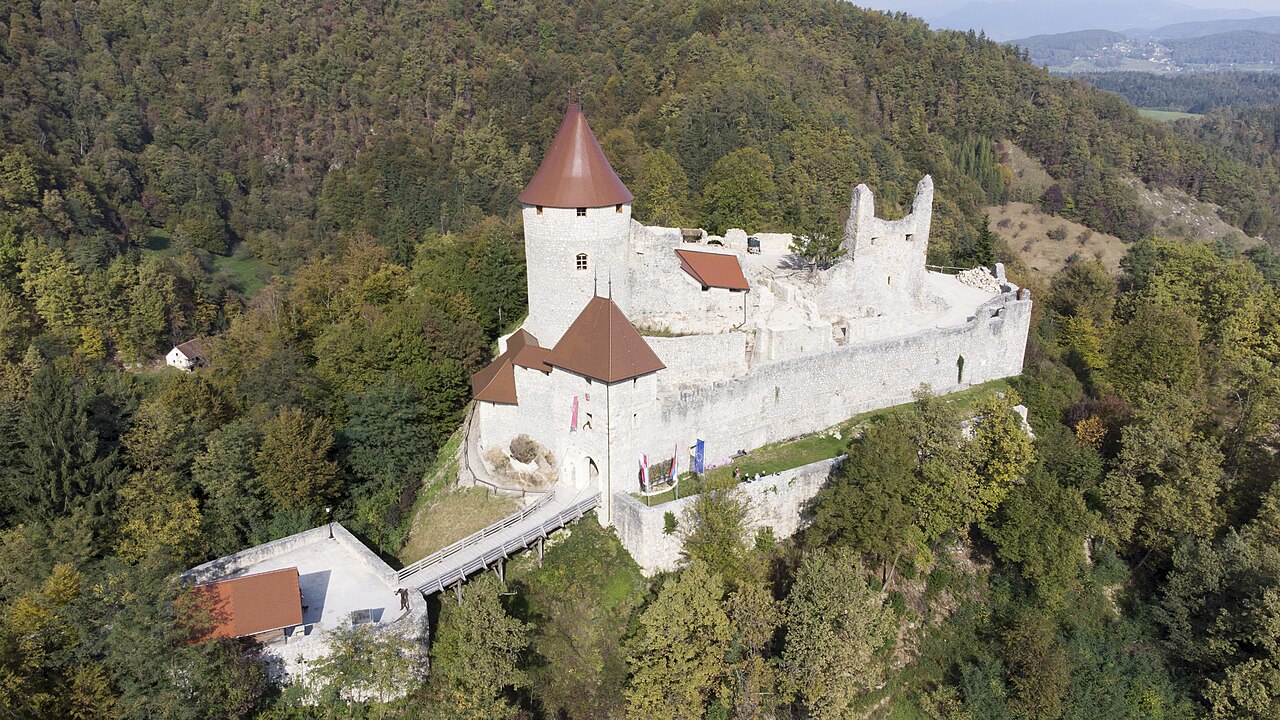
Gamberk Castle Ruins
Gamberk castle ruins stand as a significant medieval site in Ržiše, Slovenia, reflecting a complex history tied to influential noble families and regional power shifts from the 12th century onward. The castle is closely associated with the Gall family, an important ministerial lineage during the late Middle Ages. Although some early accounts suggest the castle might have been founded by Ortolf III of Svibno in the mid-11th century, modern historical research supports a construction date in the second half of the 12th century, coinciding with the arrival of the Gall family from Bavaria to Carniola as ministerials.
Medieval origins and early history
The first indirect documentary mention of the castle appears in 1248, referred to as Gallenberch. Its architectural design, typical of the period, supports an origin before the year 1200. In the 14th century, the castle remained under the ownership of the Gall-Gallenberg family, despite their relocation to the newly built Gallenstein castle near Podpeč in Lower Carinthia during the latter half of the 13th century. During this time, Gamberk castle retained control over the provincial court of law, although its strategic and administrative importance began to decline. The Gall family likely lost dominion over the castle by the end of the 14th century.
Transition of ownership and architectural evolution
By the early 15th century, ownership had passed to the House of Šternberg, who sold the castle to the Habsburgs in 1443. Under Habsburg rule, the castle was often leased or managed by appointed stewards. Notable stewards included Konrad noble Apfaltrer in 1461 and Franc noble Altenhaus in 1546. In 1548, Emperor Ferdinand I pawned the castle along with the tithe on Trojane to Hans noble Rechberg. Shortly thereafter, in 1553, the castle became a lien of Jakob noble Lamberg, who, with imperial approval, transformed the medieval tower structure into a luxurious Renaissance residence. This renovation marks a significant architectural evolution from a purely defensive fortress to a more comfortable noble residence.
Later history and decline
The castle remained in the Lamberg family until the 1630s. In 1640, it was sold by Jurij Žiga count Paradeiser to Jernej - Bartolomej baron Valvasor, father of the notable Slovene historiographer Janez Vajkard Valvasor. Ownership changed hands several times thereafter, including the Luenburg family in 1661 and the Poor Clares order from Ljubljana in 1677, who quickly sold it the same year to Gašper noble Lichtenturn. The castle underwent repairs under Andrej Ksaverij Baron Lichtenturn, maintaining its condition into the late 18th century.
Subsequent owners included the Montanists between 1804 and 1830 and a mining shareholders company in the mid-19th century that used the castle as a vacation resort. After 1875, the castle passed through several private owners but was abandoned by the late 19th century. A sketch by Hinko Kartin from the early 20th century shows that the surrounding walls were still remarkably intact, reaching the height of the second-floor roof projection.
Architectural features and current condition
Originally, Gamberk castle featured typical medieval defensive structures including thick stone walls, a central tower, and fortified gates. The Renaissance transformation introduced luxurious residential elements, reflecting changing needs and styles among the nobility. Today, the castle is classified as ruins but is undergoing reconstruction works to preserve its historical fabric and architectural significance.
Cultural and historical significance
Gamberk castle ruins offer insight into the feudal and noble dynamics of medieval Slovenia, illustrating the transition from military fortress to noble residence. The castle's ties to prominent families such as the Galls, Šternbergs, Habsburgs, and Lambergs, as well as its connection to Janez Vajkard Valvasor, underscore its importance in regional history. Its ongoing preservation efforts highlight the value placed on cultural heritage in Slovenia.
Visiting information
The castle ruins are accessible to visitors interested in medieval architecture and Slovenian history. Reconstruction efforts aim to enhance the visitor experience while protecting the site. Visitors should check local sources for current access conditions and any guided tour availability.
Frequently asked questions (FAQ)
- When was Gamberk castle first mentioned in historical records?
- Gamberk castle was first indirectly mentioned in 1248 under the name Gallenberch, though its construction likely dates back to the second half of the 12th century.
- Who were the original builders of Gamberk castle?
- The castle is closely associated with the Gall family, who are believed to have established it after arriving from Bavaria in the 12th century.
- What architectural changes did the castle undergo?
- Originally a medieval fortress, Gamberk was transformed into a Renaissance residence in the mid-16th century by Jakob noble Lamberg, adding luxurious elements to the medieval tower design.
- Is Gamberk castle currently open to visitors?
- The castle is currently in ruins but undergoing reconstruction. Visitors should check local resources for the latest information on access and tours.
- Which noble families owned Gamberk castle over the centuries?
- Ownership passed from the Gall family to the Šternbergs, then to the Habsburgs, followed by the Lambergs, Valvasor family, Lichtenturns, and others.
Information
Loading map...
Visitor reviews
No reviews yet. Been here? Write the first review and help other travelers!
Write the first reviewVisited this castle? Share your experience
Your review helps other travelers and adds first-hand knowledge to our encyclopedia.