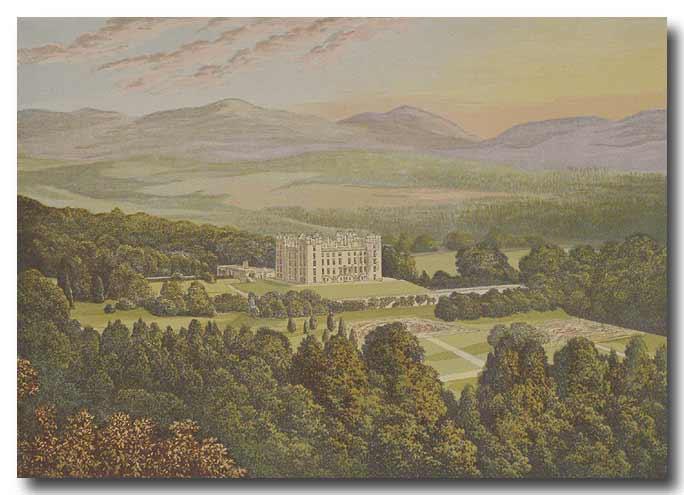
Friars Carse
Friars Carse is a historic estate located near Auldgirth in Scotland, notable for its deep connections to medieval monastic life and its evolution through centuries of Scottish history. The estate's origins date back to the 13th century, when it was established by Cistercian monks affiliated with Melrose Abbey, one of the most significant ecclesiastical institutions of medieval Scotland. This religious foundation profoundly influenced the estate's early development, with the monks operating a grange—a farm estate supporting the abbey's economic needs—on lands granted by Affrica, daughter of Edgar, around 1215. These lands were held under the authority of King William the Lion, situating Friars Carse firmly within the medieval Scottish feudal system.
The estate's strategic location along the River Nith provided vital water resources for agriculture and sustenance, including fishponds that were integral to monastic life. Nearby Carse Loch served as a monastic fish pond and contained a crannog, an artificial island refuge constructed from large oak piles and planks, which offered protection during times of conflict. Archaeological finds such as a dugout canoe and other artifacts attest to the long-standing use of this site.
Medieval and early modern architecture
By the 16th century, Friars Carse featured a fortified tower distinguished by a cap-house—a small shelter atop the tower—and a strong parapet wall encircling the structure. This tower formed the earliest known defensive element of the estate, reflecting the turbulent times in Scotland during the late medieval period. Throughout the 17th and 18th centuries, the complex expanded to include lodgings arranged around a courtyard, characterized by distinctive crow-stepped gables, a hallmark of Scottish vernacular architecture of the period.
A medieval monks’ refectory once stood nearby, recorded in 1789 as having remarkably thick walls and a large fireplace, indicative of its communal dining function. This building was demolished in the late 18th century during the reconstruction efforts led by Robert Riddell.
Robert riddell and the glenriddell mansion
In 1771, Robert Riddell, a prominent local landowner and a close associate of the famed Scottish poet Robert Burns, replaced the older, deteriorating structures with a new mansion named Glenriddell. Riddell's mansion incorporated elements of the previous buildings and became a cultural hub, especially due to Burns' frequent visits and the estate's hermitage, where the poet found inspiration.
Riddell’s connection to Burns is immortalized in the poet's works, including the poem "The Whistle," which recounts a drinking contest held at Friars Carse. The estate also housed a collection of ancient stones gathered by Captain Robert Riddell, including the notable Laugh Moor Burial Stone, a 9th or 10th-century Celtic cross originally from Morton Castle, underscoring the estate's rich archaeological heritage.
19th and early 20th century transformations
Following Robert Riddell's death in 1794, the estate passed to Dr. James Crichton in 1812, who renamed it Friars Carse. Crichton resided there until his death in 1823, after which his widow maintained the property until 1862. She was known for her benefactions to the Crichton Royal Hospital in Dumfries.
The estate later came into the possession of Thomas Nelson, an engineer associated with the construction of the Forth Rail Bridge. Nelson extended the mansion while preserving earlier architectural features such as the "Whistle" room. He also added Masonic symbols to the estate's hermitage, reflecting Robert Burns' own Masonic affiliations.
Between 1873 and the early 20th century, the mansion was rebuilt and expanded in the Scottish Baronial style using red sandstone, with architects Barbour and Bowie overseeing the 1873 construction. The southeast frontage features a distinctive round tower with a rectangular upper stage supported by corbels. A 1598 armorial panel was incorporated into the entrance tower during renovations in 1909. The interior boasts a panelled entrance hall, a snooker room with elegant wood panelling, a graceful staircase, and twenty-one bedrooms with en suite facilities, reflecting the estate's status as a refined country residence.
Estate structures and grounds
The estate's stables, dating primarily from the early 19th century and remodeled around the mansion's reconstruction, consist of four single-storey ranges forming a square courtyard with a central pend, an arched covered passage beneath a two-stage tower. A dovecot with a gabled roof complements the stable complex.
The hermitage, originally built by Captain Robert Riddell near Ellisland Farm, was a small summerhouse measuring approximately 3.2 by 2.4 meters, containing a single window and an open fireplace. By the early 19th century, the original hermitage had fallen into ruin. In 1874, Thomas Nelson constructed a new hermitage on the same site, adorned with a carved monk figure at the entrance. This structure was restored in 2009 and includes an interpretation board for visitors.
Cultural and historical significance
Friars Carse holds significant cultural importance due to its association with Robert Burns, Scotland's national poet, who frequently visited the estate and its hermitage. The estate's social gatherings and historical artifacts, such as the Laugh Moor Burial Stone, contribute to its rich heritage. The estate also played a role in healthcare history when it was acquired by the Crichton Royal Institution in 1895 and converted into a convalescent home for aristocratic and royal patients, with less affluent patients serving as estate staff.
In the 20th century, ownership passed to Charles Wedderburn Dickson and later to Bryn Asaph Ltd., which transformed Friars Carse into a memorial guest house honoring Post Office personnel who died during the World Wars, a role it maintains today.
Archaeological and natural features
The estate's landscape includes remnants of medieval monastic activity, such as the fish pond at Carse Loch and the crannog refuge. The grounds along the River Nith provide approximately 2.3 kilometers of fishing rights, shaded by ancient pedunculate oaks and other notable trees that enhance the parkland setting. Two former estate cottages near the old stables have been adapted for guest accommodation, continuing the estate's residential tradition.
The site's archaeological richness is further highlighted by a nearby location identified as a Roman encampment, traditionally linked to General Agricola's military campaigns, adding a layer of ancient historical significance to the estate's long timeline.
Frequently asked questions (FAQ)
- How do I visit Friars Carse and what are the opening hours?
- Friars Carse is a private estate with guest accommodations. Visitors should check ahead for availability and visiting times, as it is not regularly open to the public like a museum or historic site.
- What is the historical significance of Friars Carse?
- Friars Carse is significant for its medieval monastic origins, its 16th-century fortified tower, and its association with Robert Burns and Robert Riddell. It also served as a convalescent home and a memorial guest house.
- Can I see Robert Burns' hermitage at Friars Carse?
- Yes, the hermitage was rebuilt in 1874 and restored in 2009. It is located near Ellisland Farm and includes interpretive information about its connection to Robert Burns and Robert Riddell.
- What architectural styles are present at Friars Carse?
- Friars Carse features a mix of architectural styles, including elements from the late medieval fortified tower, 17th and 18th-century crow-stepped gabled lodgings, and the 19th-century Scottish Baronial style mansion built of red sandstone.
- Is Friars Carse accessible for fishing or outdoor activities?
- The estate includes about 2.3 kilometers of fishing rights along the River Nith, shaded by ancient trees, making it suitable for fishing and enjoying the natural parkland setting.
Information
Website
Visit websiteSources & official resources
Verify the information above using these authoritative references.
Loading map...
Visitor reviews
No reviews yet. Been here? Write the first review and help other travelers!
Write the first reviewVisited this castle? Share your experience
Your review helps other travelers and adds first-hand knowledge to our encyclopedia.