Frejštejn Castle
Frejštejn Castle stands as a remarkable example of a 13th-century hill castle located near the municipality of Podhradí nad Dyjí in Czechia. Its strategic position on the right bank of the Dyje River, close to the confluence with the Křeslický stream and adjacent to the Podhradské skály natural reserve, highlights the castle's historical role in controlling and defending this important border region. The castle's remains today offer a window into the architectural and military evolution from the High Medieval period through the Renaissance.
The origins and early history of Frejštejn Castle
Frejštejn was established in the 13th century by descendants of Lord Wernhard of Trnava (Thürnau), who governed the territory under the authority of the Moravian margrave Vladislav Jindřich. Early records from 1251 mention nobleman Oldřich (Ulrich) called Liber and his son Gaytmar witnessing a donation to the Jerusalem monastery, indicating the castle's early noble occupants and its integration into regional power networks.
The castle's early history was marked by turmoil following the death of King Přemysl Otakar II in 1278, when it became a stronghold for bandits. In 1286, Duke Albrecht I of Austria, with King Václav II's approval, seized and destroyed the castle to restore order. However, Frejštejn was revived and significantly expanded under Václav II's reign, with documents from 1310 citing Marquart of Frejštejn and early 14th-century charitable acts by Oldřich Vrey linked to the Zwettl monastery.
Architectural development and medieval significance
During the 1330s, the castle was managed by burgraves, officials overseeing estates and defense. Notable figures include Konrád of Bítov and Petr Hecht of Rosice. A significant construction phase under Oldřich of Frenštejn added a representative three-story palace and the chapel of St. Catherine, first mentioned in 1347, reflecting both residential comfort and spiritual needs.
Frejštejn's architecture from this period illustrates typical medieval castle features: thick defensive walls, a gatehouse, and residential quarters designed for noble habitation. The chapel's dedication to St. Catherine indicates the importance of religious life within the castle complex.
The castle under the Krajk family and decline
In 1422, King Sigismund granted Frejštejn as hereditary collateral to Lipolt I of Krajk, later passing to his brother Jan Krajíř of Krajk. Jan's notoriety for raiding local lands earned him the label "land pest" from neighboring estates. Despite official orders to demolish the castle, he was still recorded there in 1447, indicating the castle's continued occupation amid regional conflict.
The castle passed to Jan's nephew Volf in 1454, who was recognized by King George of Poděbrady in 1458 for his support during Austrian conflicts. Frejštejn likely suffered damage during the war against Matthias Corvinus and is documented as ruined by 1487. Ownership remained with Volf's descendants, Lipolt II and Jindřich, but the castle never fully recovered.
Renaissance modifications and later history
In the 16th century, Frejštejn underwent fortification upgrades, including the addition of a tower with embrasures adapted for firearms. These modifications reflect the castle's adaptation to evolving military technologies during the Renaissance. Despite these efforts, the castle gradually fell into disuse, paralleling the decline of the nearby Uherčice estate.
By 1628, the castle was owned by Jakub Berchtold, an imperial counselor elevated to nobility. However, Frejštejn was already abandoned by this time and has remained so since the 15th century. Today, it is preserved as a cultural monument owned by the municipality of Podhradí nad Dyjí.
Architectural remains and site description
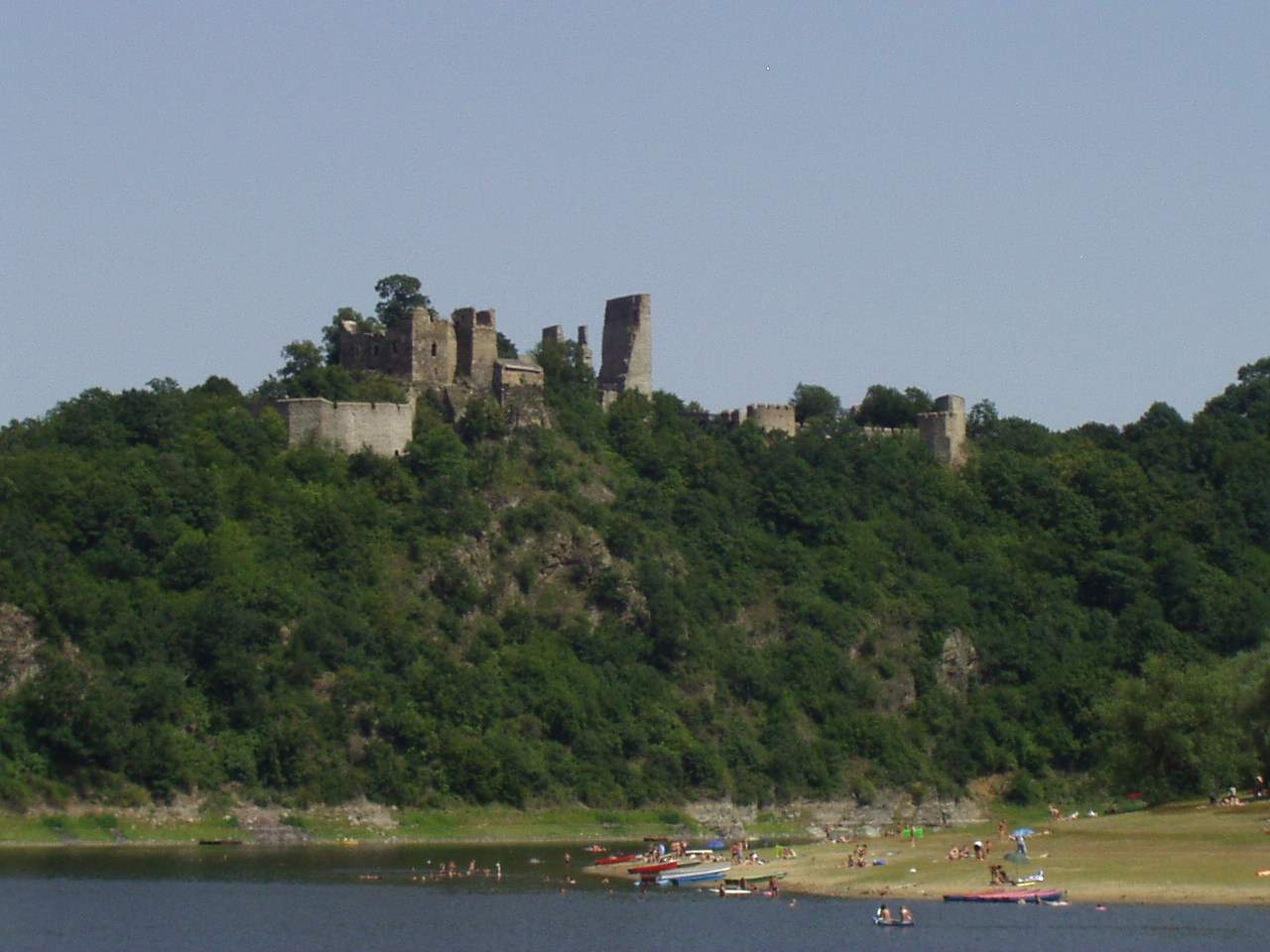
The compact ruins of Frejštejn occupy a hilltop site offering commanding views of the surrounding landscape. Surviving elements include segments of the northern defensive walls, the main entrance gate structure, and a well-preserved bastion on the southwestern side. These features illustrate medieval defensive strategies, including protection against siege warfare.
The small palace within the lower castle area is part of the original three-story residential complex from the 14th century. Adjacent to it lies the chapel of St. Catherine, a rare surviving example of medieval ecclesiastical architecture within a castle context, first documented in 1347.
The Renaissance-era tower with embrasures demonstrates the castle's later military adaptations, designed to accommodate firearms and improve defensive capabilities. This tower remains substantially intact, offering insight into the transitional period of castle fortification.
Surrounding environment and cultural significance
Frejštejn's location near the Dyje River and the Podhradské skály natural reserve enhances its historical and scenic value. The castle's ruins are a protected cultural monument, reflecting its importance in Czech heritage. Its layered architectural history from the High Medieval through the Renaissance periods makes it a valuable site for understanding regional castle development and medieval noble life.
Visiting Frejštejn Castle today
Visitors to Frejštejn can explore the atmospheric ruins set in a picturesque natural setting. The site offers a glimpse into medieval fortification techniques, noble residential architecture, and the spiritual life of castle inhabitants through the preserved chapel. Interpretative signage and local guides provide historical context, enriching the visitor experience.
The castle's preservation as a cultural monument ensures ongoing protection and study. Its ruins serve as a testament to the region's turbulent history, architectural evolution, and the enduring legacy of medieval fortresses in Czechia.
Frequently asked questions (FAQ)
- When was Frejštejn Castle built?
- Frejštejn Castle was constructed in the 13th century by descendants of Lord Wernhard of Trnava under the Moravian margrave Vladislav Jindřich.
- What remains can be seen at Frejštejn Castle today?
- Visitors can see the northern defensive walls, the main entrance gate, a well-preserved bastion, the small palace, the chapel of St. Catherine, and a Renaissance tower with embrasures.
- Who owned Frejštejn Castle during the 15th century?
- In the 15th century, the castle was owned by the Krajk family, including Jan Krajíř of Krajk, known for raids, and later by his nephew Volf, who was honored by King George of Poděbrady.
- Why is Frejštejn Castle in ruins?
- The castle was seized and destroyed in 1286, rebuilt and expanded, but likely suffered destruction during the war against Matthias Corvinus and was abandoned by the 15th century.
- Is Frejštejn Castle open to visitors?
- Frejštejn Castle is preserved as a cultural monument and is accessible to visitors, offering historical insights into medieval and Renaissance fortifications in Czechia.
Information
Current owner
Municipality of Podhradí nad Dyjí
Loading map...
Visitor reviews
No reviews yet. Been here? Write the first review and help other travelers!
Write the first reviewVisited this castle? Share your experience
Your review helps other travelers and adds first-hand knowledge to our encyclopedia.