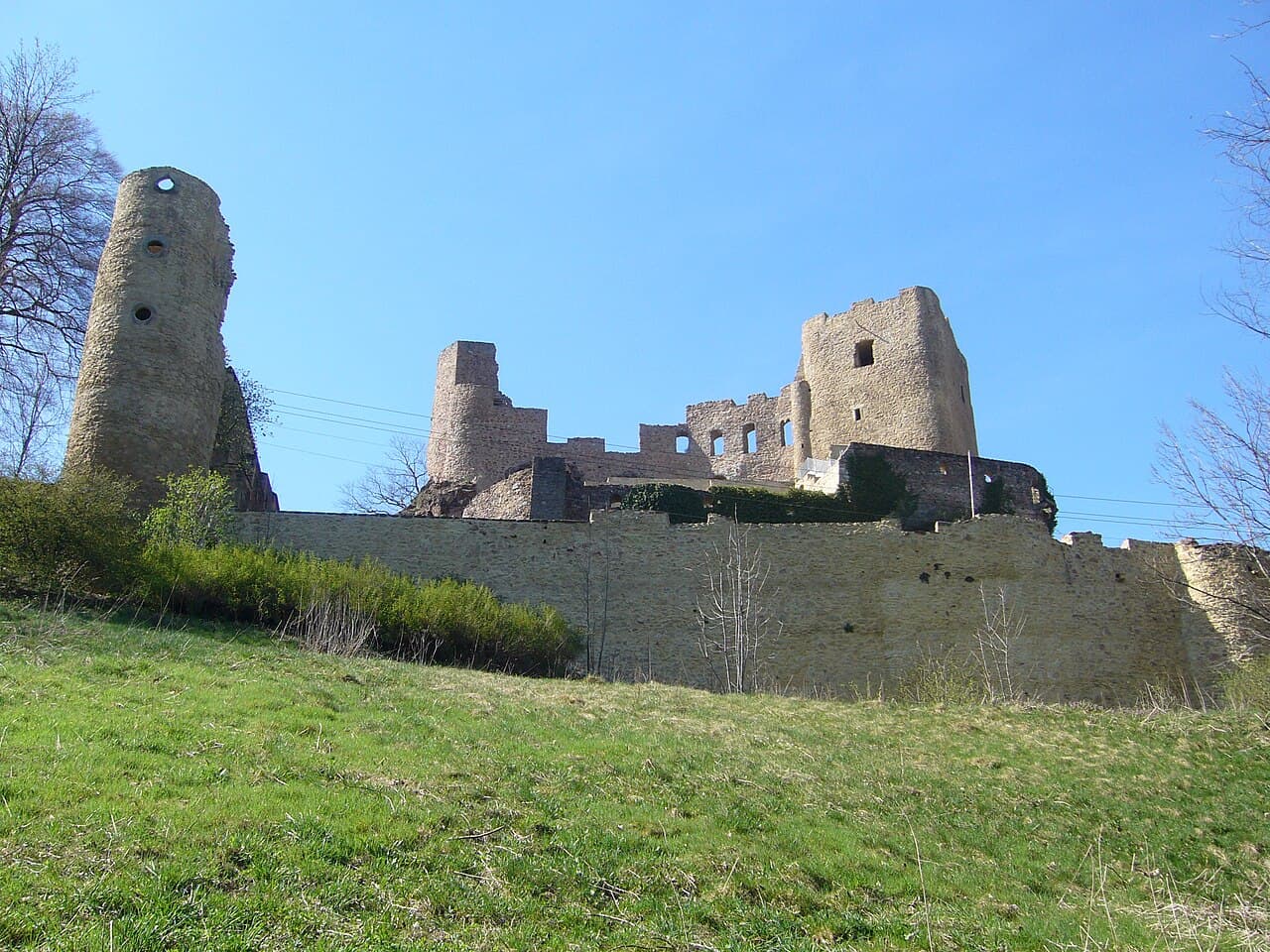
Frauenstein Castle
Frauenstein Castle stands as a significant high medieval fortress ruin perched on a 680-metre-high granite outcrop along the crest of the Eastern Ore Mountains, near the town of Frauenstein in the German district of Mittelsachsen. First documented in 1272, this castle was strategically constructed as a border fortification between the March of Meissen and Bohemia. Its primary purpose was to protect vital trade routes and the lucrative silver mining industry that flourished in the region during the 13th century.
Early construction and architectural features
The original castle layout was compact, with the inner ward measuring approximately 30 by 15 metres. Central to this was a tower house, a common defensive residential structure of the period, designed to offer both protection and living quarters. Shortly after the initial construction, a second tower house was added, linked to the first, enhancing the castle's defensive capabilities.
In the late 13th century, the castle expanded with the addition of a great hall and a castle chapel, reflecting the growing importance of the site as a noble residence and administrative center. The curtain wall, a formidable defensive barrier, was constructed in the first half of the 14th century, featuring walls approximately 1.5 metres thick. This wall enclosed the castle's key structures and provided protection against sieges and attacks.
Historical context and ownership transitions
In 1329, the castle and its associated dominion were enfeoffed by the margrave to the burgraves of Meissen, marking a shift in control and signaling its continued strategic relevance. The nearby parish of Frauenstein was granted town rights in 1411, further cementing the area's regional importance.
The castle endured significant conflict in 1438 when it was largely destroyed during a siege by the Wettin family. This siege was part of a succession dispute following the extinction of the Meinheringer line in 1426, which led to the castle passing to the House of Plauen through their Vögte (advocates). Eventually, the noble von Schönberg family took possession of Frauenstein Castle in 1473.
Renaissance palace and later uses
Between 1585 and 1588, the von Schönbergs commissioned the construction of a Renaissance palace (Schloss) near the castle ruins. This palace was designed by Hans Irmisch, the architect to the Elector, and represented a shift from medieval fortress to more comfortable noble residence.
Following the completion of the palace, the original castle was abandoned as a residence but maintained some functional roles. The castle chapel underwent renovation in 1615, indicating ongoing religious use. The last Schönberg owner sold the estate in 1647 to Prince-Elector John George I.
Subsequently, the palace was repurposed for administrative functions, including serving as a judicial office (Gerichtsamt), forestry office (Forstrentamt), and district court (Amtsgericht). However, the castle itself, unlike the palace, was not restored after suffering damage in a 1728 fire that devastated much of Frauenstein town.
Surviving structures and preservation efforts
Today, the ruins of Frauenstein Castle include the notable 13th-century tower house known as Dicker Merten and extensive sections of the thick curtain wall. Visitors can explore the remains of the cellar, kitchen, castle chapel, prison, two parlours, and several vaulted chambers that offer insight into medieval castle life.
Restoration efforts have been undertaken intermittently since the mid-20th century, with significant work completed in 1968, 1990, and 1992 to stabilize the ruins and improve public access. In 2007, an interest group was formed dedicated to preserving the castle ruins, ensuring they remain accessible to visitors and protected from private acquisition.
Architectural significance and cultural heritage
Frauenstein Castle exemplifies typical high medieval fortification architecture in the Ore Mountains region, illustrating the evolution from a compact tower house complex to a larger fortified site with curtain walls and specialized buildings such as chapels and great halls. Its location on a granite rock provided natural defensive advantages, which were enhanced by its thick walls and strategic design.
The castle's history reflects the complex political dynamics of the region during the Middle Ages, including territorial disputes, noble family succession, and the interplay between military and residential functions. Its transformation into a Renaissance palace and later administrative center demonstrates adaptive reuse over centuries.
Today, Frauenstein Castle is an important cultural monument, attracting visitors interested in medieval architecture, regional history, and the heritage of the Ore Mountains. Its ruins offer a tangible connection to the past and a window into the life and defense strategies of medieval German nobility.
Frequently asked questions (FAQ)
- How do I get to Frauenstein Castle?
- Frauenstein Castle is located in Frauenstein, Germany, and can be accessed by car or public transport. If you are driving, there is parking available nearby. For public transport, check local bus or train schedules that service the area.
- What is the historical significance of Frauenstein Castle?
- Frauenstein Castle dates back to the 13th century and has played a crucial role in the region's history. It served as a residence for various noble families and has witnessed numerous historical events over the centuries. Today, it stands as a symbol of medieval architecture and local heritage.
- When was Frauenstein Castle built?
- Frauenstein Castle was originally constructed in the early 1200s, with various modifications and expansions occurring over the following centuries. Its construction reflects the typical architectural style of the period, combining defensive features with residential elements. The castle has been preserved to showcase its historical architecture.
- Can I take guided tours of Frauenstein Castle?
- Yes, guided tours of Frauenstein Castle are available, allowing visitors to explore its rich history and architecture. These tours are informative and provide insights into the castle's past and its significance. It's recommended to check the castle's website for tour availability and scheduling.
- Why is Frauenstein Castle a popular tourist destination?
- Frauenstein Castle is popular due to its stunning medieval architecture and picturesque location. Visitors are drawn to its historical significance and the beautiful views of the surrounding landscape. Additionally, the castle hosts various cultural events and exhibitions throughout the year.
- Is it possible to host events at Frauenstein Castle?
- Yes, Frauenstein Castle can be rented for private events, including weddings and corporate functions. The castle offers a unique and historic setting for various celebrations. For more details on event hosting, it's best to contact the castle management directly.
- What are the opening hours for Frauenstein Castle?
- Frauenstein Castle is typically open to visitors from April to October, with specific hours varying by season. During peak tourist months, the castle may offer extended hours to accommodate visitors. Always check the official website for the most current opening hours before your visit.
- What are the ticket prices for visiting Frauenstein Castle?
- Ticket prices for Frauenstein Castle vary depending on age and group rates, making it accessible for families and individuals alike. Discounts may be available for students, seniors, and children. For the latest pricing information, it's advisable to check the castle's official website.
- What nearby attractions can I visit while at Frauenstein Castle?
- While visiting Frauenstein Castle, you can also explore the charming town of Frauenstein and its local shops and cafes. Nearby attractions include the scenic hiking trails and natural parks that offer stunning views of the countryside. The region is rich in history, making it a great opportunity to discover other historical sites.
Photo gallery

Information
Loading map...
Visitor reviews
No reviews yet. Been here? Write the first review and help other travelers!
Write the first reviewVisited this castle? Share your experience
Your review helps other travelers and adds first-hand knowledge to our encyclopedia.


