Fortaleza de São Francisco Xavier da Ilha de Villegagnon
Historical context and construction
The fortress was originally constructed by the French in 1555 as part of their attempt to establish a foothold in Brazil, known as the France Antarctique colony. This effort was aimed at challenging Portuguese dominance in the region. The fortifications were intended to protect the settlement and secure the bay against Portuguese incursions.
After several years of conflict, the Portuguese forces recaptured the island in 1567, incorporating the fortress into their defensive network. The Portuguese made modifications and improvements to the existing structure, reinforcing it to withstand further attacks. Over the centuries, the fortress underwent various restorations and adaptations to meet evolving military needs.
Architectural features and layout
The fortress is characterized by its star-shaped bastions, a hallmark of Renaissance military architecture designed to provide overlapping fields of fire and reduce blind spots. The walls are constructed from local stone and mortar, thick enough to absorb cannon fire. The layout includes a central courtyard surrounded by barracks, storage rooms, and command quarters.
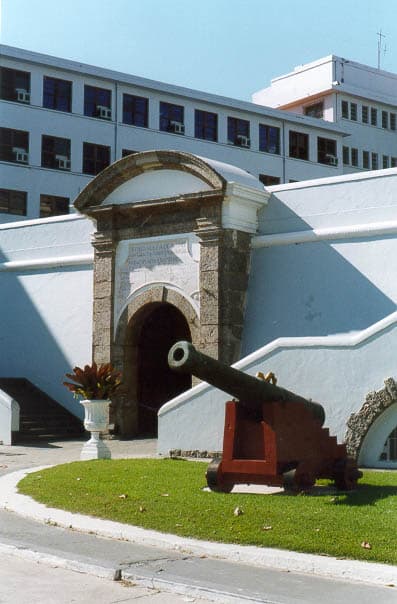
Defensive features include ramparts with parapets, embrasures for cannons, and a moat that once surrounded parts of the fortress. The entrance is fortified with a gatehouse that controlled access to the island. The structure's adaptation to the island's rocky terrain demonstrates careful planning to maximize defensive capabilities.
Role in Brazilian colonial history
The fortress was a focal point in the struggle between French and Portuguese forces for control over Brazil. Its capture by the Portuguese marked the end of French ambitions in the area and solidified Portuguese control over Guanabara Bay. Throughout the colonial period, the fortress served as a military garrison and a deterrent against foreign invasions and pirate attacks.
In later centuries, as military technology advanced, the fortress's strategic importance declined, but it remained a symbol of colonial heritage. It witnessed various historical events and changes in political power, reflecting the broader history of Brazil's colonization and defense.
Preservation and current status
Today, the Fortaleza de São Francisco Xavier da Ilha de Villegagnon is partially preserved and serves as a historical monument. It is managed by the Brazilian Navy and is occasionally open to visitors interested in military history and colonial architecture. The site offers insight into early European fortification methods in South America and the complex colonial history of Brazil.
The fortress's location on Villegagnon Island makes access limited, contributing to its preservation. Efforts have been made to maintain the structure and prevent further deterioration, though some areas remain in ruins. The site is valued for its cultural significance and as a rare example of 16th-century military architecture in the region.
Frequently asked questions (FAQ)
- How do I visit Fortaleza de São Francisco Xavier da Ilha de Villegagnon?
- The fortress is located on Villegagnon Island in Guanabara Bay and access is generally controlled by the Brazilian Navy. Visits are limited and often require prior arrangement or participation in guided tours organized by the Navy or local authorities.
- What is the historical significance of Fortaleza de São Francisco Xavier da Ilha de Villegagnon?
- The fortress represents one of the earliest European military constructions in Brazil, built by the French in 1555 during their attempt to establish the France Antarctique colony. It played a key role in the struggle between French and Portuguese forces for control over Rio de Janeiro and Guanabara Bay.
- When was the fortress built and by whom?
- The fortress was built in 1555 by the French under the leadership of Nicolas Durand de Villegagnon as part of the France Antarctique colony. It was later captured and modified by the Portuguese in 1567.
- Can I explore the architectural features of the fortress?
- Visitors can observe the star-shaped bastions, thick stone walls, and remnants of the moat and ramparts. The fortress showcases Renaissance military architectural principles adapted to the tropical environment of Brazil.
- Is the fortress accessible to people with limited mobility?
- Due to its location on an island and the historic nature of the structure, accessibility may be limited. Visitors with mobility issues should check with tour organizers or the Brazilian Navy for specific accommodations.
Photo gallery

Photo by Brazillian Navy•Attribution
Information
Current owner
Brazilian Navy
Loading map...
Visitor reviews
No reviews yet. Been here? Write the first review and help other travelers!
Write the first reviewVisited this castle? Share your experience
Your review helps other travelers and adds first-hand knowledge to our encyclopedia.