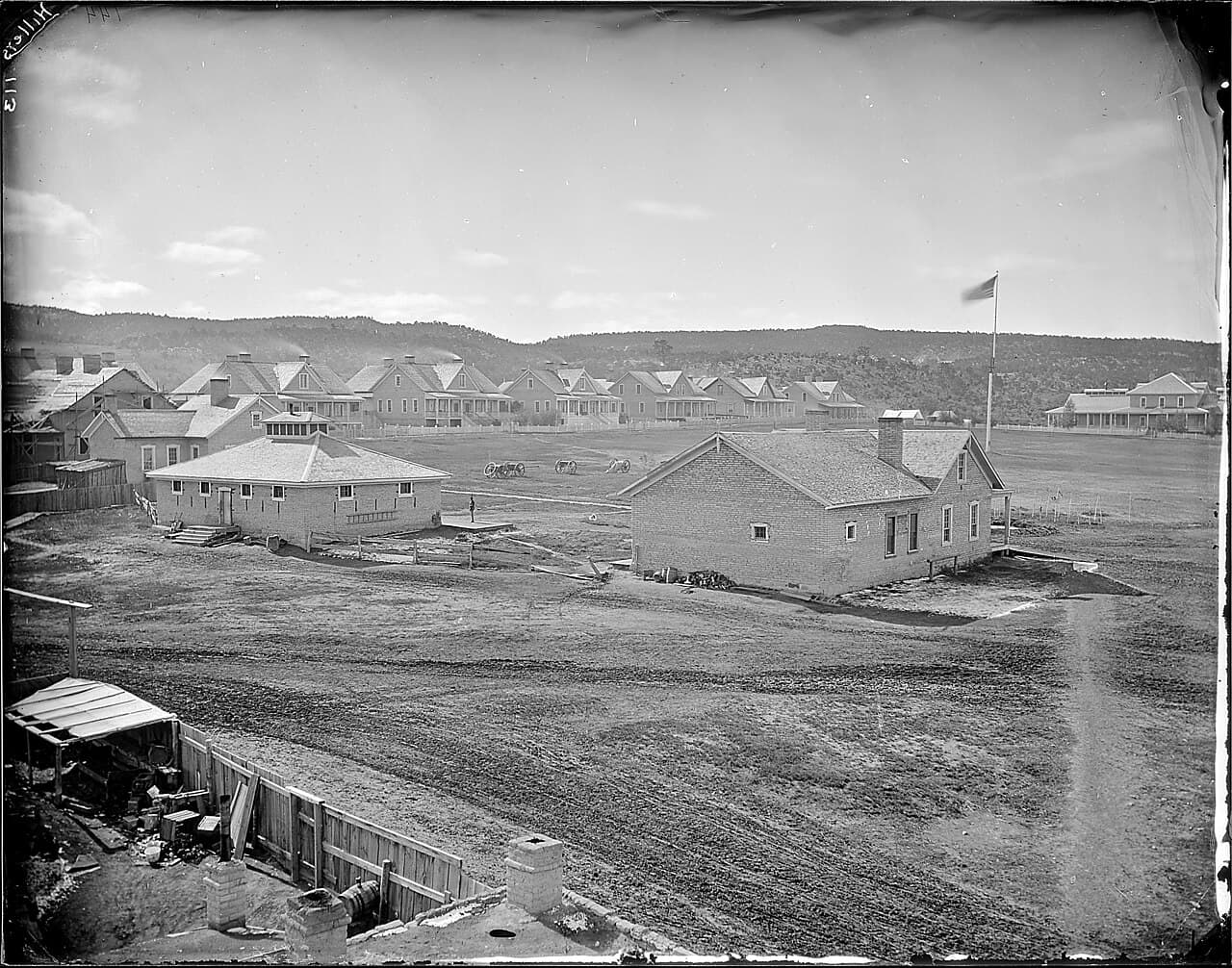
Fort Wingate
Fort Wingate is a historic military installation located near Gallup, New Mexico, United States. Established in the 19th century, it functioned as a bastioned fortress with strategic importance for military operations in the region. The fort's history is closely tied to the complex relations between the U.S. government and Native American tribes, particularly the Navajo and Apache peoples.
Historical background and early locations
The name Fort Wingate actually refers to three different sites in New Mexico over time. The first was established at Seboyeta from 1849 to 1862, followed by a second location at San Rafael from 1862 to 1868. The San Rafael fort notably served as the staging point for the infamous Long Walk of the Navajo, the forced deportation of the Navajo people during the 1860s.
The current and most well-known Fort Wingate was established in 1868 at the former site of Fort Lyon on Navajo territory. Its primary purpose was to control and "protect" the large Navajo tribe located to the north, reflecting the U.S. military's approach to Native American relations during that period.
Military role and operations
From 1870 onward, the garrison at Fort Wingate shifted focus to concerns about the Apache tribes to the south. The fort became a key military post in monitoring and managing Apache activities. Additionally, hundreds of Navajo Scouts were enlisted at Fort Wingate through the 1890s, playing a significant role in military operations in the region.
During World War II, Fort Wingate transitioned into an important ammunition depot known as the Fort Wingate Depot Activity. It supplied large quantities of munitions and explosives, including 100 tons of Composition B high explosives used in the Manhattan Project for the first Trinity nuclear test in 1945. This highlights the fort's strategic significance beyond its initial frontier military role.
Architecture and fortifications
Fort Wingate was designed as a bastioned fortress, a style characterized by angular bastions projecting from the walls to provide defensive coverage and eliminate blind spots. This fortification style was well-suited to the military needs of the 19th century, allowing defenders to cover all approaches against attacks.
The layout typically included thick defensive walls, bastions at key points, gates controlling access, and internal buildings for barracks, storage, and command. While the exact architectural details of Fort Wingate's structures evolved over time, the bastioned design remained a defining feature of the fort's military architecture.
Later history and legacy
Fort Wingate remained an active military installation until its closure in 1993 following the Base Realignment and Closure Commission decisions. Since then, the site has undergone extensive environmental cleanup efforts to address unexploded ordnance (UXO), perchlorate contamination, and lead pollution resulting from decades of military use.
The fort's historical significance was formally recognized when the Fort Wingate Historic District was added to the National Register of Historic Places in 1978. The surrounding community was designated as the Fort Wingate census-designated place in 2020, recording a population of 328 residents in the 2020 census.
Fort Wingate in cultural and military history
Fort Wingate's history reflects broader themes in American history, including westward expansion, Native American relations, and military innovation. It played a role in both the forced relocation of the Navajo and in the scientific advancements of the atomic age. The fort's evolution from a frontier bastioned fortress to a modern ammunition depot illustrates changes in military strategy and technology over more than a century.
Today, Fort Wingate stands as a site of historical memory, with ongoing efforts to preserve its structures and remediate environmental impacts. It attracts interest from historians, military scholars, and visitors seeking to understand the complex legacy of U.S. military installations in the Southwest.
Frequently asked questions (FAQ)
- What is the historical significance of Fort Wingate?
- Fort Wingate played a crucial role in the military history of the United States, serving as a supply depot during the Indian Wars and later during World War II. Its strategic location allowed it to support various military operations, making it an important site in the development of the American Southwest.
- When was Fort Wingate constructed?
- Fort Wingate was established in 1860 and underwent several expansions and modifications over the years. Its construction marked the beginning of a significant military presence in the region, which continued until its closure in 1993.
- Can I visit Fort Wingate?
- Yes, Fort Wingate is accessible to the public, although access may be limited due to ongoing preservation efforts. Visitors are encouraged to check local regulations and guidelines before their visit to ensure a safe and informative experience.
- What are the opening hours for Fort Wingate?
- Fort Wingate is typically open to visitors during daylight hours, but specific opening times may vary. It is advisable to check the official website or contact local visitor centers for the most current information regarding visiting hours.
- Is it possible to take guided tours of Fort Wingate?
- Yes, guided tours of Fort Wingate may be available, depending on the time of year and local arrangements. These tours provide valuable insights into the history and architecture of the fort, enhancing the visitor experience.
- What is the best time to visit Fort Wingate?
- The best time to visit Fort Wingate is during the spring and fall when temperatures are milder and more comfortable for outdoor exploration. Additionally, these seasons often feature fewer crowds, allowing for a more enjoyable visit.
- Are there any nearby attractions to Fort Wingate?
- Yes, there are several nearby attractions, including the scenic El Malpais National Monument and the historic Route 66. Visitors can also explore the rich Native American history of the area, taking advantage of the cultural and natural beauty surrounding Fort Wingate.
- What are the ticket prices for visiting Fort Wingate?
- Currently, there is no entrance fee to visit Fort Wingate, making it an affordable destination for history enthusiasts. However, it is always good to check for any special events or programs that may have associated costs.
- Is Fort Wingate accessible for individuals with disabilities?
- Efforts have been made to ensure that Fort Wingate is accessible to individuals with disabilities, including paved pathways and designated parking. Visitors are encouraged to reach out in advance to inquire about specific accessibility features and accommodations.
Photo gallery

Photo by Elias Olcott Beaman / James Fennemore / John Karl Hillers•Public domain
Information
Loading map...
Visitor reviews
No reviews yet. Been here? Write the first review and help other travelers!
Write the first reviewVisited this castle? Share your experience
Your review helps other travelers and adds first-hand knowledge to our encyclopedia.



