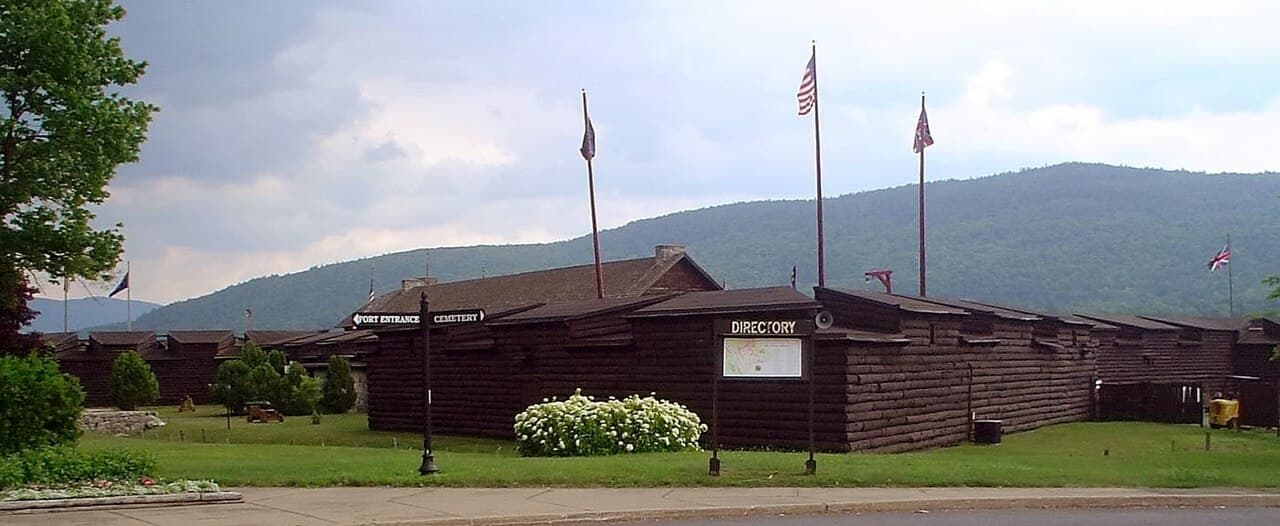
Fort William Henry
Fort William Henry is a historically significant bastioned fortress located at the southern end of Lake George in the province of New York, United States. Constructed in the 18th century during the post-Renaissance period, the fort played a crucial role in the French and Indian War, serving as a strategic British military installation on the frontier between British-controlled New York and French-held New France.
Construction and strategic importance
The construction of Fort William Henry was ordered in September 1755 by Sir William Johnson, the British Superintendent of Indian Affairs. The fort was designed as a bastioned fortress, a style that incorporated angled bastions allowing defensive cannon fire along the walls, reflecting the military architectural advancements of the period. Its primary purpose was to act as a staging ground for British attacks against the French-held Fort St. Frédéric on Lake Champlain, an important position controlling access to the interior of North America.
Fort William Henry was part of a network of forts along the vital inland waterway connecting New York City to Montreal. This chain of forts was essential in controlling movement and supply lines during the conflict between Britain and France for dominance in the region. The fort's location at the southern tip of Lake George gave it a commanding position over the lake and surrounding territory, making it a key forward base on the volatile frontier.
The 1757 siege and aftermath
In 1757, the fort became the scene of a pivotal event in the French and Indian War when it was besieged by the French forces under General Louis-Joseph de Montcalm. After a sustained siege, the British garrison was compelled to surrender. The subsequent massacre of British prisoners by Huron warriors allied with the French marked a tragic and infamous episode in the war.
This event gained further cultural significance through its depiction in James Fenimore Cooper's novel The Last of the Mohicans, which dramatized the siege and massacre, embedding Fort William Henry in American literary and historical consciousness.
Naming and historical legacy
The fort was named in honor of two British royals: Prince William, Duke of Cumberland, the younger son of King George II, and Prince William Henry, Duke of Gloucester and Edinburgh, a grandson of King George II and younger brother to the future King George III. This dual dedication reflected the British practice of honoring royal family members in military installations.
Following the 1757 siege, the French destroyed the fort and withdrew from the site. Although other forts were constructed nearby in subsequent years, Fort William Henry itself remained abandoned and in ruins for nearly two centuries.
19th and 20th century revival and preservation
During the 19th century, the ruins of Fort William Henry became a destination for tourists interested in the early colonial history of the region. The romantic appeal of the site was heightened by its association with the dramatic siege and massacre.
Interest in preserving and interpreting the fort's history was renewed in the 1950s, leading to the construction of a replica fort on the original site. Today, the reconstructed Fort William Henry operates as a living museum, offering visitors an immersive experience of 18th-century military life. It is a popular tourist attraction in the village of Lake George, featuring reenactments, guided tours, and educational programs that highlight its architectural features and historical significance.
Architectural features and design
The original Fort William Henry was designed according to the principles of bastioned fortification, which was a dominant military architectural style in the post-Renaissance period. The fort featured angular bastions at its corners, allowing defenders to cover adjacent walls with cannon and musket fire, reducing blind spots and enhancing its defensive capabilities.
The fort's walls were constructed primarily of earthworks reinforced with wooden palisades, a common practice in frontier forts where stone was less readily available. The interior contained barracks, officers' quarters, storage magazines, and a central parade ground. The fort's design balanced the need for strong defense with the practicalities of rapid construction in a remote wilderness setting.
Cultural impact and tourism today
Fort William Henry remains an important cultural landmark. Its story reflects the complex and often violent interactions between European colonial powers and Indigenous peoples during the 18th century. The site attracts history enthusiasts, scholars, and tourists who seek to understand the military, cultural, and social dynamics of early American frontier life.
The living history museum provides a tangible connection to the past, with costumed interpreters demonstrating period crafts, military drills, and daily routines of soldiers stationed at the fort. This educational approach helps preserve the memory of the fort's role in shaping the history of the northeastern United States.
Frequently asked questions (FAQ)
- How do I get to Fort William Henry?
- Fort William Henry is located in the village of Lake George, New York. It is accessible by car via major highways and has parking available on site.
- What is the historical significance of Fort William Henry?
- Fort William Henry was a key British fort during the French and Indian War, notable for its 1757 siege and subsequent massacre, which influenced American colonial history.
- When was Fort William Henry built?
- The fort was constructed in 1755 under the orders of Sir William Johnson as part of British military efforts in the French and Indian War.
- Can I visit a replica of Fort William Henry?
- Yes, a replica of Fort William Henry was built in the 1950s on the original site and operates as a living museum open to the public.
- What architectural style is Fort William Henry?
- Fort William Henry is designed as a bastioned fortress, a post-Renaissance military architectural style featuring angled bastions for improved defense.
- What are the visiting hours and ticket prices for Fort William Henry?
- The fort is open daily from 10:00 to 17:00. Tickets cost $10 for adults and $5 for children.
Photo gallery

Photo by IrisKawling at en.wikipedia•Public domain
Information
Opening hours
10:00-17:00, daily
Ticket prices
$10 adult, $5 child
Current owner
State museum
Loading map...
Visitor reviews
No reviews yet. Been here? Write the first review and help other travelers!
Write the first reviewVisited this castle? Share your experience
Your review helps other travelers and adds first-hand knowledge to our encyclopedia.



