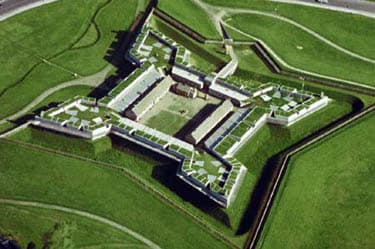
Fort Stanwix
Fort Stanwix is a historically significant 18th-century bastioned fortress located in present-day Rome, New York. Originally constructed beginning on August 26, 1758, under the supervision of British General John Stanwix, the fort was designed as a defensive stronghold during the French and Indian War. Its primary purpose was to guard the strategic portage route known as the Oneida Carry, a vital link between the watersheds of Lake Ontario and the Hudson River. The fort's construction was completed around 1762, embodying the bastioned fortress style typical of the post-Renaissance military architecture, featuring angular bastions designed to provide overlapping fields of fire and resist artillery attacks.
The strategic importance of Fort Stanwix in colonial America
Fort Stanwix occupied a crucial position in the contested frontier between British and French colonial interests. The Oneida Carry was a key overland passage used for moving troops, supplies, and trade goods, making control of the fort essential for dominance over the interior waterways. The fort's location allowed the British to secure this portage and thereby maintain communication and supply lines between their northern and southern colonial holdings.
Architectural features and military design
The fort was constructed following the principles of bastioned fortification, characterized by its star-shaped layout with projecting bastions at the corners. This design allowed defenders to cover all approaches with cannon and musket fire, eliminating blind spots. The walls were built using earthworks reinforced with timber, which absorbed artillery impacts more effectively than stone. Inside, the fort contained barracks, a magazine, officers' quarters, and storage facilities arranged around a central parade ground. Defensive ditches and palisades further enhanced its protection.
Role during the American Revolutionary War
After the British abandoned Fort Stanwix early in the American Revolutionary War, it was captured and rebuilt by American forces. The fort became a focal point during the 1777 siege, when a British army advancing from Canada attempted to seize it as part of their campaign to control the Hudson River corridor. The fort's defenders successfully repelled the siege, which was lifted after reinforcements arrived. This American victory at Fort Stanwix contributed to the failure of the British Saratoga campaign, a turning point in the war that encouraged French support for the American cause.
The 1777 siege and its military significance
The siege, lasting from August 2 to August 22, 1777, involved British forces under the command of Barry St. Leger, who sought to advance eastward from Lake Ontario. The fort's defenders, including militia and Continental Army troops, utilized the fort's bastioned defenses effectively. The arrival of American relief forces under Nicholas Herkimer and the threat of a larger battle forced the British to abandon the siege, preserving American control of this critical position.
Treaties and diplomatic importance
Fort Stanwix was also the site of two significant treaties that shaped relations between European settlers and Native American tribes. The 1768 Treaty of Fort Stanwix involved negotiations between British representatives and the Iroquois Confederacy, adjusting territorial boundaries to reduce frontier conflicts. Later, the 1784 Treaty of Fort Stanwix was signed between the United States government and Native American tribes, redefining land ownership and sovereignty following the Revolutionary War.
Preservation and the Fort Stanwix National Monument
The original fort was eventually dismantled, but the site has been preserved and reconstructed as the Fort Stanwix National Monument under the care of the National Park Service. The reconstructed fort faithfully represents the original 18th-century bastioned design and serves as an educational resource on colonial military history. The monument includes three walking trails, one of which traces the historic Oneida Carry route, offering visitors insight into the terrain and strategic considerations of the period.
Marinus Willett Collections Management and Education Center
Adjacent to the fort, the Marinus Willett Collections Management and Education Center houses an extensive collection of approximately 485,000 artifacts and documents related to Fort Stanwix and the broader Mohawk Valley region. The center features exhibits detailing the fort's history, its role in colonial and revolutionary conflicts, and the cultural heritage of the area. It also functions as a regional tourism hub, providing visitors with interpretive materials and educational programming.
Visiting Fort Stanwix today
Visitors to Fort Stanwix National Monument can explore the reconstructed fortifications, learn about the military engineering of the post-Renaissance bastioned fortress style, and gain an understanding of the fort's pivotal role in American history. The site offers a tangible connection to the colonial era and the Revolutionary War, making it a valuable destination for history enthusiasts and scholars alike.
Frequently asked questions (FAQ)
- When was Fort Stanwix built and by whom?
- Construction of Fort Stanwix began on August 26, 1758, under British General John Stanwix during the French and Indian War to secure the Oneida Carry portage.
- What is the architectural style of Fort Stanwix?
- Fort Stanwix is a bastioned fortress built in the post-Renaissance style, featuring star-shaped earthworks and bastions designed for artillery defense.
- Why is Fort Stanwix historically important?
- The fort played a key role in the French and Indian War and the American Revolutionary War, notably for its successful defense during the 1777 siege that helped thwart British plans in the Saratoga campaign.
- Can visitors tour Fort Stanwix today?
- Yes, visitors can explore the reconstructed fort at Fort Stanwix National Monument, including walking trails and the Marinus Willett Collections Management and Education Center.
- What treaties were signed at Fort Stanwix?
- The 1768 Treaty of Fort Stanwix between Britain and Native American tribes and the 1784 treaty between the tribes and the United States were signed at the fort.
Photo gallery

Photo by NPS photo•Public domain
Information
Current owner
National Park Service
Loading map...
Visitor reviews
No reviews yet. Been here? Write the first review and help other travelers!
Write the first reviewVisited this castle? Share your experience
Your review helps other travelers and adds first-hand knowledge to our encyclopedia.



