Beardslee Castle

Beardslee Castle in Little Falls, New York: a modern stone castle with Irish inspiration
New York 13365, United States of America
Modern (19th–20th c.)

Beardslee Castle stands as a striking example of 19th-century architecture that blends historical inspiration with modern functionality. Located in Little Falls, New York, this castle was constructed in 1860 as a deliberate replica of an Irish castle, reflecting the romantic fascination with medieval European architecture prevalent during the period. Though not a medieval fortress, its design faithfully evokes the imposing presence and charm of traditional stone castles.

The castle’s construction utilizes three-foot-thick limestone walls, which provide both durability and a sense of ancient solidity. The interior features oak-paneled ceilings and floors, contributing to a warm and historic atmosphere. Central to the main hall is a six-foot-wide wood-burning fireplace, a focal point that enhances the castle’s cozy yet grand ambiance. These architectural details highlight the care taken to evoke a medieval aesthetic while accommodating modern uses.

Architectural features and design inspiration

Beardslee Castle’s design draws heavily from Irish medieval castles, though it was built in the modern period of the 19th century. Its stone construction and castle-like silhouette with battlement-style parapets and towers are key features that establish its identity. Unlike authentic medieval castles built for defense, Beardslee Castle was constructed primarily as a stately residence and later adapted for hospitality purposes.

The use of limestone masonry is significant, as it provides both structural strength and an aesthetic reminiscent of ancient castles found throughout Ireland. The thick walls not only contribute to the castle’s insulation but also create an imposing exterior that commands attention. Inside, the oak woodwork and expansive fireplace evoke the grandeur of historic great halls, designed for gatherings and social events.

Historical context and evolution

While Beardslee Castle was built in 1860, a time when the United States was undergoing rapid growth and industrialization, its architecture deliberately looks to the past. This reflects the 19th-century American fascination with European heritage and the romantic revival of medieval styles. The castle was never intended as a military fortress but as a symbol of prestige and cultural connection to European traditions.

Over the years, Beardslee Castle has evolved from a private residence to a public venue. Today, it operates as a restaurant and event space, hosting weddings, banquets, and special gatherings. This adaptive reuse preserves the castle’s architectural integrity while ensuring its continued relevance and accessibility to the public.

Culinary excellence and hospitality

Beardslee Castle is renowned not only for its architecture but also for its inspired American cuisine. Under the direction of Chef/Owner Randall Brown, the castle offers a menu that changes seasonally, featuring wood-grilled meats and game, fresh seafood, and creative vegetarian dishes. The culinary offerings draw on a diverse range of influences including regional American, Island, Mediterranean, and Asian flavors, all prepared with a focus on the freshest local and seasonal ingredients.

The castle’s five intimate dining rooms provide a unique setting for guests, combining historic ambiance with modern comfort. The thick limestone walls and oak interiors create an atmosphere that is both elegant and inviting, making Beardslee Castle a sought-after destination for memorable dining experiences and special events.

Location and visitor experience

Situated at 123 Old State Road, Little Falls, New York 13365, Beardslee Castle is accessible to visitors seeking a distinctive venue that combines historical charm with contemporary hospitality. The castle’s location in central New York places it within reach of regional tourists and locals alike.

Visitors can enjoy the castle’s unique architecture, historic atmosphere, and exceptional cuisine. The venue’s adaptability for weddings and events adds to its appeal, providing a picturesque and memorable backdrop for celebrations. The castle’s preservation and ongoing use demonstrate a successful integration of historic architecture with modern cultural and commercial functions.

Frequently asked questions (FAQ)

What is the historical significance of Beardslee Castle?
Beardslee Castle, built in the early 1900s, holds significant historical value as a unique example of medieval-style architecture in New York. It was originally constructed as a private residence and has since become a popular venue for events, showcasing the rich history and craftsmanship of the era.
When was Beardslee Castle built?
Beardslee Castle was completed in 1903, and it reflects the architectural trends of the time. Its design draws inspiration from European castles, making it a fascinating structure that stands out in the landscape of New York.
Can I visit Beardslee Castle year-round?
Yes, Beardslee Castle is open to visitors throughout the year, but it is advisable to check their official website for specific opening hours and any seasonal events. Visiting during special occasions can provide a unique experience, such as themed tours or holiday celebrations.
What are the opening hours for Beardslee Castle?
Beardslee Castle typically opens to the public from Wednesday to Sunday, with varying hours depending on the season. It’s best to consult the castle's official website or call ahead to confirm the current hours before planning your visit.
Is Beardslee Castle accessible for individuals with disabilities?
Beardslee Castle strives to accommodate all visitors, but due to its historical architecture, some areas may have limited accessibility. It's recommended to contact the castle directly to discuss specific needs and to ensure a comfortable visit.
What are the ticket prices for Beardslee Castle?
Ticket prices for Beardslee Castle can vary based on the type of event or tour you are attending. General admission is typically affordable, and special events may have different pricing, so checking the official website for the most accurate information is advisable.
When is the best time to visit Beardslee Castle?
The best time to visit Beardslee Castle is during the spring and fall when the weather is pleasant and the surrounding scenery is vibrant. Additionally, special events and tours may be scheduled during these seasons, enhancing your experience at the castle.
What nearby attractions can I explore after visiting Beardslee Castle?
After touring Beardslee Castle, visitors can explore several nearby attractions such as local parks, historical sites, and dining options. The beautiful surroundings offer opportunities for hiking and enjoying the natural beauty of the area.

Loading map...

Visitor reviews

No reviews yet. Been here? Write the first review and help other travelers!

Write the first review

Visited this castle? Share your experience

Your review helps other travelers and adds first-hand knowledge to our encyclopedia.

Write a review

(5/5)

0/2000 characters

Your review will be visible after admin approval

Nearby castles

9.9 km

Beardslee Castle

Little Falls, United States Minor Outlying Islands

Beardslee Castle stands as a unique architectural landmark in upstate New York, designed to emulate the rugged charm of traditional Irish castles. This distinctive three-story stone manor, with its characteristic rough stone walls and rounded parapets, offers a rare glimpse of medieval-inspired architecture transplanted into the American wilderness. Built in the mid-19th century, the castle reflects the ambition and legacy of the Beardslee family, early settlers who played a significant role in the development of the surrounding region. Origins and historical background The Beardslee family first arrived in New York in the late 1700s, establishing themselves through entrepreneurial ventures such as a local mill that catalyzed the growth of a small community once known as "Beardslee City." Although the settlement itself did not endure, the family’s prominence in the area continued to grow. By 1860, the Beardslees embarked on constructing a residence that would symbolize their heritage and status: a castle inspired by the architectural motifs of historic Irish fortifications. Design inspiration and architectural features The castle’s design deliberately mimics the defensive and aesthetic elements of medieval Irish castles. Its exterior features rough-hewn stone walls and rounded parapets reminiscent of the battlements found in Ireland’s historic strongholds. The structure’s compact, three-story form is more akin to a fortified manor house than a large fortress, blending residential comfort with the romanticized image of a castle. This architectural choice creates an intriguing contrast against the surrounding New York woodland landscape, enhancing its mysterious and timeless appeal. Challenges and transformations through the years Despite its sturdy stone construction, Beardslee Castle has endured significant hardships, most notably a devastating fire in 1919. This blaze destroyed the interior, leaving only the distinctive exterior stone shell intact. The fire was suspected to be arson, though no definitive proof was established. The castle was subsequently rebuilt, restoring its interior and preserving its iconic silhouette. Later ownership and adaptive reuse Following the fire and restoration, the castle eventually left the Beardslee family’s possession. Over the decades, it has been repurposed and now operates as a restaurant, a role that adds a lively social dimension to the historic site. The establishment embraces the castle’s storied past and its reputation for being haunted, which has become a notable aspect of its modern identity and appeal to visitors. Architectural and cultural significance Beardslee Castle is an unusual example of 19th-century American architecture that consciously adopts and adapts European medieval castle motifs. Its survival through fire and changing ownership highlights the resilience of its construction and the enduring fascination with castle imagery in American culture. The castle’s presence enriches the historical tapestry of Little Falls, New York, providing a tangible connection to both local history and the broader romantic tradition of castle building outside Europe. Current status and visitor experience Today, Beardslee Castle remains a well-preserved structure, welcoming guests who come to dine within its historic walls and explore its unique atmosphere. The castle’s blend of architectural authenticity, historical narrative, and reputed supernatural elements make it a compelling destination for those interested in history, architecture, and the paranormal. Its setting amidst the forests of New York adds to the immersive experience, allowing visitors to appreciate the castle’s design in a context that echoes its original inspiration.

Post-Renaissance (17th–18th c.)
Details
35.2 km

Kingfisher Tower

Cooperstown, United States Minor Outlying Islands

Kingfisher Tower stands as a distinctive Gothic Revival folly on the shores of Otsego Lake in the Glimmerglass Historic District of Cooperstown. Erected around 1876 by Edward S. Clark, the founder of the Singer Sewing Machine Company, the tower was conceived as an ornamental feature to enhance the natural beauty of the lake for public enjoyment. This diminutive, yet striking, structure rises approximately 60 feet above the water, embodying the romantic architectural ideals of the late 19th century. Architectural design and features The Kingfisher Tower was designed in collaboration with the notable American architect Henry J. Hardenbergh, famed for his work on The Dakota in New York City, a project he undertook with Clark and Isaac Merritt Singer. The tower is constructed from locally sourced stone quarried from the shores of Otsego Lake, lending it a harmonious relationship with its natural surroundings. The tower's base is remarkably small, measuring only about 20 square feet, creating a slender and elegant silhouette as it rises from the lake's edge. The main floor is elevated roughly five feet above the lake surface, giving the impression that it floats above the water. Above the main floor, a platform sits at about ten feet high, providing panoramic views of the lake and surrounding landscape. Architectural details include a pyramid-shaped roof crowning the tower, with a window on each of its four sides. The windows are adorned with stained glass featuring heraldic shields, a nod to medieval castle aesthetics and the Gothic Revival style. Originally, the tower boasted a drawbridge and portcullis made of solid oak, emphasizing its castle-like character, although these features have not survived to the present day. Historical context and significance The construction of Kingfisher Tower reflects the 19th-century American fascination with medieval European architecture and romanticism. As a folly, it was not built for defense or habitation but as an ornamental structure to evoke the grandeur and mystery of castles. Edward S. Clark's intention was to create a visually pleasing landmark that complemented the natural beauty of Otsego Lake and provided a picturesque focal point for visitors and residents alike. The tower's association with the Singer Sewing Machine Company adds a layer of industrial-era history, linking the site to one of America's pioneering manufacturing enterprises. Clark's collaboration with Hardenbergh highlights the intersection of industrial wealth and architectural ambition during the post-Civil War period. Location and setting Kingfisher Tower is situated within the Glimmerglass Historic District, an area known for its scenic landscapes and cultural heritage. The district surrounds Otsego Lake, a natural landmark in Cooperstown, New York, famed for its clear waters and recreational opportunities. The tower's lakeside position allows it to serve as a visual anchor within the district, enhancing the area's historic and aesthetic value. The tower's proximity to the water and its modest footprint make it a unique example of a water-adjacent folly, blending architectural fantasy with the natural environment. Its presence contributes to the historic ambiance of Cooperstown, a town also renowned for the National Baseball Hall of Fame and Museum. Preservation and current status Today, Kingfisher Tower remains well preserved, maintaining much of its original stonework and stained glass windows. Although the original drawbridge and portcullis are lost, the tower continues to captivate visitors with its charming silhouette and romantic design. Its status as a historic landmark within the Glimmerglass Historic District ensures ongoing efforts to protect and maintain the structure. The tower is accessible to the public, offering a unique glimpse into 19th-century architectural whimsy and the cultural history of Cooperstown. Visitors can appreciate the tower's detailed masonry, its harmonious integration with the lake, and its embodiment of the Gothic Revival style in a small-scale, picturesque form. Architectural legacy and influence Kingfisher Tower exemplifies the 19th-century American trend of constructing follies inspired by European medieval castles, reflecting the era's romantic fascination with the past. Its design by Henry J. Hardenbergh connects it to significant architectural developments of the period, including urban landmarks like The Dakota. The tower's use of local stone and its lakeside setting demonstrate an early appreciation for integrating architecture with the natural environment, a principle that would gain prominence in later landscape and architectural design movements. As a small but notable example of Gothic Revival architecture, Kingfisher Tower continues to inspire interest among historians, architects, and visitors, symbolizing the blend of industrial prosperity and aesthetic ideals in post-Civil War America.

Post-Renaissance (17th–18th c.)
Details
51.8 km
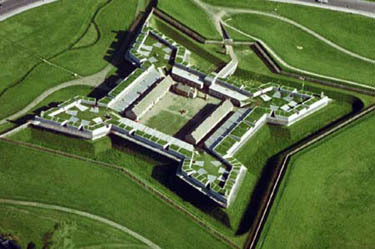
Fort Stanwix — United States of America castle

Fort Stanwix

Rome, United States of America

Fort Stanwix is a historically significant 18th-century bastioned fortress located in present-day Rome, New York. Originally constructed beginning on August 26, 1758, under the supervision of British General John Stanwix, the fort was designed as a defensive stronghold during the French and Indian War. Its primary purpose was to guard the strategic portage route known as the Oneida Carry, a vital link between the watersheds of Lake Ontario and the Hudson River. The fort's construction was completed around 1762, embodying the bastioned fortress style typical of the post-Renaissance military architecture, featuring angular bastions designed to provide overlapping fields of fire and resist artillery attacks. The strategic importance of Fort Stanwix in colonial America Fort Stanwix occupied a crucial position in the contested frontier between British and French colonial interests. The Oneida Carry was a key overland passage used for moving troops, supplies, and trade goods, making control of the fort essential for dominance over the interior waterways. The fort's location allowed the British to secure this portage and thereby maintain communication and supply lines between their northern and southern colonial holdings. Architectural features and military design The fort was constructed following the principles of bastioned fortification, characterized by its star-shaped layout with projecting bastions at the corners. This design allowed defenders to cover all approaches with cannon and musket fire, eliminating blind spots. The walls were built using earthworks reinforced with timber, which absorbed artillery impacts more effectively than stone. Inside, the fort contained barracks, a magazine, officers' quarters, and storage facilities arranged around a central parade ground. Defensive ditches and palisades further enhanced its protection. Role during the American Revolutionary War After the British abandoned Fort Stanwix early in the American Revolutionary War, it was captured and rebuilt by American forces. The fort became a focal point during the 1777 siege, when a British army advancing from Canada attempted to seize it as part of their campaign to control the Hudson River corridor. The fort's defenders successfully repelled the siege, which was lifted after reinforcements arrived. This American victory at Fort Stanwix contributed to the failure of the British Saratoga campaign, a turning point in the war that encouraged French support for the American cause. The 1777 siege and its military significance The siege, lasting from August 2 to August 22, 1777, involved British forces under the command of Barry St. Leger, who sought to advance eastward from Lake Ontario. The fort's defenders, including militia and Continental Army troops, utilized the fort's bastioned defenses effectively. The arrival of American relief forces under Nicholas Herkimer and the threat of a larger battle forced the British to abandon the siege, preserving American control of this critical position. Treaties and diplomatic importance Fort Stanwix was also the site of two significant treaties that shaped relations between European settlers and Native American tribes. The 1768 Treaty of Fort Stanwix involved negotiations between British representatives and the Iroquois Confederacy, adjusting territorial boundaries to reduce frontier conflicts. Later, the 1784 Treaty of Fort Stanwix was signed between the United States government and Native American tribes, redefining land ownership and sovereignty following the Revolutionary War. Preservation and the Fort Stanwix National Monument The original fort was eventually dismantled, but the site has been preserved and reconstructed as the Fort Stanwix National Monument under the care of the National Park Service. The reconstructed fort faithfully represents the original 18th-century bastioned design and serves as an educational resource on colonial military history. The monument includes three walking trails, one of which traces the historic Oneida Carry route, offering visitors insight into the terrain and strategic considerations of the period. Marinus Willett Collections Management and Education Center Adjacent to the fort, the Marinus Willett Collections Management and Education Center houses an extensive collection of approximately 485,000 artifacts and documents related to Fort Stanwix and the broader Mohawk Valley region. The center features exhibits detailing the fort's history, its role in colonial and revolutionary conflicts, and the cultural heritage of the area. It also functions as a regional tourism hub, providing visitors with interpretive materials and educational programming. Visiting Fort Stanwix today Visitors to Fort Stanwix National Monument can explore the reconstructed fortifications, learn about the military engineering of the post-Renaissance bastioned fortress style, and gain an understanding of the fort's pivotal role in American history. The site offers a tangible connection to the colonial era and the Revolutionary War, making it a valuable destination for history enthusiasts and scholars alike.

Post-Renaissance (17th–18th c.)
Details