Fort Monroe
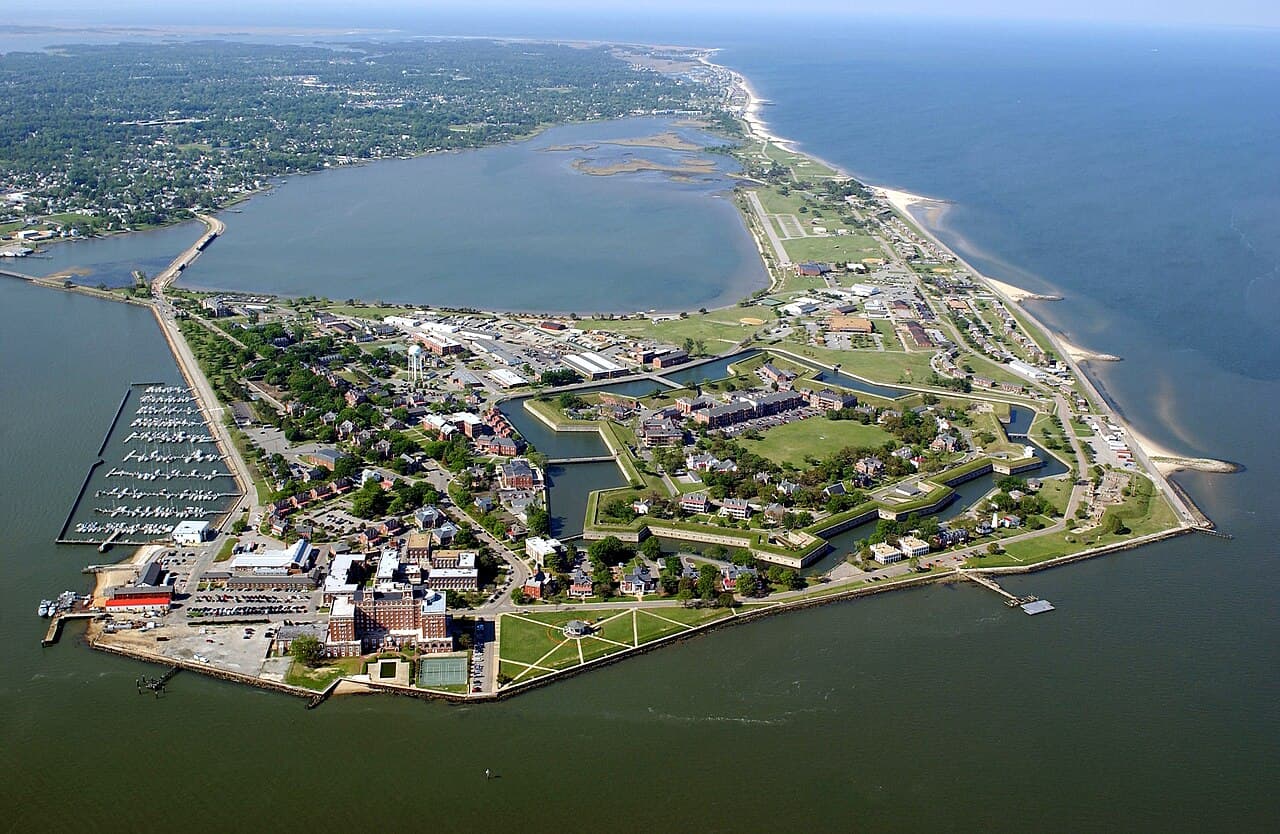
Fort Monroe, located at Old Point Comfort in Hampton, Virginia, is the largest bastioned fortress ever built in the United States, covering an extensive area surrounded by a moat. This imposing six-sided fortification was completed in 1834 as part of the United States' Third System of coastal defenses, designed to protect the vital waterways of the Chesapeake Bay and the entrance to Hampton Roads. Fort Monroe's strategic position at the confluence of the Elizabeth, Nansemond, and James Rivers made it a critical military asset for controlling naval access to important cities such as Washington, D.C. and Baltimore, as well as key shipyards and naval bases in the region.
Early strategic importance and colonial fortifications
The site of Fort Monroe was first identified for its defensive potential during the early 1600s by Captain Christopher Newport and other explorers of the Virginia Colony. Initial fortifications at Old Point Comfort began as early as 1609 with the construction of a wooden stockade known as Fort Algernourne. Over the next two centuries, a series of smaller forts were built on the site to defend the entrance to the bay. These early structures laid the groundwork for the more substantial stone fortification that would become Fort Monroe.
Design and construction of the bastioned fortress
Fort Monroe was designed as a bastioned fort with six angled bastions projecting from its walls, a classic feature of fortification architecture intended to provide overlapping fields of fire and eliminate blind spots. The fort's massive stone walls are surrounded by a deep moat, enhancing its defensive capabilities against both naval and land attacks. The construction was part of the Third System, a nationwide effort by the United States government to build durable, permanent coastal defenses following vulnerabilities exposed during the War of 1812.
The principal fort was named in honor of James Monroe, the fifth President of the United States, who was instrumental in advocating for stronger coastal defenses during his presidency. Across the channel, Fort Wool was constructed on an artificial island to complement Fort Monroe's defense of the navigation channel.
Role during the american civil war
Despite Virginia's secession and joining the Confederate States of America, Fort Monroe remained under Union control throughout the American Civil War (1861–1865). This made it a crucial Union stronghold in the South. In 1862, Union General George B. McClellan used Fort Monroe as the landing point for the Army of the Potomac during the Peninsula Campaign, an important military operation aimed at capturing the Confederate capital of Richmond.
Fort Monroe also became historically significant as a place of early freedom for enslaved African Americans. Under the Union's "contraband" policy, escaped slaves who reached the fort were declared contraband of war and granted refuge, marking the fort as a symbol of emancipation and a beacon of hope during the conflict.
Following the war, the fort served as a prison for the former Confederate president, Jefferson Davis. He was held for two years in a casemated cell within the fort's walls, now preserved as part of the Casemate Museum, which offers visitors a glimpse into this turbulent period of American history.
Twentieth-century military developments and training
At the turn of the 20th century, Fort Monroe underwent significant upgrades under the Endicott program, which modernized coastal defenses across the United States. Numerous gun batteries were added to Fort Monroe and its surrounding areas, making it the largest fort and headquarters of the Harbor Defenses of Chesapeake Bay.
Fort Monroe also became a center for military education, hosting the Coast Artillery School from 1907 to 1946, where artillery tactics and coastal defense strategies were taught. Later, it served as the headquarters for the Continental Army Command (CONARC) from 1955 to 1973, overseeing all active Army units in the continental United States. Following the division of CONARC, the United States Army Training and Doctrine Command (TRADOC) was headquartered at Fort Monroe until 2011.
Deactivation and preservation as a national monument
Fort Monroe was officially deactivated as an active military installation on September 15, 2011, with many of its functions transferred to nearby Fort Eustis. Since then, various plans for the site's reuse have been developed by the local community of Hampton.
On November 1, 2011, President Barack Obama designated portions of Fort Monroe as a national monument under the Antiquities Act of 1906. This designation marked the first time President Obama exercised this authority to protect a site of significant historical and cultural importance. Today, Fort Monroe is managed through a partnership involving the Fort Monroe Authority, the National Park Service, and the city of Hampton, ensuring its preservation and public accessibility.
Architectural features and visitor experience
Visitors to Fort Monroe can explore its extensive stone walls, bastions, and moat, as well as the Casemate Museum, which houses exhibits on the fort's military history and Jefferson Davis's imprisonment. The fort's layout exemplifies classic bastioned fort design, with angled walls allowing for comprehensive defensive coverage. The site also includes remnants of the Endicott-era gun batteries and other military structures from the 19th and 20th centuries.
The fort's location offers scenic views of the Chesapeake Bay and the surrounding waterways, enhancing its appeal as both a historical site and a destination for cultural tourism.
Frequently asked questions (FAQ)
- How do I visit Fort Monroe and what are the opening hours?
- Fort Monroe is open to the public year-round, with visitor centers and museums typically operating from morning until late afternoon. It is advisable to check the official Fort Monroe National Monument website for current hours and any special events.
- What is the historical significance of Fort Monroe during the Civil War?
- Fort Monroe remained under Union control throughout the Civil War, serving as a critical base for Union operations and a refuge for escaped slaves under the contraband policy, symbolizing early emancipation efforts.
- Can I tour the Casemate Museum at Fort Monroe?
- Yes, the Casemate Museum is open to visitors and offers exhibits on the fort's military history, including the imprisonment of Confederate President Jefferson Davis. Guided tours are often available to enhance the experience.
- Is Fort Monroe accessible for visitors with disabilities?
- Fort Monroe provides accessible pathways and facilities to accommodate visitors with disabilities, but some historic areas may have limited access due to preservation constraints. Visitors are encouraged to contact the site in advance for specific accessibility information.
- What are the best times of year to visit Fort Monroe?
- Spring and fall offer pleasant weather and fewer crowds, making these seasons ideal for exploring Fort Monroe's outdoor areas and enjoying views of the Chesapeake Bay.
Photo gallery

Public domain
Information
Current owner
Fort Monroe Authority, National Park Service, City of Hampton
Loading map...
Visitor reviews
No reviews yet. Been here? Write the first review and help other travelers!
Write the first reviewVisited this castle? Share your experience
Your review helps other travelers and adds first-hand knowledge to our encyclopedia.



