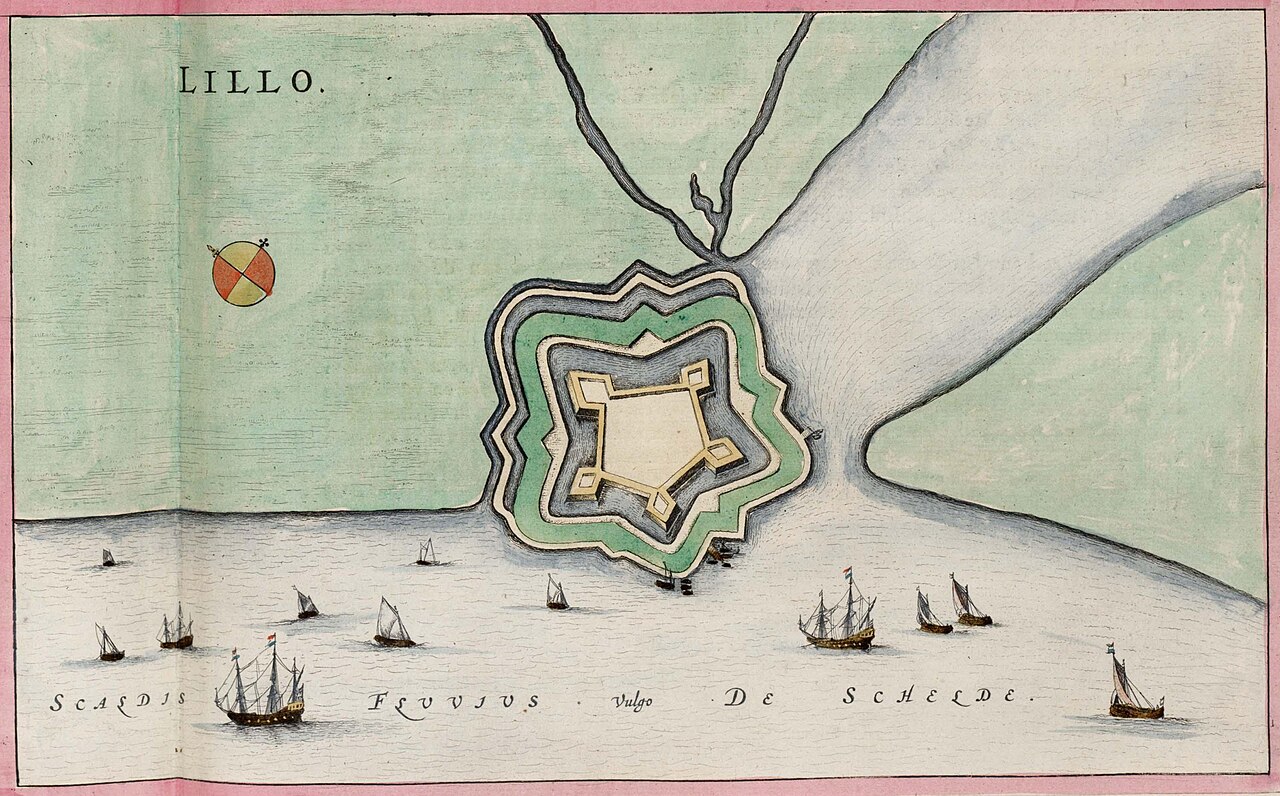
Fort Moerschans
Fort Moerschans is a historic starfort located northeast of the fortified town of Hulst in the province of Zeeland, Netherlands. This fortification played a strategic role during the turbulent times of the Eighty Years' War and subsequent conflicts in the Low Countries. Its evolution reflects the military engineering advancements from the late 16th century through the early 18th century.
The strategic context and early history
In 1584, during the height of the Eighty Years' War, the town of Hulst fell under Spanish control. To protect the important city of Antwerp from Dutch attacks, the Dutch States Party flooded the surrounding lands, creating a watery barrier that extended several kilometers near Hulst. In response, the Spanish constructed Fort Zandberg east of Hulst in 1586 to prevent Dutch forces from landing close to the town. Alongside it, a second fort named Fort de Grote Rape was built between Fort Zandberg and Hulst, forming a defensive line.
In 1591, the Dutch forces under Maurits, Prince of Orange, recaptured Hulst and the two forts. Recognizing the importance of securing this strategic area, Maurits ordered the construction of Fort Moerschans between the town and Fort de Grote Rape. This new fortification, initially featuring a rectangular layout, was integrated with the other forts and the town by a defensive line dyke with a covered way, collectively known as the "Line of Communication East of Hulst".
Military engagements and damage
The Spanish regained control of Hulst and its forts in 1596, but the Dutch recaptured the area in 1645. The fortifications, including Fort Moerschans, endured various challenges, including natural disasters such as the Flood of 1682, which caused significant damage to Fort Moerschans. Despite these setbacks, the fort remained a key military site.
18th-century modernization by Menno van Coehoorn
During the War of the Spanish Succession in the early 18th century, Fort Moerschans underwent significant strengthening under the direction of the renowned Dutch military engineer Menno van Coehoorn. Van Coehoorn enhanced the fort's defenses by adding bastions at each of its four corners, transforming it into a classic starfort layout. This design improved the fort's ability to withstand artillery attacks and provided overlapping fields of fire, a hallmark of early modern fortification techniques.
Following these upgrades, the forts and the defensive line gradually lost their military importance. By 1816, Fort Moerschans and the surrounding fortifications were officially abandoned. However, during the Belgian Revolution of 1830, Dutch troops briefly reoccupied the forts as a precautionary measure.
Current state and visitor experience
Today, Fort Moerschans is freely accessible to the public and forms part of a public park and a forest island. The site features earth ramparts west of the line dyke that have been excavated, allowing visitors to appreciate the fort's original star-shaped layout. While no buildings remain standing, the well-preserved earthworks provide a tangible connection to the area's military past.
The natural setting offers a peaceful environment for visitors interested in history, military architecture, and nature. Informational signage helps contextualize the fort's role in the region's defense system, making Fort Moerschans a valuable heritage site in Zeeland.
Frequently asked questions (FAQ)
- How do I visit Fort Moerschans?
- Fort Moerschans is freely accessible to the public year-round as part of a public park and forest area. Visitors can explore the earthworks and enjoy the natural surroundings without an entrance fee.
- What is the historical significance of Fort Moerschans?
- Fort Moerschans was a key fortification in the defense of Hulst during the Eighty Years' War and later conflicts. It was modernized in the 18th century by Menno van Coehoorn, reflecting advances in military engineering.
- When was Fort Moerschans built and by whom?
- The fort was originally constructed in 1591 under the orders of Maurits, Prince of Orange, and later strengthened in the early 18th century by military engineer Menno van Coehoorn.
- Are there any buildings remaining at Fort Moerschans?
- No buildings remain at Fort Moerschans today. The site consists mainly of excavated earth ramparts and natural parkland.
- Why is Fort Moerschans shaped like a star?
- The star shape was introduced during the early 18th century modernization by Menno van Coehoorn to improve defensive capabilities against artillery, allowing better coverage of the fort's perimeter.
Information
Architect
Menno van Coehoorn
Address
Liniedijk, Netherlands
Loading map...
Visitor reviews
No reviews yet. Been here? Write the first review and help other travelers!
Write the first reviewVisited this castle? Share your experience
Your review helps other travelers and adds first-hand knowledge to our encyclopedia.