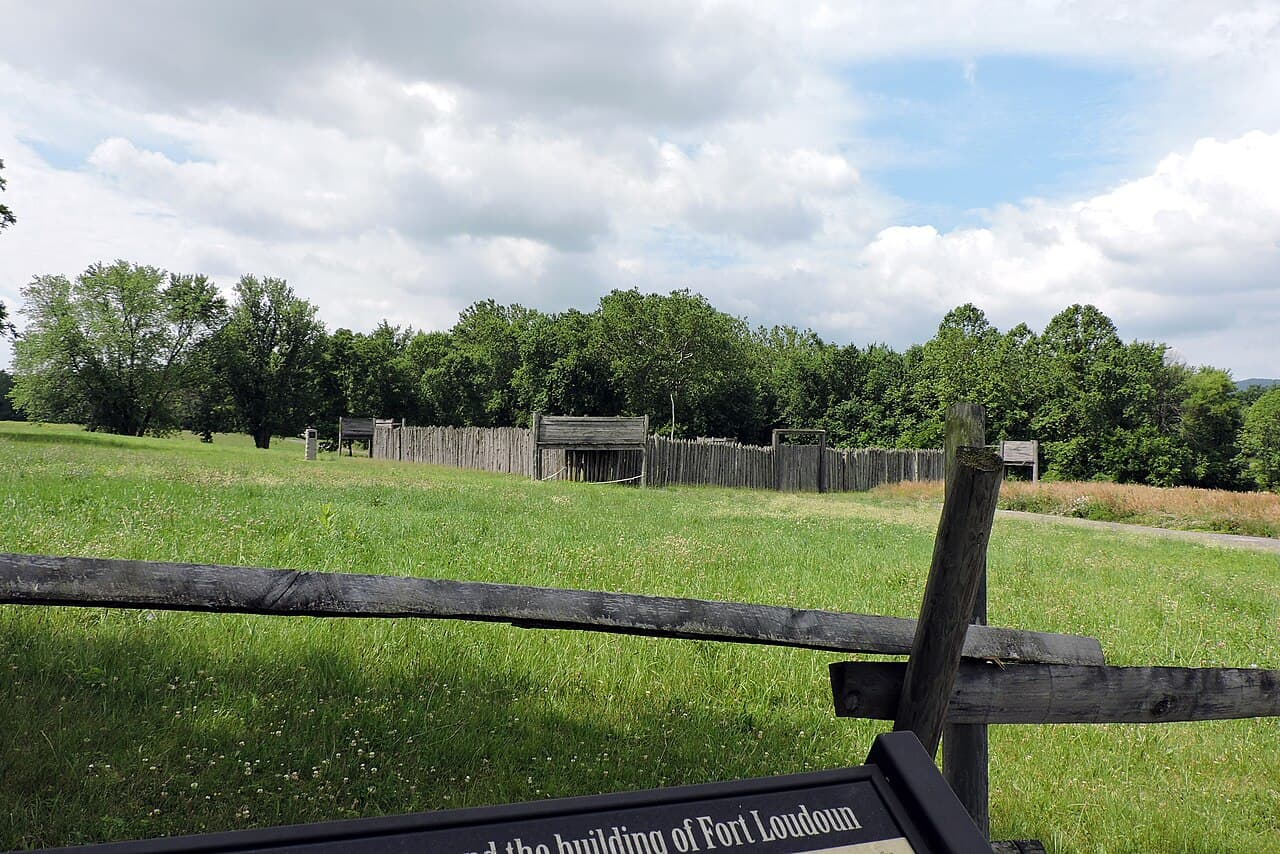
Fort Loudoun
Fort Loudoun (also spelled Fort Loudon in reference to the modern town) was a significant bastioned fortress constructed in colonial Pennsylvania during the 18th century. Named after John Campbell, 4th Earl of Loudoun, the fort played a crucial role in the military campaigns of the mid-1700s, particularly during the French and Indian War.
The strategic role of Fort Loudoun in colonial America
Built in 1756 by the Second Battalion of the Pennsylvania Regiment under the command of Colonel John Armstrong, Fort Loudoun was established as a defensive post on the Forbes Road. This road was a vital supply and troop route during the Forbes expedition, which aimed to capture the French-held Fort Duquesne at the strategic confluence of the Allegheny and Monongahela Rivers, present-day Pittsburgh.
The fort's location allowed it to serve as a staging ground and logistical base for British colonial forces. Its bastioned design provided enhanced defensive capabilities against both French forces and their Native American allies, reflecting military architectural trends of the post-Renaissance period where angled bastions allowed for better coverage of defensive fire.
Architectural features and military design
Fort Loudoun was constructed following the principles of a bastioned fortress, a style that emerged in Europe during the Renaissance and was adapted in colonial America for frontier defense. The fort featured angular bastions at its corners, designed to eliminate blind spots and allow defenders to cover the walls with intersecting fields of fire.
The fort's walls were likely made of earthworks reinforced with timber palisades, a common construction method for frontier forts in the American colonies. This combination provided both resilience against artillery and expedient construction using available materials. Inside the fort, there would have been barracks, storage buildings, and defensive ditches or moats to slow attackers.
Military campaigns and historical significance
Fort Loudoun remained occupied through several key conflicts. After the successful Forbes expedition drove the French from Fort Duquesne in 1758, the fort continued to serve as a military base during Pontiac's War (1763-1766), a widespread Native American uprising against British postwar policies and expansion.
In 1764, the fort was a base for Colonel Henry Bouquet's campaign, which was aimed at suppressing Native American resistance in the Ohio Country. Bouquet's forces used Fort Loudoun as a supply and coordination point for their operations.
During the 1765 Black Boys Rebellion, Fort Loudoun became a flashpoint when local settlers, angered by British policies that restricted their access to firearms and supplies intended for Native Americans, attacked the fort. The garrison was forced to retreat to Fort Bedford, and Fort Loudoun was subsequently abandoned.
Legacy and current status
Today, Fort Loudoun no longer stands as a preserved structure, but it remains an important historical site reflecting colonial military strategy and frontier defense. The fort's role in the French and Indian War and subsequent conflicts illustrates the complex interactions between European powers, Native American tribes, and colonial settlers in 18th-century North America.
Archaeological investigations and historical records continue to shed light on the fort's layout, construction, and operational history, contributing to a greater understanding of colonial military architecture and frontier warfare.
Photo gallery

Information
Loading map...
Visitor reviews
No reviews yet. Been here? Write the first review and help other travelers!
Write the first reviewVisited this castle? Share your experience
Your review helps other travelers and adds first-hand knowledge to our encyclopedia.



