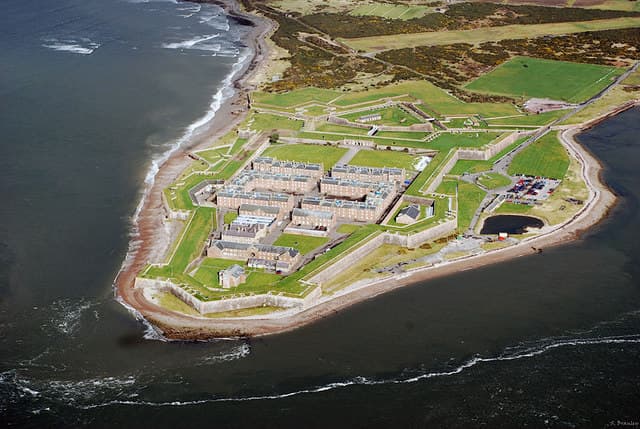
Fort George (Highland)
Fort George is a prominent 18th-century bastioned fortress located near Ardersier, to the north-east of Inverness in the Highland council area of Scotland. Constructed in the aftermath of the Jacobite rising of 1745, it was designed to exert military control over the Scottish Highlands and to prevent further Jacobite uprisings. This imposing fortress replaced an earlier Fort George in Inverness, which had been built after the 1715 Jacobite rising but was deemed inadequate for the scale of military threats in the region.
Strategic importance and historical context
The construction of Fort George was part of a wider British government effort to consolidate control over the Highlands following decades of unrest. The Jacobite risings, particularly the 1745 rebellion led by Bonnie Prince Charlie, exposed the need for a more formidable military presence in Scotland. Fort George was intended to serve as a secure base for government troops, projecting power and suppressing any future rebellions.
Work on the fortress began in 1748 and continued into the 1760s, reflecting the scale and ambition of the project. The site was chosen for its strategic location at the mouth of the Moray Firth, providing control over sea access as well as land routes into the Highlands. Its proximity to Inverness, the traditional capital of the Highlands, further enhanced its military significance.
Architectural design and features
Fort George is a quintessential example of a bastioned fortress, designed according to the principles of star fort architecture that emerged in the post-Renaissance period. The fortress features a star-shaped layout with angled bastions projecting outward to provide overlapping fields of fire, minimizing blind spots and maximizing defensive coverage. This design was influenced by the work of military engineers such as Vauban and was intended to withstand artillery sieges.
The fortress is surrounded by a deep moat and thick curtain walls constructed from robust stone. The walls are punctuated by bastions and demi-bastions equipped with gun emplacements. Inside, the complex includes barracks, officers' quarters, magazines, and various military facilities arranged around a large parade ground.
One of the notable architectural elements is the main gatehouse, which is heavily fortified and features a drawbridge and multiple layers of defense. The interior buildings are predominantly built in a utilitarian style, reflecting their military function, but also incorporate elements of 18th-century military architecture such as symmetrical layouts and durable materials.
Preservation and current use
Remarkably, Fort George has never been attacked in its history, which speaks to its deterrent effect and strategic strength. The fortress remains in excellent condition, retaining much of its original fabric and layout. It is one of the best-preserved examples of an 18th-century bastioned fortress in the United Kingdom.
Today, Fort George serves a dual role as both a military garrison and a heritage site open to the public. Visitors can explore the extensive ramparts, bastions, and interior buildings. The site includes a museum with exhibits and facsimiles that illustrate the fort's military history and its role in the Highlands over the centuries. Guided tours provide insights into the fortress's construction, design, and operational history.
Significance in Scottish military history
Fort George symbolizes the British government's efforts to impose order in the Highlands during a turbulent period of Scottish history. Its construction marked a shift towards modern military engineering and the use of permanent, heavily fortified structures to control restive regions. The fortress played a key role in maintaining peace and stability in the Highlands through the 18th and 19th centuries.
The site's continued use by the British Army underlines its enduring strategic value. While its military importance has diminished with changes in warfare, Fort George remains a living military installation, connecting past and present military traditions.
Visitor experience and accessibility
Fort George is accessible to visitors year-round, offering a comprehensive experience of military architecture and Highland history. The extensive grounds and fortifications provide ample space for exploration. Educational programs and events are often held on site, enhancing public engagement with Scotland's military heritage.
The fortress's location near Inverness makes it a popular destination for tourists interested in Scottish history, military architecture, and the Jacobite era. Facilities include a visitor center, café, and gift shop, making it a well-equipped heritage attraction.
Frequently asked questions (FAQ)
- How do I get to Fort George from Inverness?
- Fort George is located about 10 miles northeast of Inverness. Visitors can reach it by car via the A96 and A9 roads or by local bus services running from Inverness city center.
- What is the historical significance of Fort George?
- Fort George was built after the 1745 Jacobite rising to control the Scottish Highlands and prevent further rebellions. It remains one of the best-preserved 18th-century bastioned fortresses in the UK.
- Can I explore the interior of Fort George?
- Yes, visitors can explore many parts of the fortress including the ramparts, bastions, and interior buildings. There is also a museum with exhibits on the fort's history.
- Is Fort George still used by the military?
- Yes, Fort George remains an active British Army barracks while also serving as a public heritage site.
- When is the best time to visit Fort George?
- Fort George is open daily from 10:00 to 16:30. Visiting during spring and summer offers the best weather for exploring the extensive grounds.
Photo gallery

Information
Opening hours
10:00-16:30, daily
Ticket prices
£8 adult, £4 child, concessions available
Current owner
British Army
Loading map...
Visitor reviews
No reviews yet. Been here? Write the first review and help other travelers!
Write the first reviewVisited this castle? Share your experience
Your review helps other travelers and adds first-hand knowledge to our encyclopedia.


