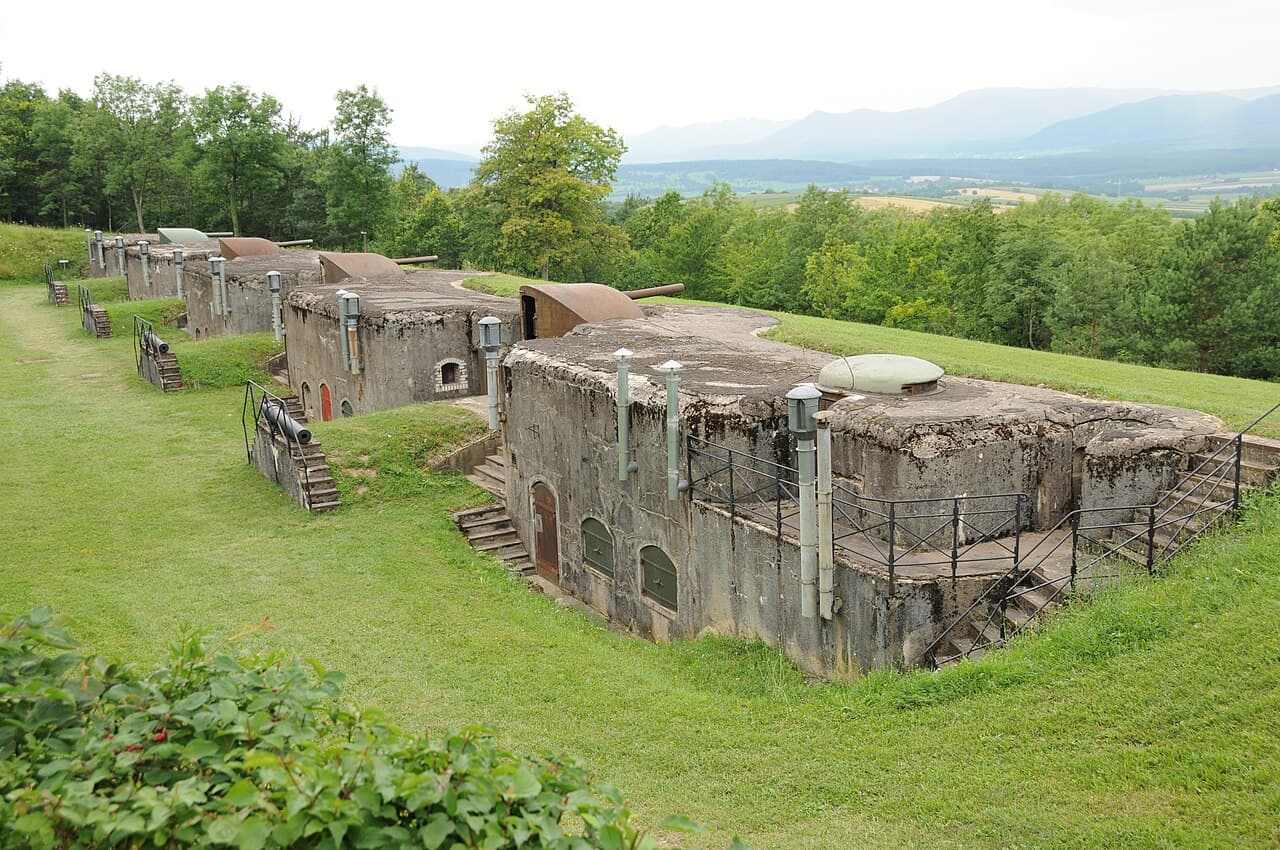
Fort de Mutzig
The Fort de Mutzig, also known historically as Feste Kaiser Wilhelm II, stands as a monumental example of late 19th-century military architecture near the town of Mutzig in the Bas-Rhin department of France. Constructed by the German Empire in 1893, it was the first major fortification built after the advent of high explosives, marking a significant evolution in fortress design. This fortification was part of a strategic network designed to defend the vital city of Strasbourg and to secure the newly annexed territories of Alsace-Lorraine following the Franco-Prussian War.
Unlike traditional masonry fortresses, which had become vulnerable to powerful artillery shells, Fort de Mutzig was designed as a bastioned fortress incorporating reinforced concrete and armored steel elements. This innovative approach allowed it to withstand the destructive power of modern artillery and high explosives, setting a precedent for future fortress construction across Europe.
Strategic importance and historical context
The fort was constructed during a period of intense military rivalry and technological advancement. After the Franco-Prussian War (1870-1871), the German Empire annexed Alsace-Lorraine, creating a new frontier with France. To secure this border and protect the key city of Strasbourg, Germany embarked on an ambitious program of fixed fortifications. Fort de Mutzig was the first of these, representing a shift in military engineering to counter the threat posed by modern artillery.
The fort's location near Mutzig was strategically chosen to control access routes and provide a forward defensive position. Its construction symbolized the German commitment to fortifying their western frontier and deterring French attempts to reclaim lost territory.
Architectural features and innovations
Design and layout
Fort de Mutzig is a sprawling complex featuring a polygonal bastioned layout typical of late 19th-century fortifications but enhanced with new materials and technologies. The fort's walls are made of thick reinforced concrete, a response to the devastating effects of high-explosive shells on older masonry forts.
The fortress includes multiple defensive layers, such as deep ditches, caponiers (covered firing positions projecting into the ditch), and armored gun turrets. These elements provided overlapping fields of fire and enhanced protection against infantry and artillery assaults.
Armament and facilities
Originally, Fort de Mutzig was equipped with a variety of artillery pieces, including 105 mm guns and smaller caliber weapons, mounted in armored turrets and casemates. The fort's design allowed for rapid firing and efficient ammunition supply, reflecting advances in military logistics and artillery tactics of the period.
Besides its military functions, the fort contained extensive living quarters, storage rooms, and command centers, making it a self-sufficient military installation capable of withstanding prolonged sieges.
Operational history
Despite its formidable design, Fort de Mutzig saw limited combat action. During World War I, the fortress was part of the German defensive system but did not experience significant fighting. In 1917, the Germans removed about half of the fort's 105 mm guns for use elsewhere, reflecting changing military priorities.
Following the Armistice of 1918, the fort was handed over intact to the French Army, who designated it as a rear defense post for the Rhine frontier. During World War II, the fortress was briefly occupied by German forces but was evacuated in June 1940. Subsequently, the fort was mistakenly bombed by the German Luftwaffe, resulting in casualties among German troops stationed there.
In November 1944, the US Third Infantry Division captured the lightly defended fortress after a short siege, marking the end of its military significance. Post-war, the French Army used the site for training exercises until the 1960s before it was abandoned but remained under military ownership.
Preservation and current status
Fort de Mutzig is notable for being one of the best-preserved pre-World War I fortifications in Europe. Its preservation owes much to the fact that it never underwent major combat damage, retaining almost all of its original equipment and structural elements.
Since 1984, a joint German-French group has been engaged in restoring the fortress, emphasizing historical authenticity and conservation. In 1995, a museum was opened on site, allowing visitors to explore restored areas and learn about the fort's history and technological innovations.
The fortress also serves as a venue for historical reenactments and educational programs, enhancing public engagement with this significant military heritage site. In 2014, the fort's original name, Kaiser Wilhelm II fortress, was officially reinstated, honoring its German origins and historical context.
Architectural significance and legacy
Fort de Mutzig represents a transitional moment in fortress design, bridging the gap between traditional masonry castles and modern concrete fortifications. Its use of reinforced concrete, armored turrets, and integrated defensive systems influenced subsequent military architecture and reflects the rapid technological changes of the late 19th and early 20th centuries.
The fortress exemplifies the strategic military thinking of the German Empire during a period of intense European rivalry and serves as a tangible reminder of the geopolitical tensions that shaped the region's history.
Frequently asked questions (FAQ)
- What are the visiting hours for Fort de Mutzig?
- Fort de Mutzig is typically open to visitors from 10:00 to 17:00 daily, but it is advisable to check the official website for seasonal variations and special event schedules.
- Is Fort de Mutzig accessible for people with limited mobility?
- The fortress features uneven terrain and historic structures, which may pose challenges for visitors with limited mobility. Some areas have been adapted for accessibility, but assistance may be required for full exploration.
- What is the historical significance of Fort de Mutzig?
- Fort de Mutzig was the first modern bastioned fortress built after the invention of high explosives, marking a key development in military architecture and the defense of Strasbourg.
- Can I join guided tours at Fort de Mutzig?
- Guided tours are available at Fort de Mutzig and provide detailed insights into its architecture, history, and military role. Booking in advance is recommended, especially during peak tourist seasons.
- Are there any museums or exhibitions at Fort de Mutzig?
- Yes, the fortress houses a museum opened in 1995 that showcases restored areas and exhibits related to its military history and technological innovations.
Photo gallery

Information
Sources & official resources
Verify the information above using these authoritative references.
Loading map...
Visitor reviews
No reviews yet. Been here? Write the first review and help other travelers!
Write the first reviewVisited this castle? Share your experience
Your review helps other travelers and adds first-hand knowledge to our encyclopedia.



