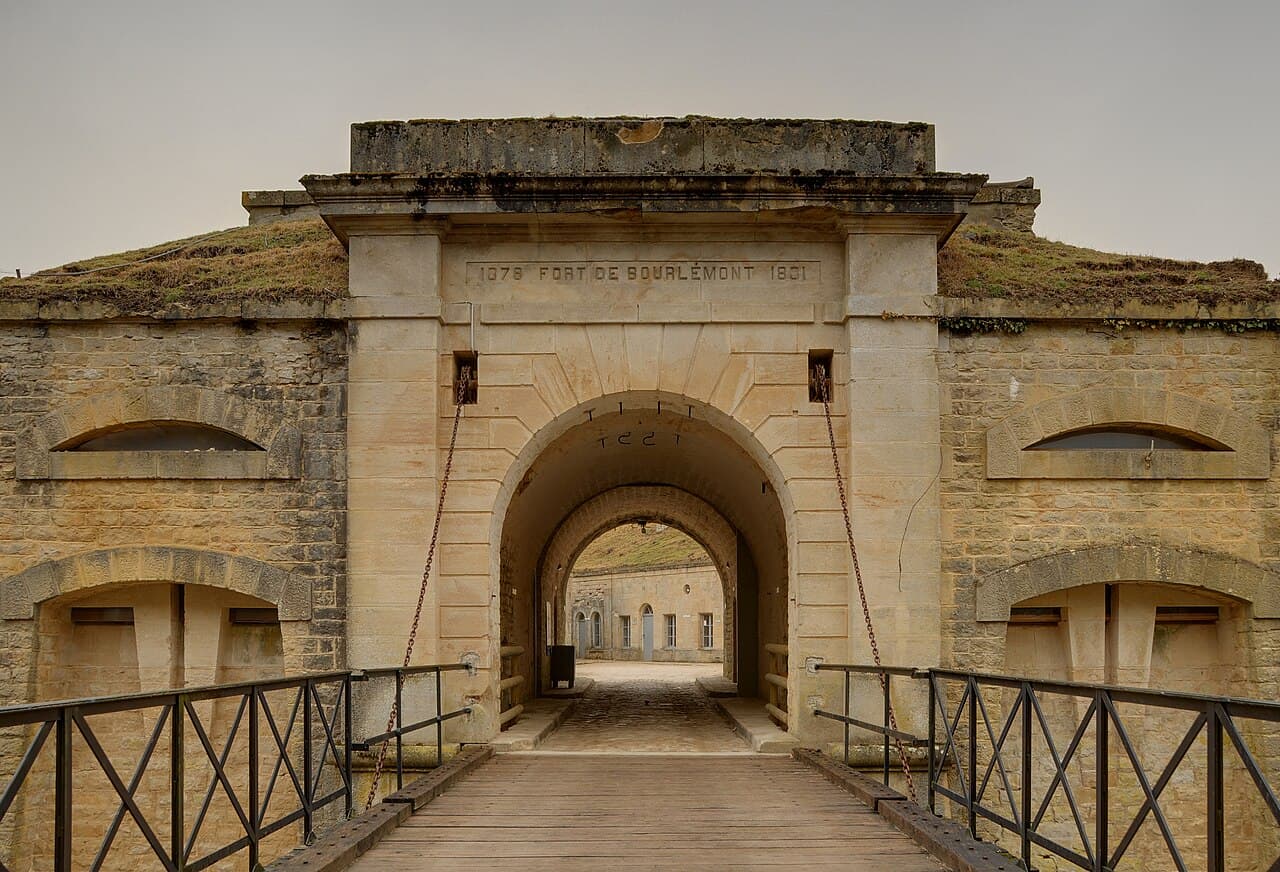
Fort de Bourlémont
Fort de Bourlémont, also known as Fort Choiseul, is a significant example of 19th-century military architecture located near the town of Mont-lès-Neufchâteau, approximately 3 kilometres west of Neufchâteau in northeastern France. Constructed between 1878 and 1881, this fort was an integral part of the Séré de Rivières system of fortifications, a network of defenses developed in response to the rapid advancements in artillery technology during the late 19th century.
The fort was strategically positioned to protect the Charmes Gap (Trouée de Charmes), a key corridor through which invading forces might advance. This location was critical for the defense of the French interior, as the gap provided a natural route for armies moving from the east. The fort's design reflects the military engineering principles of its time, emphasizing strong, angled bastions capable of withstanding artillery bombardment.
Historical context and strategic importance
Following the Franco-Prussian War of 1870-1871, France undertook a comprehensive modernization of its defensive structures. The Séré de Rivières system, named after General Raymond Adolphe Séré de Rivières, aimed to create a network of forts that could delay or repel enemy advances. Fort de Bourlémont was one of several fortifications constructed to secure vulnerable points along France's eastern borders.
This fort's role was to control the Charmes Gap, a natural passage between the Vosges Mountains and the plains of Lorraine. Its presence was intended to prevent enemy forces from exploiting this route to penetrate deeper into French territory. The fort's location near Neufchâteau made it a critical element in the regional defensive strategy.
Architectural features and design
Fort de Bourlémont is classified as a bastioned fortress, a style characterized by angular bastions projecting from the main walls, designed to eliminate blind spots and provide overlapping fields of fire. This design was particularly effective against the artillery of the era, allowing defenders to cover all approaches with cannon fire.
The fort's layout includes a series of thick masonry walls and earthworks, which absorb and deflect incoming artillery shells. The bastions are connected by curtain walls, creating a polygonal shape that maximizes defensive coverage. Inside, the fort contained barracks, ammunition magazines, and command posts, all protected by the robust outer defenses.
One notable feature of Fort de Bourlémont is its use of concrete and reinforced masonry, materials that were becoming more common in military construction during the late 19th century. These materials enhanced the fort's ability to withstand bombardment compared to earlier stone-only structures.
Defensive structures and armament
The fort was equipped with artillery placements positioned on the bastions and within protected casemates. These guns were intended to cover the approaches to the fort and engage enemy forces at a distance. The design also included features such as dry moats and caponiers—covered firing positions projecting into the ditch—to defend against infantry assaults.
Defensive ditches surrounded the fort, creating additional obstacles for attackers. The entrance was heavily fortified with gates and defensive works to prevent easy access. The overall design reflects a transition from medieval-style fortifications to modern, artillery-resistant defenses.
Later history and preservation
After its construction, Fort de Bourlémont remained an important military installation through the late 19th and early 20th centuries. However, advances in artillery and military technology eventually rendered such forts less effective. During World War I and World War II, the fort's strategic role diminished, although it may have served as a defensive position or observation post.
Today, Fort de Bourlémont stands as a well-preserved example of the post-Franco-Prussian War French military architecture. Its preservation allows visitors and historians to study the evolution of fortification design in response to changing warfare technologies.
Current status and visitor information
The fort is located in the region of Grand Est in France, near the town of Mont-lès-Neufchâteau. While not as widely known as other French fortifications, it attracts interest from military history enthusiasts and those interested in 19th-century architecture.
Access to the fort may be limited depending on ownership and preservation efforts. Visitors are advised to check local resources for opening hours and guided tour availability. The site offers a glimpse into the era of bastioned fortresses and the defensive strategies employed by France in the late 1800s.
Frequently asked questions (FAQ)
- What is the historical significance of Fort de Bourlémont?
- Fort de Bourlémont, built in the 19th century, is a key example of military architecture designed to defend against potential invasions. Its strategic location allowed it to play an important role in the defense of the region during various conflicts. Today, it serves as a testimony to France's military history and engineering prowess.
- When was Fort de Bourlémont constructed?
- Construction of Fort de Bourlémont began in 1874 and was completed in 1879. It was part of a series of fortifications intended to modernize France's military defenses. The fort reflects the advancements in military architecture of the time.
- Can I visit Fort de Bourlémont?
- Yes, Fort de Bourlémont is open to visitors who wish to explore its rich history and impressive architecture. Guided tours are often available, providing insights into the fort's construction and historical significance. It’s advisable to check the official website for current visiting arrangements.
- What are the opening hours for Fort de Bourlémont?
- The opening hours for Fort de Bourlémont may vary depending on the season and special events. Typically, the fort is open to visitors from late spring to early autumn, with specific hours listed on their official site. It's best to confirm before planning your visit.
- Is it possible to access Fort de Bourlémont for individuals with disabilities?
- Accessibility at Fort de Bourlémont may be limited due to the fort's historical structure and terrain. However, efforts are made to accommodate visitors with mobility challenges; it's recommended to contact the management in advance to discuss specific needs and available facilities.
- When is the best time to visit Fort de Bourlémont?
- The best time to visit Fort de Bourlémont is during the spring and early autumn when the weather is generally pleasant for outdoor exploration. These seasons often feature fewer crowds, allowing for a more enjoyable experience. Check local events that may enhance your visit during these times.
- What are the ticket prices for visiting Fort de Bourlémont?
- Ticket prices for Fort de Bourlémont are generally affordable, with discounts available for students, seniors, and groups. Children under a certain age may enter for free. It’s advisable to check the official website for the most up-to-date pricing information and any special offers.
- Are there any nearby attractions to visit along with Fort de Bourlémont?
- Yes, there are several attractions near Fort de Bourlémont, including the picturesque town of Neufchâteau and its historic sites. Visitors can also explore nearby natural parks and walking trails, making it a great day trip destination. Combining visits to these sites can enhance your experience of the region.
Photo gallery

Information
Loading map...
Visitor reviews
No reviews yet. Been here? Write the first review and help other travelers!
Write the first reviewVisited this castle? Share your experience
Your review helps other travelers and adds first-hand knowledge to our encyclopedia.



