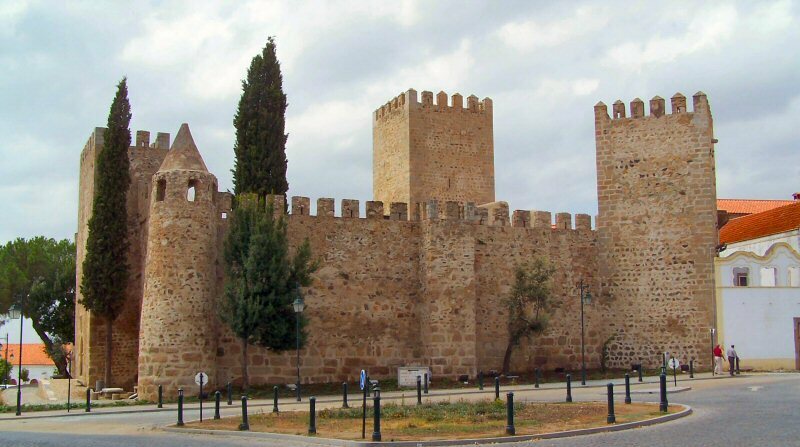
Flor da Rosa Monastery
Flor da Rosa Monastery, known locally as Mosteiro de Flor da Rosa, is a remarkable example of a fortified Gothic monastery situated in the village of Flor da Rosa in the Alto Alentejo region of Portugal. Founded in the mid-14th century, this complex uniquely combines religious, military, and residential architectural elements, reflecting its dual role as a spiritual center and a defensive stronghold.
Founding and historical context
The monastery was established in 1356 by Álvaro Gonçalves Pereira, the first Prior of Crato of the Knights Hospitaller. This military order had relocated its headquarters to the nearby castle at Crato in 1340, following a generous land grant from King Sancho II of Portugal. The foundation of Flor da Rosa Monastery was part of the order's broader strategy to consolidate their presence in the region and to provide a fortified religious sanctuary.
Architectural design and features
The original design of Flor da Rosa Monastery is a distinctive blend of Gothic architectural style with fortified elements. The complex was composed of a cruciform church featuring typical Gothic pointed arches and ribbed vaults, alongside a castle-like palace and living quarters for the monks. The monastery's defensive characteristics include thick walls, battlements, and fortified towers, which were necessary due to the turbulent political climate of the time.
The church and cloister
The Gothic church is the centerpiece of the monastery, designed in a cruciform plan that emphasizes verticality and light. Its interior, though partially visible through an ornate fence today, originally housed religious art and altarpieces characteristic of the period. Adjacent to the church is the cloister, a serene courtyard surrounded by covered walkways, which served as a place for meditation and daily monastic activities.
Fortifications and palace
The castle-like palace within the monastery complex served both residential and defensive purposes. Its robust construction includes battlements and arrow slits, enabling defenders to protect the monastery from attacks. This dual-purpose design reflects the Knights Hospitaller's role as both monks and warriors.
Later modifications and restorations
Over the centuries, the Flor da Rosa Monastery underwent several modifications and embellishments. Significant changes occurred in the 16th and 17th centuries, adapting the complex to evolving architectural tastes and functional needs. The monastery suffered damage during the catastrophic 1755 Lisbon earthquake and a severe thunderstorm in 1897, prompting restoration efforts to preserve its structural integrity and historical value.
Modern use and accessibility
Today, the monastery is part of the Pousadas de Portugal chain, operating as a luxury hotel that offers guests a unique opportunity to experience a historic fortified monastery with modern comforts. While hotel access is restricted to guests, the entrance hall of the church and the cloister remain open to the public, allowing visitors to appreciate the monastery's architectural and historical significance. The church interior can be viewed through an ornate fence, preserving its delicate features.
Significance and heritage
Flor da Rosa Monastery stands as one of the most important examples of a fortified monastery on the Iberian Peninsula. Its combination of religious, military, and residential architecture illustrates the complex role of the Knights Hospitaller in medieval Portugal. The monastery's preservation and adaptive reuse as a luxury hotel contribute to the cultural heritage and tourism appeal of the Alto Alentejo region.
Frequently asked questions (FAQ)
- What is the historical significance of Flor da Rosa Monastery?
- Flor da Rosa Monastery is a key example of a fortified Gothic monastery built by the Knights Hospitaller in the 14th century, reflecting their dual religious and military roles.
- Can visitors access the interior of the church at Flor da Rosa Monastery?
- The church interior can only be viewed through an ornate fence, but the entrance hall and cloister are freely accessible to visitors.
- Is Flor da Rosa Monastery open to the public for tours?
- While the monastery operates as a luxury hotel, parts of it, including the entrance hall and cloister, are open to the public without charge.
- When was Flor da Rosa Monastery built and by whom?
- It was built in 1356 by Álvaro Gonçalves Pereira, the first Prior of Crato of the Knights Hospitaller.
- What architectural styles are represented in Flor da Rosa Monastery?
- The monastery showcases Gothic architecture combined with fortified castle-like features typical of medieval military orders.
Information
Current owner
Pousadas de Portugal
Address
R. do Mosteiro 10, Portugal
Loading map...
Visitor reviews
No reviews yet. Been here? Write the first review and help other travelers!
Write the first reviewVisited this castle? Share your experience
Your review helps other travelers and adds first-hand knowledge to our encyclopedia.