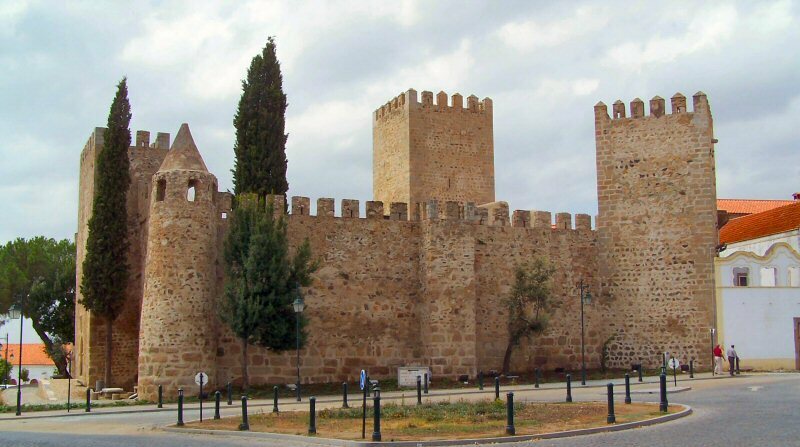
Crato Castle
Crato Castle, also known locally as Castelo de Crato or Castelo de Azinheira, is a historically significant fortress situated in the village of Crato in the Alto Alentejo region of Portugal. This castle occupies a prominent hilltop position at an elevation of approximately 272 meters, providing commanding views of the surrounding landscape. The site’s strategic location has made it a focal point of military and political activity since at least the medieval period, with possible earlier origins linked to Roman fortifications.
The earliest known fortification on this site may have been a Roman fortress, though no extensive Roman remains are visible today. The castle as it is historically recognized was founded in 1232 when King Sancho II of Portugal granted the territory to the Knights Hospitaller, a prominent religious and military order. Charged with fortifying the frontier region, the Hospitallers established their presence and began construction under Prior D. Mem Gonçalves. This marked the beginning of the castle’s development as a key defensive and administrative center.
Medieval origins and the knights hospitaller
The medieval castle was constructed during the High to Late Medieval period, initially featuring a trapezoidal layout with five corner towers, including a prominent keep tower on the northern side. The castle was part of a broader effort to secure the region following the Christian reconquest from Muslim rule around 1160. The Hospitallers not only fortified the castle but also played a vital role in repopulating and administratively organizing the area.
Between 1336 and 1341, following the Battle of Salado in 1340, the Hospitaller order moved its Portuguese headquarters from Leça do Balio to Crato. This elevated the castle’s importance as the order’s central stronghold in Portugal. In 1356, the order also constructed the nearby Flor da Rosa Monastery, a fortified monastery that complemented the castle’s military and religious functions.
In 1430, under Prior D. Frei Nuno Gonçalves de Góis, the castle underwent significant reconstruction and the town was enclosed with defensive walls supported by six towers. These improvements enhanced the castle’s defensive capabilities and the security of the settlement.
Political turmoil and royal connections
The castle’s history is marked by episodes of political conflict. In 1440, during a succession crisis, Queen Eleanor of Aragon, regent of Portugal, sought refuge within the castle. Her stay was brief, as promised military support from Castile failed to materialize, leading her to flee. The castle was subsequently besieged and severely damaged by forces loyal to the regent Peter, Duke of Coimbra. Despite this, the castle was rebuilt and continued to serve as a strategic fortress.
Crato Castle also hosted significant royal events, including the wedding of King Manuel I of Portugal and Eleanor of Austria in 1518, underscoring its ongoing importance in the early modern period. The castle’s main gate was reconstructed in 1525 for the marriage of King João III and Catherine of Austria, reflecting continued royal patronage and the castle’s ceremonial role.
Adaptation to gunpowder warfare and decline
During the Portuguese Restoration War (1640–1668), efforts were made to modernize the castle’s defenses to withstand artillery attacks. Starting in 1642, the fortress was transformed into a star-shaped bastioned fort with an irregular polygonal plan. This redesign included the addition of bastions, ravelins, and stone artillery platforms, reflecting contemporary military architectural trends designed to counter cannon fire.
However, in 1662, the castle was captured and heavily damaged by Spanish troops led by Don John of Austria. The siege resulted in significant destruction and the castle was torched, leading to the loss of important archival documents. After this event, the castle was abandoned militarily and gradually fell into ruin.
Preservation efforts and current condition
In the 20th century, the ruins of Crato Castle underwent several phases of consolidation and restoration, beginning in the 1940s under the Directorate-General for Buildings and National Monuments. These efforts aimed to stabilize the remaining structures and conserve the site’s historical fabric. The castle was declared a Property of Public Interest in 1982, recognizing its cultural and architectural significance.
Despite these efforts, recent decades have seen controversial developments, including the construction of unsightly concrete structures within the castle walls by a private foundation during the 1990s. These additions were intended to support a museum and conference center but were never completed and now contribute to the site’s neglected appearance. Currently, the castle is closed to the public, with gates locked and the site largely abandoned.
Architectural features and surviving elements
Today, visitors to Crato Castle can observe remnants of its complex history through surviving architectural features. The medieval trapezoidal layout is partially visible, anchored by the remains of five corner towers, including the northern keep. Sections of the town’s defensive walls and six towers—such as the Sino, Seda, São Pedro, Porta Nova, Beringal, and Santarém towers—still stand, offering insight into the medieval fortifications.
The 17th-century bastioned fortifications include a star-shaped irregular polygonal plan with four projecting bastions and a ravelin on the south-southwest side. Notable surviving elements from this period are the northern bastion with its twelve casemates, a guardhouse, stone artillery platforms, and a large central cistern essential for siege resilience. Several cannon embrasures and partially ruined towers also remain, illustrating the castle’s adaptation to early modern warfare.
These architectural layers demonstrate the castle’s evolution from a medieval fortress into a bastioned fortification designed for gunpowder artillery, reflecting broader changes in military architecture over several centuries.
Cultural significance and heritage status
Crato Castle stands as a testament to the military, religious, and political history of the Alto Alentejo region. Its association with the Knights Hospitaller and its role in key historical events, including royal ceremonies and military conflicts, underscore its importance in Portuguese heritage. The castle’s designation as a Property of Public Interest highlights its value as a cultural landmark deserving preservation and study.
While currently inaccessible to visitors, the castle’s ruins offer significant potential for archaeological research, heritage tourism, and cultural revitalization. Efforts to balance conservation with sustainable development could ensure that Crato Castle remains a vital part of Portugal’s historical landscape.
Frequently asked questions (FAQ)
- How do I visit Crato Castle?
- Currently, Crato Castle is closed to the public with locked gates and no visitor access due to its abandoned condition and ongoing preservation challenges.
- What is the historical significance of Crato Castle?
- Crato Castle was a key medieval fortress of the Knights Hospitaller and played important roles in Portuguese royal history and military conflicts.
- When was Crato Castle originally built?
- The castle was founded in 1232 by the Knights Hospitaller under King Sancho II's grant, with possible earlier Roman origins at the site.
- Can I see the star-shaped bastioned fort features at Crato Castle?
- Yes, remnants of the 17th-century star-shaped bastioned fort design, including bastions and artillery platforms, are still visible among the ruins.
- Why was Crato Castle transformed into a bastioned fort?
- During the Portuguese Restoration War, the castle was modernized starting in 1642 to withstand artillery attacks, reflecting advances in military architecture.
Information
Current owner
Municipality of Crato
Address
Largo do Castelo, Crato, Portugal
Loading map...
Visitor reviews
No reviews yet. Been here? Write the first review and help other travelers!
Write the first reviewVisited this castle? Share your experience
Your review helps other travelers and adds first-hand knowledge to our encyclopedia.