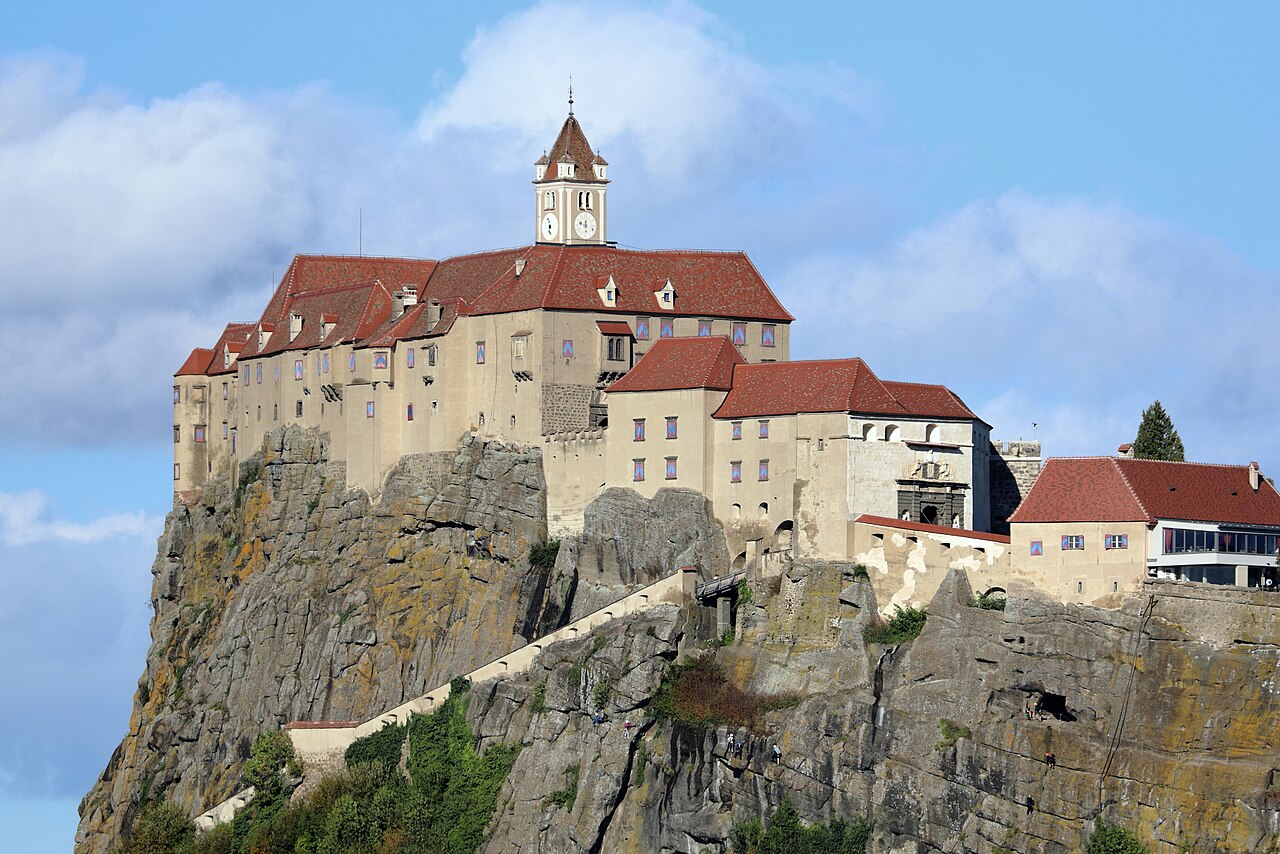
Feistritz Castle

Feistritz Castle in Ilz, Austria
Ilz, Austria
High Medieval (11th–13th c.)
Well Preserved

Feistritz Castle in Ilz, Austria, is a historic fortress with origins tracing back to the 12th century. First documented in 1122, it stands as a remarkable example of medieval architecture that evolved through the centuries. The castle's strategic location near the Ilz River contributed to its significance in regional defense and administration during the High Medieval period.

Early history and medieval origins

The initial construction of Feistritz Castle dates to the 12th century, reflecting the typical characteristics of High Medieval fortifications. Originally, the castle would have featured defensive walls, a keep or donjon, and a courtyard designed to serve both military and residential purposes. Its early role was likely tied to controlling trade routes and protecting the surrounding lands in the region historically known as Styria, although today it is situated in the federal state of Styria, not Wien as sometimes mistakenly noted.

Architectural evolution and Renaissance rebuilding

The main building that visitors see today largely dates from 1570, a period that marks the castle's transition into the Renaissance architectural style. This reconstruction introduced more refined residential features, including larger windows, decorative stonework, and improved living quarters, moving away from purely defensive medieval designs. The Renaissance influence is evident in the symmetrical layouts and the ornamental details that contrast with the earlier austere medieval structures.

Restoration after the 1605 fire

In 1605, Feistritz Castle suffered a significant fire that damaged parts of the structure. Following this event, the castle underwent extensive restoration and expansion. These efforts not only repaired the fire damage but also enhanced the castle's residential and defensive capabilities. The restorations included rebuilding sections of the walls, updating interior spaces, and possibly adding bastions or other fortification elements typical of the late Renaissance period.

Architectural features and layout

The castle complex includes a combination of defensive and residential elements. The core structure is a Renaissance manor house with thick stone walls, surrounded historically by curtain walls and possibly a moat. The presence of towers or a donjon would have been typical for a castle of this period, serving as lookout points and last-resort defensive positions. The courtyard likely served as a central organizing space for daily activities and gatherings.

Defensive elements

While the castle's defensive importance diminished over time, original medieval features such as battlements, arrow slits, and fortified gates may still be visible or have influenced later architectural adaptations. The castle's position near waterways and on elevated ground would have added natural defensive advantages.

Historical significance and ownership

Throughout its history, Feistritz Castle was owned by various noble families who played roles in the regional politics of Styria and Austria. Its mention in 1122 indicates its early importance, and the continued investment in rebuilding and restoration reflects its sustained value as a noble residence and administrative center.

Current condition and visitor information

Today, Feistritz Castle is well preserved and remains a notable landmark in Ilz. The castle's blend of medieval and Renaissance architecture attracts visitors interested in historical structures and Austrian heritage. While some areas may have undergone modern restoration, the castle retains much of its historical character.

Visiting details

The castle is accessible to the public during specified visiting hours, often including guided tours that explain its architectural features and historical context. Visitors can explore the castle grounds, courtyards, and main residential buildings, gaining insight into the lifestyle of the medieval and Renaissance nobility.

Feistritz Castle in the context of Austrian castles

Feistritz Castle exemplifies the evolution of Austrian castles from medieval fortresses to Renaissance residences. Its continuous adaptation over centuries illustrates broader trends in castle architecture and noble life in Central Europe. The castle's preservation allows it to serve as a cultural and historical resource, connecting modern visitors with Austria's medieval past.

Frequently asked questions (FAQ)

How do I get to Feistritz Castle?
Feistritz Castle is located in Ilz, Austria, and can be easily accessed by car or public transportation. The nearest train station is in nearby Hartberg, from where you can take a taxi or local bus to the castle. Be sure to check local transport schedules for the most convenient options.
What is the historical significance of Feistritz Castle?
Feistritz Castle dates back to the 12th century and played a crucial role in the region's defense during the Middle Ages. It has been a residence for various noble families, contributing to its rich history. Today, it stands as a testament to the architectural styles and historical events of its time.
When was Feistritz Castle built?
Feistritz Castle was constructed in the mid-12th century, making it one of the oldest fortifications in the region. Over the centuries, it has undergone several renovations and expansions, reflecting changes in architectural styles. Its long history adds to its charm and significance.
Can I visit Feistritz Castle year-round?
Yes, Feistritz Castle is open to visitors year-round, but it's advisable to check specific opening hours before planning your visit. Seasonal events and guided tours are often available, enhancing the visitor experience. The castle's beautiful surroundings are particularly stunning in spring and autumn.
Why is Feistritz Castle a popular tourist attraction?
Feistritz Castle attracts visitors due to its stunning architecture, rich history, and picturesque location. It also offers guided tours that provide insights into its past and architectural features. Additionally, the scenic views of the surrounding countryside make it a perfect spot for photography enthusiasts.
Is it possible to host events at Feistritz Castle?
Yes, Feistritz Castle is available for private events such as weddings, corporate meetings, and cultural gatherings. The castle offers a unique and historical backdrop, making any event memorable. It is recommended to contact the management for details on availability and services.
What are the ticket prices for visiting Feistritz Castle?
Ticket prices for Feistritz Castle vary depending on the type of tour and the season. Generally, adult tickets range from €8 to €12, while discounts are available for children and groups. It's best to check the official website for the most current pricing and special offers.
What are the opening hours for Feistritz Castle?
Feistritz Castle typically opens at 10 AM and closes at 6 PM during the tourist season. However, hours may vary in the off-peak season or during special events. Always confirm the opening hours before your visit to ensure a smooth experience.
Are there any nearby attractions to visit after Feistritz Castle?
Yes, after exploring Feistritz Castle, you can visit the charming town of Ilz, which offers beautiful parks and local shops. Additionally, the scenic landscapes of the Steiermark region provide ample opportunities for hiking and outdoor activities. Don't miss the chance to explore other historical sites in the vicinity as well.

Information

Hill Castle

Loading map...

Visitor reviews

No reviews yet. Been here? Write the first review and help other travelers!

Write the first review

Visited this castle? Share your experience

Your review helps other travelers and adds first-hand knowledge to our encyclopedia.

Write a review

(5/5)

0/2000 characters

Your review will be visible after admin approval

Nearby castles

9.4 km

Schloss Herberstein

Stubenberg, Austria

Schloss Herberstein stands majestically on a steep rocky slope within the Feistritz ravine in Feistritztal, Austria. This hill castle benefits from natural defenses, being inaccessible from three sides and concealed from view outside the ravine, a strategic location that contributed significantly to its medieval defensive capabilities. The castle's origins trace back to the 12th century, making it a remarkable example of high medieval fortification architecture. Initial construction focused on establishing a stronghold that could withstand the turbulent conflicts of the era. By around 1400, Schloss Herberstein underwent substantial expansion with the addition of a large outer bailey or forward fortification, which was further extended multiple times throughout the 15th century. This period also saw the incorporation of the Gothic chapel of St. Catherine, one of the castle's oldest surviving structures, reflecting the religious and cultural priorities of its medieval inhabitants. Medieval origins and fortifications The castle was originally known as "Hervigstein" and was constructed to dominate the surrounding landscape, overlooking the Feistritz River valley. Its position on a rocky outcrop provided a formidable natural defense, supplemented by man-made fortifications such as thick curtain walls, battlements, and a moat, which was typical of castles built during the high medieval period. The fortifications were enhanced around the 15th century, a time marked by frequent regional conflicts. The outer bailey served as a defensive buffer zone, protecting the inner castle and providing space for auxiliary buildings and garrisons. The castle's layout was carefully designed to maximize its defensive potential, with narrow access points and elevated towers for surveillance and defense. Renaissance transformation and residential adaptation By the 16th century, the military importance of Schloss Herberstein diminished, and the castle was transformed into a more comfortable residential palace for the noble Herberstein family. This transition is evident in the architectural modifications that introduced Renaissance elements, including large windows, decorative stonework, and more spacious living quarters. A key feature from this period is the Knight's Hall (Rittersaal), a grand ceremonial room used for gatherings and official functions. The castle's medieval moat was filled in during this time, symbolizing the shift from a fortress to a stately home. The Renaissance remodeling also included enhancements to the castle's interior, emphasizing comfort and status rather than purely defensive concerns. Baroque additions and cultural significance The 17th century brought further architectural developments, notably the creation of the Florentinerhof courtyard, designed in the Italianate style popular at the time. This courtyard added an elegant, open-air space within the castle complex, enhancing its residential and social functions. Additional buildings completed by the late 1600s further enriched the castle's layout, blending Baroque architectural influences with the existing medieval and Renaissance structures. These changes reflected the evolving tastes and needs of the castle's occupants, who increasingly viewed Schloss Herberstein as a symbol of prestige and cultural refinement. Modern use and cultural heritage In the late 20th century, Schloss Herberstein expanded its role beyond a noble residence by opening its grounds to the public. In 1960, the castle was converted into a zoological park, now known as the Herberstein Zoo. This zoo is renowned for its well-designed habitats and is home to animals from all five continents, including Europe's largest cheetah park. The castle itself remains under the ownership of the Herberstein family and continues to serve as a private residence and administrative center. It also functions as a cultural venue, hosting art exhibitions and events that celebrate both classical and contemporary works. Within the castle park, the Bruno Gironcoli Museum is housed in a separate 2000-square-meter building. This museum showcases the largest collection of works by the Austrian sculptor Bruno Gironcoli, known for his large-scale, futuristic sculptures. Some of these pieces are also displayed permanently in Vienna's Donau City complex, linking Schloss Herberstein to broader cultural networks. Architectural features and preservation Schloss Herberstein's complex layout reflects its layered history, combining medieval fortifications, Renaissance residential halls, and Baroque courtyards. The castle's well-preserved structures include the Gothic chapel of St. Catherine, the Knight's Hall, and the Florentinerhof courtyard, which together illustrate the evolution of castle architecture from fortress to noble residence. The castle's position on a rocky slope and its natural concealment have helped preserve its integrity over centuries. Its continuous use and careful maintenance by the Herberstein family have ensured that it remains a vibrant historical site, blending architectural grandeur with cultural vitality. The gothic chapel of st. catherine This chapel, dating from before 1400, is a significant medieval religious structure within the castle grounds. It features typical Gothic architectural elements such as pointed arches, ribbed vaults, and stained glass windows. The chapel served both spiritual and community functions for the castle's inhabitants and remains a highlight for visitors interested in medieval ecclesiastical architecture. The knight's hall The Rittersaal or Knight's Hall is a large ceremonial room introduced during the Renaissance transformation. It was used for formal gatherings, banquets, and events, reflecting the castle's shift towards residential and social functions. The hall's spacious design and decorative details exemplify Renaissance aesthetics and noble status. The florentinerhof courtyard Added in the 17th century, the Florentinerhof courtyard embodies Italian Baroque influences, providing an elegant outdoor space within the castle complex. Its design emphasizes symmetry, open space, and decorative elements that enhance the castle's residential appeal.

High Medieval (11th–13th c.)
Details
12.8 km

Herberstein Castle

Hartberg-Fürstenfeld, Austria

Herberstein Castle is a remarkable high medieval hill castle located in the Hartberg-Fürstenfeld district of Styria, Austria. Perched on a rocky outcrop within the Feistritz ravine, the castle's natural defensive position renders it inaccessible from three sides and hidden from view outside the ravine, providing a strategic advantage against attackers. The castle's origins trace back to the 12th century, making it one of the oldest fortified residences in the region.The earliest section of the castle, situated near what is now the zoo, was originally called Herwigstein and was held under the fiefdom of the Stubenberg family. The castle's ownership changed hands when Otto von Hartenberg redeemed it from the Stubenbergs, establishing the lineage that would become the Herberstein family. This transition marked the beginning of the castle's development into a significant noble seat.Architectural evolution and expansionsBy the year 1400, the castle underwent significant expansion with the construction of a massive outer bailey, which incorporated the Gothic chapel of St. Catherine. Throughout the 15th century, the bailey was further extended multiple times, enhancing the castle's defensive and residential capabilities. The castle's transformation continued in the mid-16th century, when it was remodeled into a more comfortable residential building featuring prominent Renaissance architectural elements. This phase of construction was driven by the need to accommodate the numerous offspring of the Herberstein family, reflecting their growing prominence and wealth.17th-century enhancementsThe 17th century saw the addition of the magnificent banqueting hall, a grand space designed for hosting noble gatherings and celebrations. During this period, a deep moat was also constructed, further bolstering the castle's defenses. Mid-century, the Florentinerhof was built, inspired by Italian architectural models, showcasing the influence of Renaissance and early Baroque styles on the estate. By the end of the century, additional structures such as St. George's Chapel, the gardener's home, and the Maierhof were completed, expanding the castle complex and its functional spaces.Historical significance and ownershipDuring the 17th and 18th centuries, the Counts of Herberstein were among the most powerful landowners in Styria, possessing about one-fifth of the region. Their extensive holdings included approximately 1,000 farms that were tributary to the castle, underscoring the estate's economic and political importance. Remarkably, the castle remains under the ownership of the Herberstein family today, serving as both a residential home and an administrative center.Herberstein castle today: cultural and natural attractionsVisitors to Herberstein Castle can enjoy guided tours of selected parts of the historic building, including its beautifully preserved interiors and chapels. The castle grounds also feature extensive historic gardens that reflect centuries of horticultural tradition. A unique highlight is the Herberstein Zoo, which has a long-standing tradition dating back to the 17th century when fallow deer were first kept here, marking the earliest known instance of such animal husbandry in Austria.In the late 1960s, the estate was transformed into a modern zoo showcasing animals from all five continents. Today, the zoo is renowned for its well-designed enclosures and is home to the largest cheetah park in Europe. An innovative feature of the cheetah park is a remodeled ski-lift system that simulates prey movement, encouraging the cheetahs to exercise their natural hunting instincts by chasing food transported at high speed.The castle also hosts the Gironcoli Museum, dedicated to the works of Bruno Gironcoli, a prominent contemporary Austrian artist. This cultural addition enriches the visitor experience by blending historical architecture with modern art.Architectural features and layoutThe castle's layout reflects its evolution from a fortified medieval stronghold to a Renaissance residence. Key features include the outer bailey with its defensive walls, the Gothic chapels of St. Catherine and St. George, and the banqueting hall known for its grandeur. The Florentinerhof courtyard, inspired by Italian Renaissance architecture, adds a distinctive aesthetic dimension to the complex.The castle's moat and natural rock defenses combine to create a formidable barrier. The integration of residential wings alongside defensive structures illustrates the transition in castle design from military fortress to noble residence.Gardens and ancillary buildingsThe historic gardens surrounding the castle are carefully maintained and include a variety of plant species that have been cultivated over centuries. Ancillary buildings such as the gardener's home and the Maierhof reflect the operational aspects of the estate, supporting both agricultural and domestic needs.Visiting information and public accessHerberstein Castle is open to the public and offers guided tours that provide insights into its rich history and architectural development. Visitors can explore the castle interiors, stroll through the historic gardens, and enjoy the zoo's diverse animal collection. The combination of cultural heritage and natural attractions makes Herberstein a distinctive destination for tourists interested in history, architecture, and wildlife.

High Medieval (11th–13th c.)
Details
13.7 km
Riegersburg Castle — Austria castle

Riegersburg Castle

Riegersburg, Austria

Riegersburg Castle is a striking medieval hill castle perched atop a dormant volcanic cone in the Austrian state of Styria. This imposing fortress overlooks the town of Riegersburg and stands as a testament to centuries of military architecture, noble lineage, and regional history. Owned by the Princely Family of Liechtenstein, the castle today serves as a museum with a rich collection of exhibitions that highlight its multifaceted past. Visitors can explore 25 of its 108 rooms, including those dedicated to the castle's history and the darker chapters involving witches and sorcerers. Early history and strategic location The origins of Riegersburg Castle date back to the 12th century, with the first official mention occurring in 1138 under the name "Ruotkerspurch," meaning "Rüdiger's castle." The exact date of initial construction remains uncertain, but it is known that a knight named Rüdiger von Hohenberg established a small keep on the volcanic hill around 1122. The castle's location on a basalt volcanic cone rising to 484 meters above sea level provided natural defensive advantages, with steep cliffs on three sides and access only from the south, making it a formidable stronghold. The volcanic neck, a petrified remnant of an ancient stratovolcano extinct for approximately two million years, supplied the basalt stone used in building the castle's robust walls and structures. The site has been inhabited for around 6,000 years, with evidence of a large village dating back to the 9th century BC. Throughout antiquity, the region experienced Roman occupation, Bavarian migration, and Hungarian invasions, all contributing to the area's turbulent history and the need for a strong fortress. Architectural evolution and fortifications Castle complex and layout Riegersburg Castle comprises two main sections: the Upper Castle (Obere Feste or Kronegg) and the Lower Castle (Niedere Feste or Lichtenegg). The Upper Castle, likely built before 1100, is situated on the northern summit of the volcanic cone and consists of two to three-story buildings arranged around two narrow inner courtyards. The southern courtyard features elegant arcades supported by columns and vaults, while the northern courtyard, known as the Brunnenhof, contains a well dating to 1640 with an ornate wrought-iron canopy. A small chapel near the entrance adds to the religious and cultural significance of the site. The Lower Castle was constructed around 1140–1150 by Margrave Otakar III to limit the influence of local nobles. Over the centuries, the castle's fortifications were expanded and modernized, especially during the 17th century under the guidance of Baroness Katharina Elisabeth von Wechsler, also known as the "Gallerin." She transformed the fortress into one of Austria's largest and strongest castles, adding extensive walls, five gates, and two trenches, enclosing an area of about 15 hectares. Defensive features The castle's defensive system is renowned for its complexity and strength. It includes a three-kilometer-long wall with six gates and eleven bastions named after saints and historical figures. The gates, constructed between 1678 and 1690 by master builder Bartholomeus Ebner, feature elaborate portals, with the Wenzeltor (Vaclav Gate) distinguished by statues of the Roman war gods Mars and Bellona. Access to the castle involves crossing a wooden bridge over a deep moat, enhancing its impregnability. An independent stairway called the Eselsteig (Donkey Path), carved into the western rock face around 1420, provides a separate route to the Upper Castle, bypassing the Lower Castle. The fortress also includes trenches and bastions designed to repel attacks, reflecting the military architectural advancements of the late medieval and early modern periods. Notable historical figures and events Throughout its history, Riegersburg Castle was owned by various noble families, including the Aribonids, von Riegersburg-Wildon, Kuenring-Dürnstein, von Walsee, von Stubenberg, von Reichenburg, von Stadl, von Ursenbeck, and von Wechsler. The castle endured a notable siege in 1412 during the "Walseer Fehde," a feud involving the von Walsee family and the sovereign of Styria. The most influential owner was Baroness Katharina Elisabeth von Wechsler, who took control in the 17th century and significantly expanded and fortified the castle. Known for her strong will in a male-dominated society, she protected her estate fiercely. Under her tenure, the castle acquired its current form and grandeur, with lavish interiors and formidable defenses. Her era was also marked by the tragic Styrian witch hunts from 1673 to 1675, during which one of her handmaidens, Katharina Paldauff, known as the "Flower Witch," was accused of sorcery and executed. This dark chapter is commemorated in the castle's museum exhibitions. After the extinction of the Purgstall family around 1800, the castle was purchased in 1822 by Prince Johann Josef von Liechtenstein, whose family has maintained ownership ever since. The castle was briefly occupied by Soviet forces in 1945 during World War II but survived without significant damage. Interior highlights and cultural significance Visitors to Riegersburg Castle can explore a variety of historically significant rooms, including princely chambers, a picture gallery, the Roman Hall, Turkish Hall, Knight’s Hall, and a princely dining room. The White Hall, a richly decorated Baroque summer dining room completed in 1658 by master builder Antonio Solari, stands out for its elaborate ornamentation and an inscription noting the high cost of construction. The castle also hosts exhibitions dedicated to its history and the witch trials, providing insight into the social and cultural dynamics of the region during the medieval and early modern periods. The museum's displays offer a comprehensive narrative of the castle's role as a military fortress, noble residence, and cultural landmark. Modern preservation and visitor experience Today, Riegersburg Castle is a well-preserved monument attracting visitors interested in history, architecture, and folklore. The castle is accessible via diagonal glass elevators for those seeking convenience, while more active visitors can ascend on foot through the town center, passing through the fortress's seven gates to experience the authentic medieval atmosphere. The castle grounds continue a tradition of viticulture dating back to the 17th century. The surrounding vineyards, covering about 10 hectares, are leased to the Bernhart winery, which produces wine under the "Riegersburg" label. This blend of historical heritage and living tradition enhances the castle's unique appeal. Additionally, the steep rock faces surrounding the castle offer several via ferrata climbing routes of moderate to difficult levels, making it a unique destination that combines medieval architecture with outdoor adventure. Preservation efforts have been overseen by Prince Emanuel von und zu Liechtenstein since 2014, ensuring that the castle remains a vibrant cultural and historical site for future generations.

High Medieval (11th–13th c.)
Details