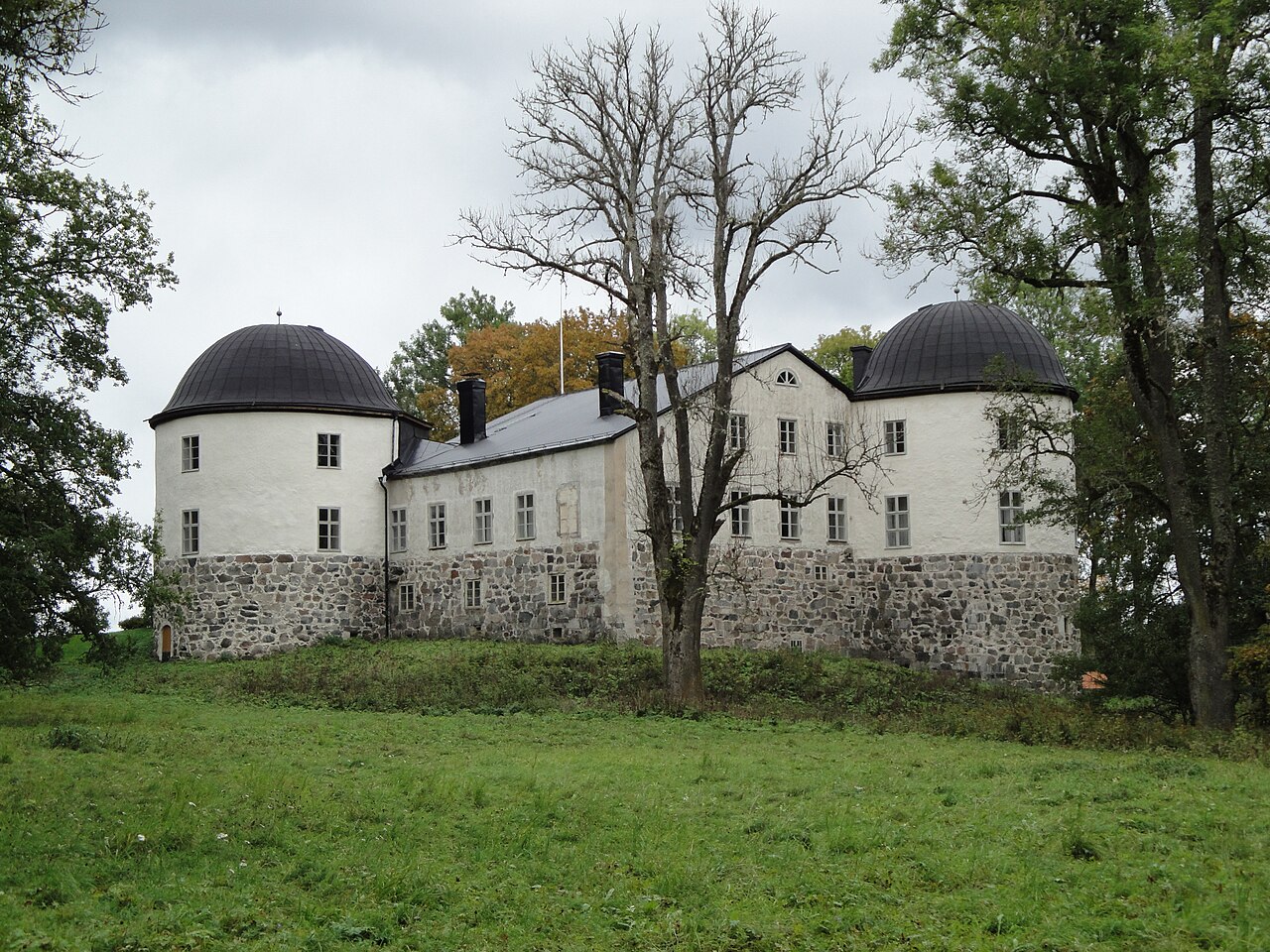
Ekebyholm Castle

Ekebyholm Castle in Norrtälje, Sweden
Norrtälje, Sweden
Post-Renaissance (17th–18th c.)
Well Preserved

Ekebyholm Castle is a distinguished manor house located by Lake Syningen in the Rimbo parish within Norrtälje Municipality, Stockholm County, Sweden. Originally a noble estate, it has evolved over centuries from its early origins as part of the estate of Mörby, reflecting Sweden's aristocratic and architectural history. Today, Ekebyholm serves an educational purpose as the site of Ekebyholmsskolan, an Adventist school established in 1932.

The origins and early history of Ekebyholm

The estate of Ekebyholm was historically connected to the larger estate of Mörby, which was owned by the family of Slaveka, of Pomeranian descent. In the late 16th century, the estates passed into the hands of the prominent Swedish noble family Oxenstierna. Bengt Gabrielson Oxenstierna af Mörby (died 1591) acquired both estates, which were subsequently divided between his sons. The elder son, Gabriel Bengtsson Oxenstierna (1586–1656), inherited Mörby, while the younger, posthumous son Bengt Bengtson Oxenstierna (1591–1643) received Ekebyholm. It was Bengt Bengtson Oxenstierna who first established a manor house on the Ekebyholm site, marking the beginning of the estate's built history.

18th-century transformation under Arvid Horn

The manor's current architectural form dates primarily to the 18th century, when it was substantially rebuilt under the ownership of Arvid Horn (1664–1742), a notable Swedish statesman and military leader. Horn's renovations gave Ekebyholm its characteristic appearance, transforming it into a grand residence that reflected the tastes and styles of the post-Renaissance period in Sweden. The manor house exhibits elements typical of the era, including a symmetrical facade and refined classical details, though it is not a castle in the medieval fortress sense.

Architectural features and style

Ekebyholm is best described as a manor house with a castle-like appearance rather than a fortified castle. The building's style aligns with post-Renaissance architectural trends prevalent in Sweden during the 1700s. The manor features a balanced, elegant facade with large windows and modest decorative elements that emphasize proportion and harmony. The estate includes surrounding parkland and outbuildings that contribute to its historic character.

Later history and current use

In the 20th century, Ekebyholm transitioned from a noble residence to an educational institution. In 1932, the property was acquired by the Adventist school, which established Ekebyholmsskolan on the premises. The school continues to operate there, maintaining the estate's legacy as a site of cultural and community importance. This adaptive reuse has helped preserve the manor house and its grounds.

Preservation and condition

Ekebyholm remains well preserved as a historic manor house, with much of its 18th-century character intact. The building and grounds are maintained to support their current educational function, while also preserving the architectural heritage of the estate. Visitors interested in Swedish manor houses and noble estates of the post-Renaissance period find Ekebyholm a notable example.

Historical significance and cultural context

Ekebyholm Castle illustrates the evolution of Swedish noble estates from fortified medieval holdings to elegant manor houses reflecting changing architectural and social trends. The estate's connection to the Oxenstierna family and Arvid Horn links it to significant figures in Swedish history. Its survival and continued use highlight the adaptive reuse of historic properties in Sweden.

Location and surroundings

Situated near Lake Syningen, Ekebyholm benefits from a scenic natural setting typical of Swedish manor estates. The surrounding landscape includes parkland and agricultural land that historically supported the estate's economy. Its location in Norrtälje Municipality places it within reach of Stockholm while retaining a rural character.

Frequently asked questions (FAQ)

How do I get to Ekebyholm Castle?
Ekebyholm Castle is located in Norrtälje, Sweden, and can be reached by car or public transportation. If you are driving, follow the signs to Norrtälje and then to the castle. Public buses also run from Stockholm to Norrtälje, with local transit options available to reach the castle.
What is the historical significance of Ekebyholm Castle?
Ekebyholm Castle dates back to the 17th century and has played a crucial role in Swedish history. Originally built as a manor, it has served various purposes over the centuries, including as a home for nobility and a venue for significant events. Its rich history reflects the architectural and cultural evolution of the region.
When was Ekebyholm Castle built?
Ekebyholm Castle was constructed in the late 1600s, with its architecture showcasing the Baroque style popular during that period. Over the years, it has undergone several renovations that have preserved its historical charm while adapting to modern needs. The castle is a testament to Sweden's architectural heritage.
Can I visit Ekebyholm Castle at any time?
Ekebyholm Castle has specific opening hours, typically from late spring to early autumn. It is recommended to check the castle's official website for the latest visiting hours and any special events that may alter the schedule. Group tours may also be available by prior arrangement.
Why is Ekebyholm Castle a popular tourist destination?
Ekebyholm Castle is a popular tourist destination due to its stunning architecture, beautiful surroundings, and rich history. Visitors can enjoy guided tours, picturesque views of the surrounding landscape, and learn about its significance in Swedish culture. Additionally, the castle often hosts events and exhibitions that attract a wide range of visitors.
Is it possible to host events at Ekebyholm Castle?
Yes, Ekebyholm Castle offers facilities for hosting various events, including weddings, conferences, and private functions. The castle's historical ambiance provides a unique backdrop for any occasion. It is advisable to contact the castle directly for more information on venue availability and booking procedures.
What are the ticket prices for visiting Ekebyholm Castle?
Ticket prices for visiting Ekebyholm Castle vary depending on the type of tour and the season. Typically, there are discounted rates for children, students, and seniors. For the most accurate and up-to-date prices, it is recommended to check the castle's official website prior to your visit.
What is the best time to visit Ekebyholm Castle?
The best time to visit Ekebyholm Castle is during the summer months when the weather is pleasant, and the gardens are in full bloom. This period also coincides with the castle's extended opening hours and various events. However, visiting in the spring or autumn can also offer a quieter experience with stunning seasonal changes.
Are there any nearby attractions to explore after visiting Ekebyholm Castle?
Yes, there are several nearby attractions to explore after visiting Ekebyholm Castle, including the picturesque town of Norrtälje with its charming shops and restaurants. The surrounding nature offers opportunities for hiking, boating, and enjoying the scenic views of the archipelago. Visitors can also explore other historical sites in the region to enhance their experience.

Information

Palace Castle

Loading map...

Visitor reviews

No reviews yet. Been here? Write the first review and help other travelers!

Write the first review

Visited this castle? Share your experience

Your review helps other travelers and adds first-hand knowledge to our encyclopedia.

Write a review

(5/5)

0/2000 characters

Your review will be visible after admin approval

Nearby castles

6.2 km

Mörby Castle Ruins

Norrtälje, Sweden

Mörby Castle ruins stand as a significant historical site in Norrtälje, Sweden, with origins tracing back to the late medieval period. The castle was first documented in 1387, when it was constructed by the knight Henrik Damerow. This early mention highlights Mörby's medieval heritage and its role as a fortified residence during a turbulent era in Swedish history. Early history and ownership The castle initially served as a stronghold for the Damerow family before passing into the hands of the influential Oxenstierna family in 1452. The Oxenstiernas maintained ownership for over two and a half centuries, a period during which Mörby Castle underwent significant changes and played a role in regional power dynamics. The family's stewardship reflects the castle's importance as a noble residence and defensive structure in medieval Sweden. Architectural evolution and reconstruction In 1550, after suffering damage from a fire, Mörby Castle was rebuilt. This reconstruction likely involved updating the castle's fortifications and living quarters to suit the needs of the time, blending medieval defensive features with emerging Renaissance influences. Despite these changes, the castle retained much of its medieval character, including its prominent tower, which remains a visible ruin today. Structural features The surviving ruins include the substantial tower body, which provides insight into the castle's original defensive design. The tower would have served both as a lookout point and a last refuge during attacks. Other remnants suggest the presence of thick stone walls and possibly a courtyard, typical of late medieval hill castles in Sweden designed to withstand sieges and control surrounding lands. Decline and destruction By the early 18th century, Mörby Castle's strategic importance had diminished. In 1733, the castle was deliberately abandoned and allowed to fall into decay. The roof was removed and transported to Ekeby Castle, marking a significant step in the castle's decline. This practice of reusing building materials was common in the period, reflecting changes in property ownership and the shifting needs of the nobility. Ultimately, Mörby Castle was destroyed by fire in 1740. The blaze left the structure in ruins, which have since become an important archaeological and cultural site. The ruins today provide valuable evidence of medieval castle construction and the historical narrative of Swedish nobility. Current condition and cultural significance Today, the Mörby Castle ruins are classified as ruins and remain a notable landmark in Norrtälje. The site attracts visitors interested in medieval architecture and Swedish history, offering a tangible connection to the past through its preserved stonework and the enduring tower remains. The castle's story reflects broader themes in Swedish medieval and early modern history, including noble family dynamics, military architecture, and the evolution of fortifications. Visiting and exploring mörby castle ruins Visitors to the site can explore the ruins and appreciate the scale and craftsmanship of the original castle. While no complete buildings remain, the ruins' layout and surviving elements provide a clear sense of the castle's former grandeur. The location in Norrtälje makes it accessible for those interested in historical tourism and cultural heritage in Sweden.

Late Medieval (14th–15th c.)
Details
9.8 km

Johannesberg Castle

Rimbo, Sweden

Johannesberg Castle in Rimbo, Sweden, stands on a hill surrounded by water, a location that has offered natural defense since the 11th century. The site has witnessed a long history of occupation and transformation, beginning with early strongholds and evolving into the estate known today. Its strategic position made it an important local center during medieval times. Early medieval origins and medieval history The earliest known fortification on the site dates back to the 11th century, when the hill was a natural stronghold. In the 12th century, a local chief named Gutti controlled the area, which later became known as Gottröra. Gutti divided the land into two parts: the southern part called Djursby (now Johannesberg) and the northern part. This division laid the foundation for the estate's later development. During the late 17th century, the estate was owned by Johan Leijonhufvud, who passed it to his relative Adam Lewenhaupt. Lewenhaupt renamed the estate Johannesberg in honor of Johan Leijonhufvud. Unfortunately, Lewenhaupt died in Russian captivity, never returning to the estate. Over the following centuries, Johannesberg was held by several noble families, including the Banér, Gyllenstierna, Horn af Åminne, and Lagergren families, reflecting its status as an important noble estate in Sweden. Architectural changes and ownership in the modern era At the end of the 19th century, the estate was acquired by Mr. Grönwall, a wholesale dealer. During his ownership, the original main building was destroyed by fire. The subsequent owner, Mr. Conti, rebuilt the main building around the turn of the 20th century, resulting in the present structure that defines the castle today. This building reflects the architectural styles and construction techniques of the modern period, dating from approximately 1900. In the 1930s, the estate was purchased by Bergengren, a prominent landowner with estates across Sweden, England, and France. Bergengren retained ownership of the agricultural lands of Johannesberg and played a significant role during World War II. World war ii and the norwegian resistance training During World War II, the main building and several cottages on the estate were rented to the Swedish government. Under the management of Harry Söderman, the manager of the Criminal Technical Institution, the castle served as a training center for Norwegian refugees. These refugees were officially educated as policemen but were in fact trained to join the Norwegian resistance movement against Nazi occupation. At its peak, about 1,500 Norwegian trainees were present at Johannesberg. After the war, many of these individuals maintained connections through comrade clubs. Their efforts and camaraderie were commemorated with a monument erected in the castle park in June 1990. Late 20th century restoration and recreational development In 1987, Johannesberg was acquired by a private company that undertook significant restoration work. The two wings of the estate were rebuilt, and the property was prepared for renewed use by 1989. A 27-hole golf course was established and opened in 1991, alongside a clubhouse featuring a swimming pool, marking a shift towards recreational and hospitality functions. Since 1995, the castle has been owned and operated by the family of Manfred and Mariette Kuhl, who continue to maintain its role as a venue for leisure and events while preserving its historical legacy. Architectural features and landscape The castle's location on a hill surrounded by water has historically provided natural defense advantages. The current main building, constructed around 1900, reflects modern architectural styles of that period, though specific stylistic details are less documented. The estate includes restored wings and extensive grounds adapted for leisure activities, including the golf course and parkland. Cultural and historical significance Johannesberg Castle embodies layers of Swedish history from the medieval era through modern times. Its association with noble families, its role during World War II as a training site for the Norwegian resistance, and its transformation into a recreational estate illustrate its diverse functions over centuries. The monument commemorating the Norwegian trainees underscores the castle's unique place in Scandinavian wartime history.

Modern (19th–20th c.)
Details
20.4 km
Penningby Castle — Sweden castle

Penningby Castle

Norrtälje, Sweden

Penningby Castle is a prominent late medieval hill castle located in the municipality of Norrtälje, in the historical province of Uppland, Sweden. Situated roughly 70 kilometres north of Stockholm, the castle occupies a strategic valley near Edsviken, a narrow inlet connected to the Baltic Sea's Saltsjön bay. Its position near waterways historically linked the Baltic Sea to the religious center of Uppsala, underscoring its military and administrative importance during the medieval period. The castle's origins date back to the early 14th century, with the estate first documented in the 1330s. Nearby lie the remains of an older fortress at Estängen, likely a predecessor to the current structure, featuring a moat and overgrown ruins that hint at the site's long-standing defensive role. Penningby Manor's earliest known owners included Lord Tord Bonde, burgrave of Raasepori and margrave of Viipuri castles, indicating the estate's connection to prominent noble families. Medieval origins and construction The construction of the current castle began in the 15th century, initiated by Lady Birgitta Tordsdotter Bonde, daughter of Tord Karlsson Bonde, the Lord High Constable of Sweden. This phase marked the transformation of the manor into a fortified residence, reflecting the turbulent political climate of the era and the growing need for defensible noble homes. The castle was designed as a twin house, a rare architectural form for coastal fortresses, combining residential and defensive functions in a single complex. During the late 15th and early 16th centuries, further expansions were undertaken by Lord Lars Turesson of the Tre Rosor family. He constructed an imposing tower just before the 1550s and remodeled the eastern façade to include a new entrance, enhancing both the castle's fortifications and its residential appeal. The sea tower was also expanded with the addition of a distinctive round salon, celebrated as one of the most elegant rooms within the castle, blending aesthetic refinement with strategic vantage points over the surrounding waterways. Architectural features and layout Penningby Castle's main building is roughly square, anchored by two round towers placed diagonally at its corners. The southwestern tower houses a large well, crucially positioned near the historical watercourses connecting Penningbyån and Väsbysjön. These waterways were part of a medieval transport route, highlighting the castle's role in controlling regional movement and trade. The castle's lower two floors showcase traditional medieval construction techniques, built from robust gray stone and featuring cylindrical vaults that provide both structural strength and fire resistance. Portions of the original fortress walls remain intact, preserving the defensive character of the estate. Above these stone foundations, the upper two floors were largely rebuilt in the 17th century using sandstone, creating a visual contrast and reflecting evolving architectural tastes and residential needs. The castle's sea tower and its round salon stand out as architectural highlights. This salon, likely added during Lord Lars Turesson's tenure, exemplifies a rare blend of military functionality and refined living spaces uncommon in many medieval fortifications. Historical significance and notable figures Penningby Castle has been associated with several prominent Swedish noble families, including the Vasas, Fleming, Bielke, Ryning, Oxenstierna, and Torstenson lineages. One of its most notable residents was Svante Nilsson, born at Penningby around 1460, who served as regent of Sweden from 1504 until his death in 1512. The castle also has a connection to early Swedish colonial history in North America through Olof Persson Stille, who was employed at Penningby Manor before emigrating to New Sweden. Stille became a magistrate and judge in the Delaware River colony, linking the castle to transatlantic history. Later history, restoration, and current status In 1805, Countess Maria Juliana von Rosen redesigned the castle's gardens in the English landscape style, introducing naturalistic elements and gentle curves that replaced earlier formal designs. However, a devastating fire in 1831 severely damaged the castle's interiors, necessitating reconstruction of the roof and main house framework. Subsequent restorations in the 20th century focused on stabilizing the towers and preserving the castle's structural integrity. A major restoration project between 1951 and 1953 helped conserve the castle, which was officially declared a national cultural heritage site (byggnadsminne) in 1980. Today, Penningby Castle is not inhabited but is accessible to visitors during the summer season. It has also served as a filming location for several Swedish films and television productions, highlighting its cultural significance. The castle grounds and surrounding landscape The castle grounds include the historic garden redesigned in the early 19th century and the remains of the older fortress ruins nearby. The presence of moats and water features reflects the site's defensive origins and its integration with the natural landscape. The valley setting near Edsviken provides scenic views and underscores the castle's strategic placement near important medieval transport routes. Overall, Penningby Castle offers a rich architectural and historical narrative that spans from medieval fortification to noble residence and cultural landmark. Its preservation allows insight into Swedish noble life, defensive architecture, and the region's evolving landscape from the 14th century onward.

Late Medieval (14th–15th c.)
Details