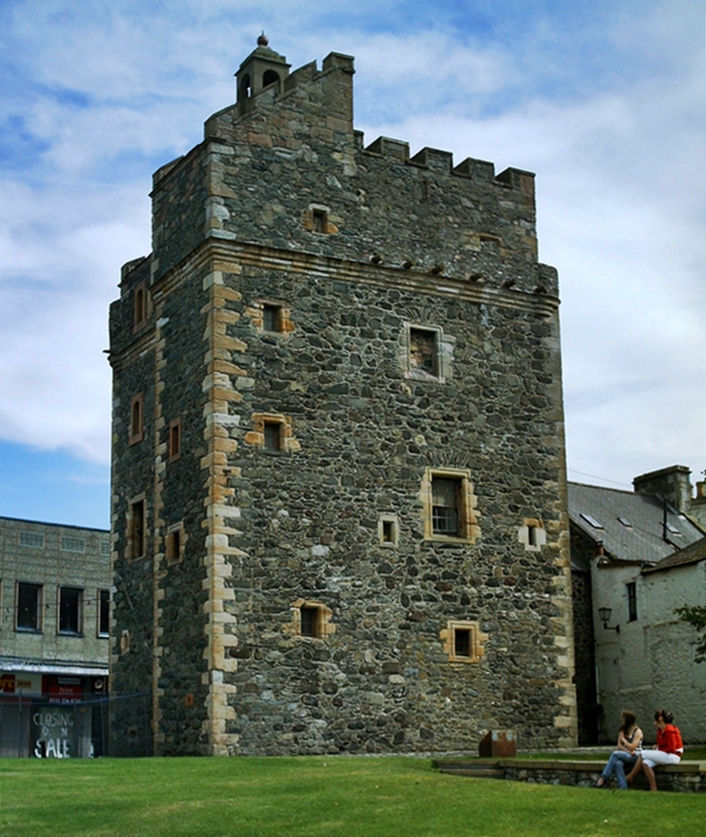
Dunskey Castle
Dunskey Castle stands as a striking ruin of a three-storied L-shaped tower house, perched dramatically atop cliffs near Portpatrick, Scotland. Its strategic location on a rocky promontory known as Castle Point commands views over the Irish Sea and the North Channel, reflecting its historic role in coastal defense and regional power struggles. The castle is naturally defended on three sides by precipitous cliffs, while the landward side features a formidable rock-cut ditch approximately 15 meters wide and 2.5 meters deep, underscoring its defensive design.
The origins of Dunskey Castle trace back to the early 16th century, built by the Adair family of Kinhilt, a lineage of Irish descent. The site itself had earlier fortifications, likely including a promontory fort and a defensive structure from the 14th century, which were removed to accommodate the new tower house. The castle’s initial fortification was destroyed in 1489 during local clan conflicts when Sir Alexander McCulloch set fire to the earlier structure. Subsequently, Ninian Adair rebuilt the castle in 1510, creating the distinctive L-shaped layout that remains visible in its ruins today. This reconstruction included a main hall with a large fireplace and vaulted cellars, emphasizing both domestic comfort and military readiness.
Historical lineage and ownership
The castle served as the ancestral home of the Adair family for over three centuries, with a brief interlude in 1455 when it was controlled by the Kennedy family. In 1620, the estate was acquired by Hugh Montgomery, 1st Viscount Montgomery, who expanded the castle by adding a north wing featuring vaulted chambers and a gallery. Montgomery’s grandson, also named Hugh, was a staunch Royalist during the Wars of the Three Kingdoms. Following his defeat, he surrendered to Oliver Cromwell and was exiled, leading to the loss of the property.
Subsequently, the castle passed into the hands of the Blair family by the mid-17th century. Over time, Dunskey Castle fell into disrepair and was recorded as a ruin by 1684, approximately fifty years after Montgomery’s enhancements. Throughout its history, the castle was intimately connected with prominent Scottish families, reflecting the turbulent noble rivalries and shifting allegiances documented in medieval Scottish records.
Architectural features and defensive structures
The surviving ruins of Dunskey Castle exhibit the robust characteristics of a Scottish tower house from the late medieval period. The main structure measures roughly 30 meters in length and between 14.3 to 14.5 meters in width, with walls approximately 1.5 meters thick, constructed primarily from rubble masonry. This construction technique involved irregular stones set in mortar, typical of Scottish castles designed for both defense and habitation.
The L-shaped plan allowed for better defense and internal organization, with the main block housing the great hall and private chambers. The vaulted cellars on the ground floor provided secure storage and possibly shelter during attacks. One cellar is notably unusual in lacking a doorway, which may indicate a specialized function or an architectural anomaly.
Defensive features include the extensive rock-cut ditch on the landward side, serving as a formidable obstacle to any assailants approaching from inland. Additionally, foundations near the tower suggest the presence of a south range of buildings, while the north-east wing added by Montgomery in the 17th century demonstrates the castle’s architectural evolution.
On the cliff edge, ruins of a watchtower measuring approximately 7 by 7 meters remain, highlighting the castle’s role in maritime surveillance. Historical maps from the late 16th century indicate that two such watchtowers once guarded this coastline, emphasizing the strategic importance of monitoring sea approaches against potential invasions or raids.
Interior spaces and notable features
The interior of Dunskey Castle included a great hall rebuilt around 1520, measuring approximately 36 by 17 feet, featuring a large fireplace that would have served as the social and administrative heart of the residence. The vaulted cellars beneath the hall provided functional space for storage and protection.
An intriguing feature of the site is a cave beneath the castle, reportedly extending deep underground. This natural or possibly modified feature may have served as a secret escape route or a storage area, adding to the castle’s defensive capabilities and mystery.
Today, Dunskey Castle remains a roofless shell, with only the upper part of its arched entrance surviving. The ruinous state of the castle was already documented in an 18th-century sketch by Francis Grose, capturing the evocative atmosphere of this once formidable stronghold.
Cultural and heritage significance
Dunskey Castle is a significant monument within the Scottish medieval heritage, illustrating the architectural and historical evolution of coastal tower houses. Its connections to notable families such as the Adairs, Kennedys, and Montgomerys provide insight into the complex social and political landscape of Scotland from the late medieval period through the early modern era.
The castle’s strategic location and defensive features reflect broader themes in Scottish castle architecture, including adaptation to natural landscapes and the integration of military and domestic functions. As a ruin, it offers valuable archaeological and educational opportunities, attracting visitors interested in Scotland’s rich history and coastal defenses.
Frequently asked questions (FAQ)
- How do I visit Dunskey Castle?
- Dunskey Castle is located near Portpatrick in Scotland and can be visited by the public. Access involves walking along coastal paths, so comfortable footwear is recommended. There are no formal visitor facilities on site, so visitors should plan accordingly.
- What is the historical significance of Dunskey Castle?
- Dunskey Castle is significant for its role as a fortified coastal residence of the Adair family and its connections to Scottish noble families like the Kennedys and Montgomerys. It reflects the turbulent history of clan rivalries and coastal defense in medieval Scotland.
- When was Dunskey Castle built?
- The current tower house structure of Dunskey Castle was built in the early 16th century, around 1510, by Ninian Adair following the destruction of earlier fortifications in 1489.
- Can I explore the interior of the castle?
- As a roofless ruin, Dunskey Castle’s interior is accessible but without modern safety features. Visitors can explore the remains of the great hall, vaulted cellars, and defensive ditches, but should exercise caution due to uneven surfaces and exposed masonry.
- Why is the castle located on cliffs?
- The castle’s position on cliffs at Castle Point provided natural defense on three sides and commanding views over the Irish Sea, making it strategically important for monitoring maritime activity and deterring attacks.
Information
Sources & official resources
Verify the information above using these authoritative references.
Loading map...
Visitor reviews
No reviews yet. Been here? Write the first review and help other travelers!
Write the first reviewVisited this castle? Share your experience
Your review helps other travelers and adds first-hand knowledge to our encyclopedia.