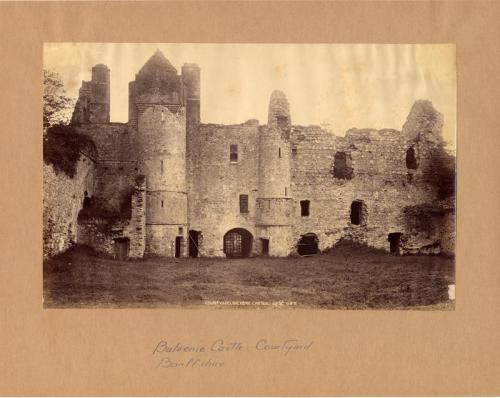
Drumin Castle
Drumin Castle is a ruined late medieval tower house located near Glenlivet in Moray, Scotland. Constructed in the 14th century, it occupies a strategic position near the confluence of the Livet and Avon rivers, an area that once served as a local village center. The castle's history is closely tied to the powerful Scottish families of the Stewarts and Gordons, reflecting the turbulent medieval period in the region.
The origins and historical significance of Drumin Castle
The lands on which Drumin Castle stands were granted by King Robert II of Scotland to his son Alexander Stewart, known as the "Wolf of Badenoch," in the early 1370s. This royal connection established the castle as part of the Stewart family's territorial holdings in the Scottish Highlands. It is believed that the tower house may have been built by Alexander's illegitimate son, Sir Andrew Stewart, further cementing the site's ties to this influential dynasty.
In 1490, ownership of the castle passed from the Stewarts to the Gordon family when Sir William Stewart sold the estate. The Gordons were a prominent noble family in northeast Scotland, and their acquisition of Drumin Castle reflects the shifting power dynamics of the late medieval period. By the 16th century, however, the castle had fallen out of residential use and was gradually abandoned.
Architectural features and structural remains
Design and defensive elements
Drumin Castle was built as a tower house, a common type of fortified residence in medieval Scotland designed to provide both defense and domestic accommodation. The surviving structure rises approximately 11.3 meters high, with stone walls up to 2.8 meters thick at the base, tapering to around 2.2 meters above the vaulted cellar. This robust masonry construction was typical of the period, aimed at resisting attacks and providing a secure stronghold.
Vaulted cellar and ground floor
The castle's lowest level contains a large vaulted cellar measuring about 11 meters by 6 meters. This space was used for storage, including wood and shelter for animals, and archaeological evidence shows it was periodically cleaned and maintained, indicating continued use even after the castle's abandonment as a residence.
Upper floors and domestic adaptations
The first floor, measuring approximately 6.5 by 7.5 meters, retains partial remains and was cleared of overgrowth during excavations in 1996. Within this floor, the stone platform of a probable fireplace was found, suggesting it served as a living or communal area. The floors above were constructed with wooden beams, with the second floor likely containing a latrine or an access structure in the south corner. The third floor featured later additions such as a fireplace, two windows, and a latrine in the north corner, reflecting adaptations to improve comfort and sanitation over time.
Later history and changes in use
After the castle was abandoned as a noble residence, its stones were gradually removed and repurposed for local farm buildings. In the 19th or 20th century, the site found a new function as a storage warehouse. During this period, a small adjoining building with two compartments and an iron gate was constructed, and a staircase was added to facilitate access to the first floor. These alterations reflect the pragmatic reuse of the structure long after its military and residential significance had ended.
Preservation and archaeological importance
Today, Drumin Castle stands as a scheduled monument, legally protected due to its cultural and historical value. The remaining walls, vaulted cellar, and ancillary structures provide a coherent archaeological record of the castle's evolution from a fortified noble residence to a utilitarian storage site. Excavations have revealed important details about medieval Scottish construction techniques, defensive architecture, and domestic life within a tower house.
The site offers valuable insights into the late medieval period in Moray and the broader Highland region. Its connections to the Stewart and Gordon families illuminate aspects of Scottish noble lineage and territorial control during a time of frequent conflict and shifting alliances.
Frequently asked questions (FAQ)
- How do I get to Drumin Castle?
- Drumin Castle is located near Glenlivet in Moray, Scotland. The nearest town is Ballindalloch, and the site can be reached by local roads. Visitors should check local maps and travel guides for the best route and parking options.
- What is the historical significance of Drumin Castle?
- Drumin Castle was built in the 14th century and is connected to the Stewart and Gordon families, important noble lineages in medieval Scotland. It reflects the defensive and domestic architecture of late medieval tower houses.
- Is Drumin Castle accessible to the public?
- As a ruin and scheduled monument, Drumin Castle is accessible for viewing, but there are no formal visitor facilities. Visitors should exercise caution around the ruins and respect the protected status of the site.
- When was Drumin Castle abandoned?
- Drumin Castle was abandoned as a residence by the 16th century and gradually fell into disrepair. Stones were repurposed for local farm buildings, and the site later served as a storage warehouse.
- What architectural features remain at Drumin Castle?
- The castle retains its vaulted cellar, thick stone walls, partial upper floors, and evidence of fireplaces and latrines. Later additions include a small two-compartment building with an iron gate and a staircase added during its use as a warehouse.
Information
Loading map...
Visitor reviews
No reviews yet. Been here? Write the first review and help other travelers!
Write the first reviewVisited this castle? Share your experience
Your review helps other travelers and adds first-hand knowledge to our encyclopedia.