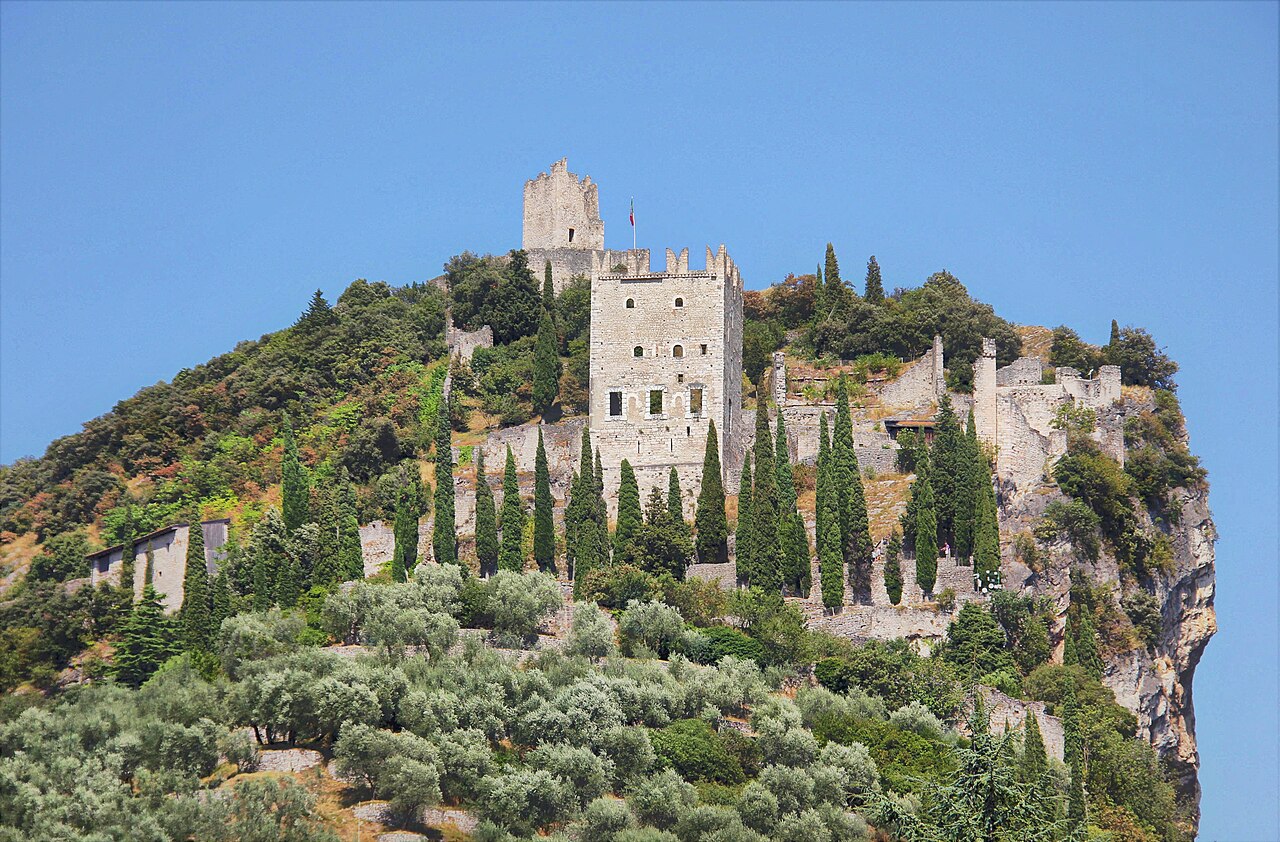
Drena Castle
Drena Castle stands as a striking example of a medieval hill castle perched atop a rocky spur in Trentino-Alto Adige, Italy. Its strategic location commands the deep gorge carved by the Rio Salagoni and controls the vital communication routes between Trento and Lake Garda. The castle's origins date back to the 12th century, likely built on the site of a prehistoric village, and it has witnessed centuries of military and noble activity, embodying the architectural and historical evolution of the region.
Historical significance and origins
The hill on which Drena Castle is situated reveals a long continuum of human occupation, beginning in the Late Neolithic period between the 4th and 3rd millennia BCE. Archaeological finds, including Bronze Age pottery and flint arrowheads, underscore the area's importance long before the medieval fortress was constructed. Although evidence of Roman or Late Antique presence remains limited, the discovery of a Carolingian fortified church dedicated to Saint Martin from the 9th century, alongside a large cemetery, highlights early medieval activity and the area's enduring strategic and religious significance.
The castle itself was first documented in 1175 as belonging to the Counts of Arco. Initially featuring a Romanesque keep and defensive walls, it served as a noble stronghold to assert control over regional routes and territories. Throughout the 13th century, the fortress became a focal point of conflict among local noble families, the Counts of Tyrol, and the Prince-Bishop of Trento. The Seiano family briefly seized the castle in 1266, only to lose it the following year to the Arco family, illustrating the turbulent power struggles of the era.
In 1301, troops loyal to Prince-Bishop Filippo Bonacolsi captured the castle as part of efforts to consolidate control over the northern Garda area. A peace treaty in 1315 temporarily affirmed the Prince-Bishop’s authority over the fortress. Later, after regional conflicts settled, a lasting peace was brokered in 1398 through the intervention of Gian Galeazzo Visconti and Leopold IV, returning the castle to the Arco family as a feudal possession in 1433.
Architectural features and construction phases
Medieval defensive structures
Drena Castle is a quintessential example of a Romanesque hill castle with significant later modifications. The castle's core is a robust Romanesque keep, a quadrangular tower rising approximately 27 meters high, dating from the 12th century. This keep served as the principal defensive stronghold and symbol of noble power. Surrounding the keep is a roughly triangular outer defensive wall about one meter thick, constructed from rubble stones and river pebbles, topped with distinctive swallowtail battlements typical of medieval fortifications in the region.
The castle’s layered defenses include an inner wall partially preserved within the outer enclosure, creating multiple lines of defense. The main entrance is accessed via a 16th-century gate tower, which leads to a weapons courtyard or bailey. Traces of a 15th-century corner tower, once the primary entrance, remain visible, alongside foundations of stables and service buildings that supported the castle’s daily functions.
Residential and functional buildings
Within the castle grounds, a 15th-century residential palace known as the Palazzo Comitale reflects the adaptation of the fortress for noble residence and leisure, serving as a hunting lodge and summer retreat. The castle also includes the remains of a 9th-century church dedicated to Saint Martin, restored and preserved as a significant historical element. The presence of a cistern with a stone barrel vault highlights the importance of water storage for sustaining inhabitants during sieges.
Excavations have uncovered pottery fragments and other artifacts within the palace and surrounding areas, now displayed in the castle’s archaeological museum. Visitors can explore restored kitchens, stables, and the cistern, gaining insight into the castle’s operational aspects and the lifestyle of its medieval occupants.
The castle’s role in regional conflicts
Throughout its history, Drena Castle was a contested stronghold due to its strategic position controlling access between Trento and Garda. It featured prominently in the power struggles involving local noble families, the Counts of Tyrol, and ecclesiastical authorities. The castle’s fortifications were tested during numerous conflicts, including the War of the Spanish Succession.
In 1703, during this war, the castle suffered significant damage when French troops under General Vendôme set it ablaze. This attack was part of a broader campaign that destroyed many castles in the region, including the nearby Rocca di Arco. The fire left the castle in ruins, and over time, local inhabitants quarried stones from the site for building materials, accelerating its decay.
Restoration and modern use
Preservation efforts for Drena Castle began in the early 20th century, with initial restoration work in 1910 halting further deterioration. The municipality of Drena acquired the castle in 1983, initiating extensive restoration and partial reconstruction between 1984 and 1988. These efforts stabilized the ruins and enhanced visitor access.
Today, the castle is a well-preserved historical site featuring a permanent archaeological museum that exhibits artifacts recovered during excavations. The castle hosts various cultural events throughout the year, attracting visitors interested in medieval history and architecture. The 25-meter-high fourteenth-century tower offers panoramic views over the evocative Marocche stone quarry, a natural glacial phenomenon consisting of an expansive field of boulders.
Despite a partial collapse of the western defensive wall in 2018, which created a large opening, the castle remains safe for visitors and continues to be a significant cultural landmark in the region.
Visitor experience and access
Visitors to Drena Castle typically begin their tour from the car park adjacent to provincial road 84. A scenic paved path leads up to the 16th-century main gate, passing through the castle’s layered defensive structures and courtyards. Along the route, visitors can observe the remains of the first door tower from the 15th century, as well as the stables, warehouses, and the Palazzo Comitale.
The castle grounds include the lawn of La Lizza, enclosed by crenellated walls, and the imposing Mastio complex dating from the 12th century. The site offers a rich combination of architectural styles and historical layers, providing an immersive experience into medieval fortification and noble life.
Throughout the year, Drena Castle hosts exhibitions and cultural events that highlight its historical and archaeological significance, making it a dynamic destination for history enthusiasts and tourists alike.
Frequently asked questions (FAQ)
- How do I get to Drena Castle?
- Drena Castle is located in the picturesque village of Drena, Italy, accessible by car or public transport from nearby cities like Trento. The nearest train station is in Trento, from where you can take a bus or taxi to reach the castle. Make sure to check local transport schedules for the most convenient options.
- What is the historical significance of Drena Castle?
- Drena Castle dates back to the 12th century and played a crucial role in the defense strategy of the region. It was a residence for various noble families, reflecting the feudal history of northern Italy. Today, it stands as a testament to medieval architecture and the rich history of the area.
- When was Drena Castle built?
- Drena Castle was constructed in the 12th century, with its strategic position chosen for defensive purposes. Over the centuries, it underwent several renovations and expansions to enhance its fortifications and living quarters. The castle's architecture showcases the evolution of medieval building techniques.
- Can I visit Drena Castle?
- Yes, Drena Castle is open to visitors, allowing you to explore its ancient walls and enjoy stunning views of the surrounding landscape. Guided tours are available, providing insights into the castle's history and architecture. Be sure to check the opening hours before planning your visit.
- Is it possible to take guided tours of Drena Castle?
- Absolutely! Guided tours are offered at Drena Castle, providing a deeper understanding of its historical significance and architectural features. These tours are typically led by knowledgeable guides who can share fascinating stories and details about the castle's past.
- What are the opening hours of Drena Castle?
- Drena Castle is generally open to visitors from April to October, with varying hours depending on the season. Typically, it opens in the morning and closes in the late afternoon, but it's advisable to check the official website for the most accurate and current information before your visit.
- What are the ticket prices for Drena Castle?
- Ticket prices for Drena Castle are quite reasonable, often ranging from €5 to €10 for adults, with discounts available for students and seniors. Children under a certain age may enter for free. Be sure to check for any special events that might affect pricing.
- When is the best time to visit Drena Castle?
- The best time to visit Drena Castle is during the spring and early autumn months when the weather is pleasant and the surrounding landscapes are vibrant. Additionally, visiting during these times allows you to avoid the summer crowds. Early mornings or late afternoons are particularly peaceful for exploration.
- Are there any nearby attractions to visit?
- Yes, Drena is surrounded by beautiful attractions, including the stunning Sarca Valley and the nearby town of Arco, known for its charming streets and historic castle. Outdoor enthusiasts can also enjoy hiking and biking trails in the region. Plan a day to explore the natural beauty and history of this enchanting area.
Information
Website
Visit websiteSources & official resources
Verify the information above using these authoritative references.
Loading map...
Visitor reviews
No reviews yet. Been here? Write the first review and help other travelers!
Write the first reviewVisited this castle? Share your experience
Your review helps other travelers and adds first-hand knowledge to our encyclopedia.