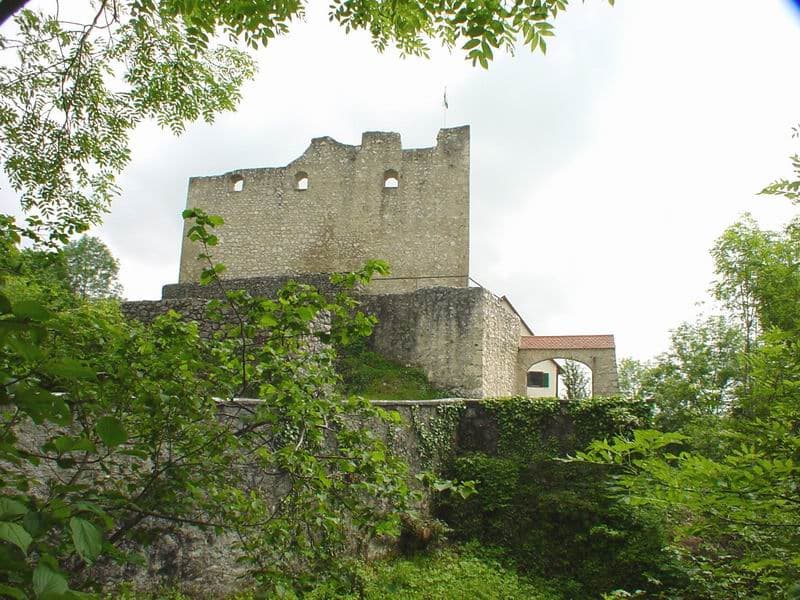
Derneck Castle — Germany castle

Derneck Castle

Derneck Castle in Hayingen, Germany
Hayingen, Thuringen, Germany
Late Medieval (14th–15th c.)
Partially Preserved

Derneck Castle, located in Hayingen, Germany, is a historic hill castle dating back to the late medieval period, around 1350. It was originally constructed by Degenhard von Gundelfingen, a member of a prominent noble family. The castle’s oldest surviving structure is its medieval tower, which remains a significant architectural feature and testament to its 14th-century origins.

Historical background and origins

The castle was built during a time when fortified residences were essential for noble families to assert control over their territories and provide defense. The Gundelfingen family played an important role in the region's medieval history, and Derneck Castle served as a strategic stronghold. While much of the original medieval complex has not survived intact, the tower remains a key element that reflects the castle’s initial defensive purpose.

Architectural features and later developments

The tower of Derneck Castle is the oldest part of the structure, showcasing typical medieval defensive architecture with thick stone walls and narrow windows designed for protection and observation. This tower would have been central to the castle’s defense system, providing a vantage point over the surrounding landscape.

In the 18th century, additional buildings were constructed around the tower, reflecting changes in architectural styles and the castle’s evolving function. These later additions likely served residential and administrative purposes rather than defense, indicating a shift from a fortress to a more domestic estate.

Current use and preservation

Today, Derneck Castle functions as a hostel, offering accommodation while preserving its historical character. The adaptive reuse of the castle allows visitors to experience a piece of medieval heritage within a living, functional space. The preservation of the medieval tower alongside the 18th-century buildings provides a layered architectural narrative spanning several centuries.

Location and significance

Situated in the region historically known as Thuringen, Derneck Castle occupies a strategic position typical of hill castles, which were often built on elevated ground for defensive advantage. Its location in Hayingen places it within a landscape rich in medieval history and cultural heritage, contributing to the broader understanding of regional noble estates and fortifications.

Visitor information and cultural value

As a site open to the public in its current function as a hostel, Derneck Castle offers an immersive historical experience. Visitors can appreciate the juxtaposition of medieval and 18th-century architecture while enjoying the castle’s unique atmosphere. The site’s preservation and continued use highlight the importance of maintaining historical structures through adaptive reuse.

Frequently asked questions (FAQ)

How do I get to Derneck Castle?
Derneck Castle is located in Hayingen, Germany, and is accessible by car or public transportation. If you are traveling by car, you can use GPS navigation for the best route, and there are parking facilities available nearby. Public transport options include local buses that connect to Hayingen.
What is the historical significance of Derneck Castle?
Derneck Castle dates back to the 13th century and has played a crucial role in the region's history. Originally built as a defensive fortress, it has witnessed numerous historical events and changes over the centuries. Today, it stands as a monument to medieval architecture and the local heritage.
When was Derneck Castle last renovated?
Derneck Castle underwent significant restoration work in the early 2000s to preserve its historical features and enhance visitor accessibility. The renovations focused on structural integrity and maintaining the castle's original charm. This ensures that visitors can appreciate the site while also enjoying modern facilities.
Can I take guided tours of Derneck Castle?
Yes, guided tours of Derneck Castle are available, providing an in-depth look at its history, architecture, and significance. These tours are led by knowledgeable guides who can share fascinating stories and insights about the castle. It's recommended to check the castle's official website for tour schedules and availability.
Why is Derneck Castle considered an architectural gem?
Derneck Castle is renowned for its impressive medieval architecture, featuring sturdy stone walls, towers, and intricate details that reflect the craftsmanship of its time. The castle's design not only served defensive purposes but also showcased the wealth and power of its former inhabitants. Its well-preserved state allows visitors to experience a piece of history first-hand.
Is it possible to host events at Derneck Castle?
Yes, Derneck Castle offers facilities for hosting events such as weddings, corporate meetings, and special celebrations. The picturesque setting and historical ambiance make it a unique venue for memorable occasions. Interested parties should contact the castle management for availability and booking details.
What are the opening hours for Derneck Castle?
Derneck Castle is typically open to visitors from 10 AM to 6 PM during the summer months, with shorter hours in the winter. It's advisable to check the official website or contact the castle directly for the most current opening hours, especially during holidays or special events. Planning your visit in advance ensures a smooth experience.
What are the ticket prices for visiting Derneck Castle?
Ticket prices for Derneck Castle are generally affordable, with discounts available for children, students, and seniors. Special family rates may also apply, making it accessible for groups. Check the castle's website for the latest pricing and any promotional offers before your visit.
What is the best time to visit Derneck Castle?
The best time to visit Derneck Castle is during the spring and early autumn when the weather is mild, and the surrounding landscapes are particularly beautiful. These seasons often feature fewer crowds, allowing for a more relaxed exploration of the castle. Additionally, special events and activities are more likely to be held during these times.
Are there nearby attractions to visit after Derneck Castle?
Yes, there are several nearby attractions worth exploring after your visit to Derneck Castle. The charming town of Hayingen offers local shops and cafes, while the surrounding region features scenic hiking trails and nature reserves. Consider visiting other historical sites or natural landmarks in the area to enhance your experience.

Photo gallery

Derneck Castle
Click to view

Photo by Mewes at German Wikipedia•Public domain

1 photo • Click any image to view in full screen

Information

Hill Castle

Loading map...

Visitor reviews

No reviews yet. Been here? Write the first review and help other travelers!

Write the first review

Visited this castle? Share your experience

Your review helps other travelers and adds first-hand knowledge to our encyclopedia.

Write a review

(5/5)

0/2000 characters

Your review will be visible after admin approval

Nearby castles

1.4 km

Niedergundelfingen Castle

Münsingen, Germany

Niedergundelfingen Castle is a historic fortress located in Münsingen, Germany, with origins dating back to around 1080. Constructed by the noble Gundelfingen family, the castle exemplifies the architectural and feudal developments typical of the high medieval period. Initially built as a fortified residence, it underwent significant enlargement around 1250, reflecting the evolving defensive needs and status of its occupants. Historical significance and ownership The castle was established by the Gundelfingen family, a prominent noble lineage in the region during the Middle Ages. The family's influence and wealth allowed them to construct and expand the castle, which served both as a stronghold and a symbol of their power. Over the centuries, Niedergundelfingen Castle remained in residential use, adapting to changing political and social conditions. By the 18th century, it was still inhabited, indicating its sustained importance in the local aristocratic landscape. Architectural features and layout Niedergundelfingen Castle was originally designed as a hill castle, strategically positioned to oversee the surrounding landscape and control access routes. The structure included typical medieval defensive elements such as sturdy walls, towers, and a gatehouse. The enlargement around 1250 likely introduced additional fortifications and expanded living quarters to accommodate the needs of its residents. Although much of the castle is now in ruins, the site still reveals remnants of its original layout, including sections of the defensive walls and foundational structures. The castle's chapel, a significant feature for medieval noble residences, has been restored, preserving an essential aspect of its historical and cultural heritage. The chapel restoration The chapel at Niedergundelfingen Castle has been carefully restored, highlighting its importance as a place of worship and community gathering within the castle complex. This restoration allows visitors to appreciate the religious architecture and the role of faith in the lives of the castle's inhabitants. Current condition and preservation Today, Niedergundelfingen Castle stands as a ruin, with much of its original structure lost to time and decay. Despite this, the site remains a valuable cultural and historical landmark, attracting visitors interested in medieval architecture and regional history. The restoration of the chapel provides a focal point for heritage conservation efforts, ensuring that part of the castle's legacy endures. Visiting Niedergundelfingen Castle The castle ruins, including the restored chapel, offer a glimpse into the medieval past of Münsingen and the surrounding region. Visitors can explore the remains of the defensive walls and imagine the castle's former grandeur. The site is accessible to the public, providing an educational experience about high medieval fortifications and noble life. Nearby attractions in Münsingen include other historical sites and natural landscapes, making Niedergundelfingen Castle a worthwhile destination for those interested in history and architecture. Architectural style and period context The castle's construction in the high medieval period places it within an era characterized by the development of stone fortifications replacing earlier wooden structures. Its architectural style is primarily Romanesque, typical for castles built in the 11th and 12th centuries, with later additions possibly showing early Gothic influences as seen in the expansion around 1250. This period saw the rise of feudalism and the need for fortified residences that combined defensive capabilities with domestic functions. Niedergundelfingen Castle exemplifies these trends through its strategic location, robust construction, and integration of a chapel within its complex.

High Medieval (11th–13th c.)
Details
1.7 km

Hohengundelfingen Castle

Münsingen, Germany

Hohengundelfingen Castle stands as a significant medieval hilltop fortress near the village of Gundelfingen within the municipality of Münsingen, Germany. Constructed around the early 13th century, the castle was likely founded by Swigger IV von Gundelfingen, a nobleman active between 1160 and 1228. This stronghold served as the ancestral seat of the influential Gundelfingen family, reflecting their regional power and status during the High Medieval period. The castle's strategic location on a gently sloping spur overlooking the Lautertal valley provided commanding views of the surrounding landscape, including the Große Lauter river and the Alb plateau. Its position was chosen for both defensive advantage and territorial oversight, typical of hill castles built during this era. Historical background and ownership The earliest documented mention of Burg Hohengundelfingen dates to 1236, confirming its existence as a noble residence by that time. The castle was a symbol of the Gundelfingen family's prominence until an inheritance division around 1250 weakened their hold on the region. In 1293, ownership transferred to the Habsburg family, marking a significant shift in control. Throughout the late 13th and 14th centuries, the castle's ownership fluctuated, often used as collateral in pledges and occasionally reclaimed by Gundelfingen descendants. This instability reflects the turbulent political landscape of the region, characterized by conflicts between noble families and emergent imperial cities. By 1389, records describe the castle as a Burgstall, indicating it had fallen into ruin. This destruction likely occurred during the regional wars involving Eberhard the Greiner and rebellious cities, though exact details of the siege or battles remain unclear. In later centuries, the site passed through various hands, including the von Landsee family and Carl Joseph Reichsgraf von Palm in 1774. The Palm family incorporated the castle's name into their own, becoming Palm-Gundelfingen. After 1805, the castle ceased to be an imperial territory, coming under the Kingdom of Württemberg's jurisdiction. The Freiherr von Gumppenberg-Pöttmös acquired it in 1812, continuing its legacy of noble ownership. The 20th century saw renewed interest when industrialist Hans Römer purchased the ruins in 1939. Römer initiated extensive restoration efforts over seventeen years, aimed at preserving and partially reconstructing the medieval fortress. Architectural features and remains Hohengundelfingen Castle is classified as a hill castle, characterized by its elevated position and defensive design. The most prominent surviving element is the bergfried, a tall, sturdy main tower approximately twelve meters high. Constructed from rusticated ashlar blocks (known as Buckelquadern in German), this masonry technique is typical of early 13th-century castle building and gives the tower its distinctive rugged appearance. The castle's layout included fortified walls, gates, and courtyards, though much of these structures have not survived intact. The bergfried would have functioned as a last refuge and lookout point, providing surveillance over the Lautertal valley and access routes below. Visitors today can appreciate the panoramic views from the bergfried and remaining ruins, which encompass the Lautertal river valley and the surrounding Alb plateau. The castle's siting on a relatively flat spur rather than a steep hill makes it accessible via a marked path from a nearby parking area, requiring only a short, gentle walk. Conservation and public access Thanks to the mid-20th-century restoration led by Hans Römer, the ruins of Hohengundelfingen Castle have been stabilized and partially reconstructed. These efforts have preserved key architectural elements, especially the bergfried, allowing the site to serve as a tangible link to the region's medieval heritage. The castle is open to the public, offering historical insights and scenic views. Its conservation status is best described as partially restored, with ongoing maintenance ensuring the ruins remain accessible and safe for visitors. The castle in regional context Hohengundelfingen Castle holds cultural and historical significance within the Lautertal valley and the broader Swabian Jura region. Its connection to the noble Gundelfingen family and later the Habsburgs highlights its role in the medieval power dynamics of southern Germany. The castle's proximity to the Große Lauter river and the village of Gundelfingen underscores its function as a territorial stronghold overseeing important local waterways and trade routes. Its ruins today stand as a monument to the complex feudal history and architectural heritage of the area. Visitor information and experience The site is accessible year-round, with no significant elevation change on the approach path, making it suitable for most visitors. Interpretive signage provides historical context, enhancing the educational value of the visit. The panoramic views from the bergfried and castle grounds are a highlight for photographers and history enthusiasts alike. Nearby towns and landmarks offer additional attractions, including Münsingen’s historic center and the scenic landscapes of the Swabian Jura. Visitors are encouraged to explore the surrounding region to gain a fuller appreciation of the castle's historical setting.

High Medieval (11th–13th c.)
Details
2.6 km

Bichishausen Castle

Münsingen, Germany

Bichishausen Castle stands as a compelling example of a medieval rock castle nestled in the Große Lautertal valley near Münsingen, Germany. Its origins trace back to the early 13th century, a period marked by regional noble power struggles and the strategic development of fortifications across the Swabian Jura. The castle's location at approximately 640 meters above sea level afforded it commanding views of the valley, the Große Lauter river, and the village of Bichishausen, underscoring its military and administrative significance in the Middle Ages. The castle's history is closely intertwined with prominent noble families such as the Counts of Achalm, the Gundelfingen family, and later the Truchsessen von Magolsheim and Buttlar families. Initially constructed in the first half of the 13th century, the castle underwent significant architectural transformations around 1300, including the demolition of an older tower and the erection of a massive shield wall. This wall was a critical defensive feature designed to protect against siege warfare, enclosing two inner courtyards and reflecting the typical layout of shield wall castles of the period. Historical development and ownership Early medieval origins and 13th-century construction The site originally belonged to the Counts of Achalm in the 11th century, likely under the rule of Rudolf. By the 13th century, ownership transitioned to the Gundelfingen family, notable regional nobles who likely commissioned the castle's construction. Key figures include Swigger IV of Gundelfingen and Konrad II, the latter serving as a judge for Württemberg, indicating the castle's role not only as a military fortress but also as a seat of local governance. 14th and 15th centuries: conflict and transition In the late 13th and early 14th centuries, the castle saw important modifications, including the demolition of the original tower and the reinforcement of defenses with the shield wall. The castle's military significance was underscored in 1372 when Kuno Truchsess von Bichishausen died fighting for Württemberg against the imperial city of Reutlingen. Following this period, the castle passed to the Truchsessen von Magolsheim family, marking a shift in ownership that reflected the complex feudal allegiances of the region. 16th century modernization and decline The 16th century brought significant changes under Heinrich Treisch von Buttlar, an imperial councilor and veteran of the Turkish wars. He modernized the castle, adapting it as a residential estate with updated living quarters and enhanced fortifications, including the addition of zwinger walls. These outer defensive enclosures were designed to trap attackers and provide layered protection. However, after the death of Heinrich's wife Anna in 1545, the castle gradually fell into disuse and decay. Later ownership and ruin Subsequent owners included Wolf von Vellberg, Count Georg II of Helfenstein, and the Prince of Fürstenberg. The castle suffered destruction during the 17th century, likely due to military conflicts or neglect, and remained in ruins thereafter. It entered private ownership in 1923 before being transferred to local authorities in 1972, prompting restoration efforts in the 1970s to preserve its remains. Architectural features and castle layout Rock castle setting and defensive design Bichishausen Castle is classified as a rock castle ruin, strategically perched on elevated terrain of the Swabian Jura. Its position on rocky outcrops enhanced natural defenses and allowed control over the border region between Württemberg and Fürstenberg. The castle was part of a network of eleven castles visible along the Lauter valley, underscoring its strategic importance. Shield wall and inner courtyards The castle's most prominent feature is its massive shield wall, a thick, tall stone barrier constructed to absorb and repel attacks. This wall encloses two inner courtyards: the outer bailey and the core castle. The core castle contained the palace and the foundations of the keep (bergfried), which was the main defensive tower. Excavations during the 1973-1975 restoration uncovered the stump of the bergfried, revealing its robust 13th-century construction. 16th-century zwinger walls and later fortifications In the 16th century, the castle's defenses were augmented with zwinger walls, additional outer enclosures designed to trap invaders and provide layered defense. These walls were built from locally sourced stone, integrating with the natural rocky terrain. The zwinger created a narrow killing zone between the outer walls and the main shield wall, enhancing the castle's defensibility against artillery and infantry assaults. Visitor experience and present condition Ruins and panoramic views Today, the ruins of Bichishausen Castle are freely accessible to visitors. The site offers a unique opportunity to explore medieval fortifications amidst the natural beauty of the Große Lautertal valley. Visitors can observe the remnants of the shield wall, bergfried foundations, and zwinger walls, gaining insight into medieval defensive architecture. The elevated position provides sweeping panoramic views of the valley, river, and village below. Visitor tips and safety considerations Visitors wishing to climb the castle ruins should exercise caution, especially during wet or snowy weather. The steel stairs installed for access can become slippery, making careful footing essential. The castle is rarely visited by tourists, offering a tranquil experience for those interested in history, architecture, and nature. Cultural and historical significance Bichishausen Castle exemplifies the evolution of medieval fortifications in southern Germany, reflecting changes in military technology, noble residence standards, and regional power dynamics from the 13th through the 16th centuries. Its layered construction phases—from the original 13th-century keep and shield wall to the 16th-century zwinger additions—illustrate the adaptation of castle architecture to new defensive needs. The castle's role in regional conflicts, including the 14th-century wars involving Württemberg and Reutlingen, situates it within the broader historical narrative of territorial disputes in the Holy Roman Empire. The involvement of notable families such as the Gundelfingens, Truchsessen, and Buttlar underscores the castle's importance as a noble seat and military stronghold. Preservation efforts in the 20th century have ensured that the ruins remain a valuable cultural heritage site, providing educational and recreational opportunities while maintaining the historical integrity of the structure. The castle's integration into the landscape of the Swabian Jura continues to attract historians, architects, and visitors interested in medieval fortifications and German history.

High Medieval (11th–13th c.)
Details

