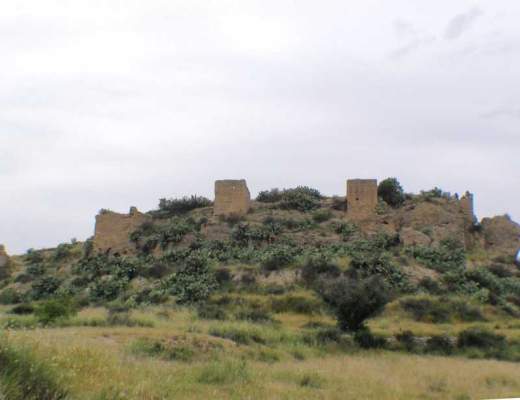
Del Río Castle
Del Río Castle, known locally as Castillo del Río, is a historic fortress situated on a hill east of the town of Aspe in the province of Alicante, Spain. It occupies a strategic position on a mound called Tabayá, near the confluence of the Tarafa and Vinalopó rivers. The castle's location provided control over the valley route leading towards Elche, making it a significant military and administrative site during the High Medieval period.
Constructed in the early 12th century under Almoravid rule, the castle likely replaced an earlier Iberian settlement, reflecting the region's layered history of occupation. The fortress was designed to follow the natural contours of the hill, forming a roughly oval walled enclosure. It featured 12 square towers connected by robust curtain walls, built primarily for defense and surveillance. Unlike many contemporary castles, Del Río Castle did not have a central keep or donjon. Instead, its defensive strength lay in the perimeter towers and walls.
Architectural features and layout
The castle's design emphasizes its role as a fortified settlement rather than a noble residence. The twelve towers were evenly spaced along the curtain walls, providing overlapping fields of fire and observation points. The walls were constructed with local stone, and their thickness was sufficient to withstand siege engines of the time. The absence of a keep suggests that the castle's defense relied on the collective strength of its walls and towers.
Del Río Castle's position allowed for intervisibility with Del Mola Castle to the north, enabling communication and coordinated defense between the two fortifications. The castle also served as the nucleus of a village known historically as "Old Aspe," which developed within its protective walls. This village was eventually relocated in the 13th century to the site of present-day Aspe, likely due to changing political and economic circumstances.
Historical context and ownership
During the 12th century, the castle was part of the Almoravid frontier in the Iberian Peninsula. In 1265, it was conquered by the forces of Alfonso X of Castile, marking a shift in control from Muslim to Christian rule. Later, in 1296, the castle was occupied by Aragonese troops and entrusted to the lords of Crevillente. This reflected the complex political landscape of the region during the Reconquista.
By 1304, Del Río Castle was fully incorporated into the Kingdom of Valencia. At the end of the 15th century, ownership passed to the Counts of Cocentaina, a noble family with significant influence in the area. Following the expulsion of the Muslims in the early 17th century, the surrounding lands were depopulated. In 1611, the Marquess of Elche initiated efforts to repopulate the area with Christian settlers, reflecting broader demographic and social changes in post-Reconquista Spain.
Current condition and visitor information
Today, the remains of Del Río Castle are accessible to the public. The site is classified as a hill castle with partially preserved structures, primarily consisting of the surviving sections of the curtain walls and some towers. While the castle does not retain elaborate architectural details or interiors, it offers valuable insight into medieval military architecture and the historical landscape of Alicante.
Visitors can explore the ruins freely, though the site lacks extensive interpretive materials or facilities. The castle's modest remains provide a tangible connection to the region's High Medieval heritage and its role in the shifting political boundaries of medieval Spain.
Significance in medieval military architecture
Del Río Castle exemplifies the strategic use of natural topography in castle construction during the High Medieval period. Its design prioritizes defense and surveillance over residential comfort, characteristic of frontier fortifications during the Reconquista. The castle's network of towers and curtain walls allowed defenders to monitor and control movement through the valley effectively.
The castle's lack of a central keep is notable, as most contemporary fortresses featured a stronghold tower as the last line of defense. Instead, Del Río relied on its perimeter fortifications, which may indicate a design adapted to the specific terrain and tactical needs of the region. Its intervisibility with nearby fortifications like Del Mola Castle reflects a coordinated defensive system common in medieval Spain.
Frequently asked questions (FAQ)
- How do I get to Del Río Castle?
- Del Río Castle is located south of the CV-847 road in Spain. Visitors can reach the castle by car or through local public transport options. There are signs along the road to guide you to the castle's entrance.
- What is the historical significance of Del Río Castle?
- Del Río Castle dates back to the medieval period and played a crucial role in the defense of the region against invasions. Its strategic location allowed it to serve as a lookout point and stronghold for local rulers. The castle is a testament to the architectural and military history of the area.
- When was Del Río Castle built?
- Construction of Del Río Castle began in the late 12th century and was completed in the early 13th century. It was built during a time of turmoil and conflict in the region, reflecting the need for fortified structures. The castle has undergone various renovations and restorations over the centuries.
- Can I take guided tours of Del Río Castle?
- Yes, guided tours are available for those interested in learning more about the history and architecture of Del Río Castle. These tours typically include insights into the castle's strategic importance and details about its construction. It is recommended to book in advance, especially during peak tourist seasons.
- Why is Del Río Castle a popular tourist destination?
- Del Río Castle attracts visitors due to its rich history, stunning views, and well-preserved architecture. The castle offers a glimpse into medieval life and provides ample opportunities for photography and exploration. Additionally, its location near other historical sites makes it an ideal stop for tourists.
- Is it possible to access Del Río Castle with a wheelchair?
- While Del Río Castle has some accessible areas, the uneven terrain and steep paths may pose challenges for wheelchair users. It is advisable to contact the castle management in advance to inquire about specific accessibility options. They can provide the most up-to-date information on facilities and assistance available.
- What are the opening hours for Del Río Castle?
- Del Río Castle is typically open to visitors from 10 AM to 6 PM, but hours may vary depending on the season. It is best to check the official website or contact the castle directly for the most current opening times. Special holiday hours may also apply.
- What are the ticket prices for visiting Del Río Castle?
- Ticket prices for Del Río Castle are generally affordable, with discounts available for students and seniors. Children under a certain age may enter for free. For the latest pricing information and any special promotions, it is recommended to visit the castle's official website.
- What nearby attractions can I visit while at Del Río Castle?
- In addition to Del Río Castle, visitors can explore several nearby attractions such as local museums, historic towns, and natural parks. The surrounding area is rich in culture and offers opportunities for hiking and enjoying the scenic landscape. Planning a full day of exploration can enhance your visit to the castle.
Loading map...
Visitor reviews
No reviews yet. Been here? Write the first review and help other travelers!
Write the first reviewVisited this castle? Share your experience
Your review helps other travelers and adds first-hand knowledge to our encyclopedia.