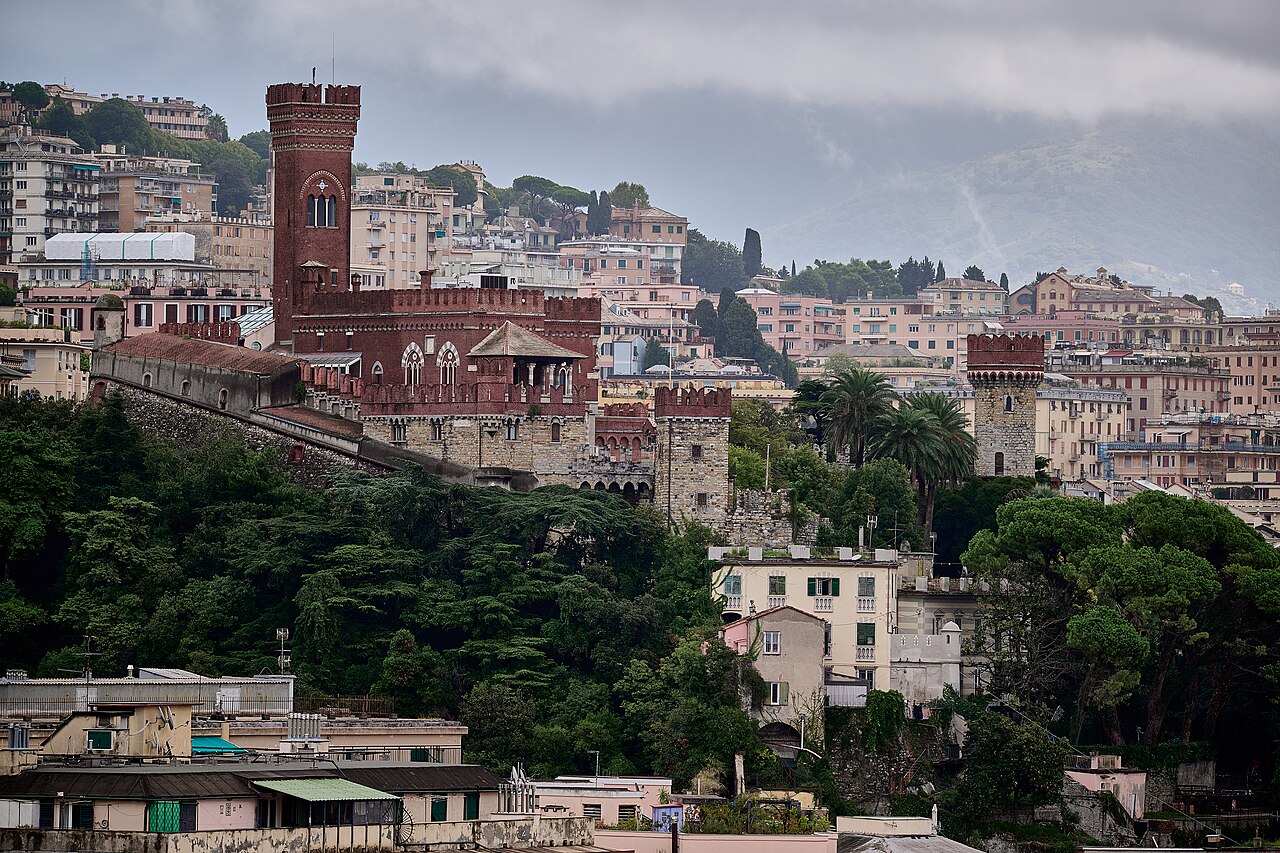
D'Albertis Castle stands as a distinctive example of 19th-century Gothic Revival architecture in the city of Genoa, Italy. Built between 1886 and 1892, this castle was designed by the sea captain and explorer Enrico Alberto d'Albertis as a residence that reflected his passion for history, exploration, and art. The castle's design is an eclectic architectural collage, drawing inspiration from the palatial Gothic structures of Florence and the medieval castles of the Aosta Valley. Its location on a historic fortified site adds layers of historical significance, as it incorporates the foundations of a 13th-century fortress and a 16th-century bastion.
Architectural design and historical foundations
The castle was constructed under the supervision of the prominent Gothic Revival architect Alfredo D'Andrade, who collaborated closely with d'Albertis to realize a structure that combined historical authenticity with romantic medieval aesthetics. The castle's exterior features turrets, battlements, and crenellated walls typical of Gothic Revival style, while the interior is richly decorated with artifacts and design elements reflecting d'Albertis's global travels.
D'Albertis carefully preserved the original medieval foundations, including a bastion and a turret from the earlier fortifications, integrating them into the new construction. This fusion of old and new creates a unique architectural dialogue between Genoa's medieval past and the 19th-century revivalist movement.
Museum of world cultures
Since its donation to the city of Genoa upon d'Albertis's death in 1932, the castle has served as a cultural institution. In 2004, it was inaugurated as the Museo delle Culture del Mondo (Museum of World Cultures), showcasing an extensive collection of ethnographic and archaeological artifacts gathered by Enrico and his relative Luigi Maria d'Albertis during their explorations across Africa, the Americas, New Guinea, and Oceania.
The museum's collections include a diverse range of objects such as weapons from Sudan and the Zambezi region, Chinese spears, and European halberds. Visitors can also view traditional clothing made from buffalo and deer leather adorned with porcupine quills from indigenous peoples of the Canadian and American plains. Notably, the museum holds artifacts from the Maya civilization of Honduras, highlighting the broad geographic scope of the collection.
Additional exhibits focus on maritime history, featuring models of ships and yachts, nautical instruments, and photographs from d'Albertis's personal library. A separate section, the Museo delle Musiche dei Popoli (Museum of Peoples' Music), displays an impressive array of musical instruments from around the world, emphasizing the cultural diversity represented within the castle.
Cultural and historical significance
D'Albertis Castle is not only an architectural landmark but also a repository of global cultural heritage. It reflects the 19th-century European fascination with exploration and ethnography, embodied by d'Albertis's own voyages and collections. The castle's preservation of medieval foundations connects it deeply to Genoa's historical fabric, while its function as a museum broadens its role to an educational and cultural center.
The castle's location on a hill overlooking Genoa provides panoramic views of the city and the Ligurian Sea, enhancing its appeal as a tourist destination. Its well-preserved Gothic Revival style, combined with the rich museum collections, makes it a unique site for those interested in architecture, history, and world cultures.
Visiting information and accessibility
The castle is open to the public, welcoming visitors who wish to explore its architectural features and extensive museum collections. The museum offers guided tours and educational programs to deepen visitors' understanding of the artifacts and the castle's history. Its accessibility and cultural offerings make it a significant attraction within Genoa's rich heritage landscape.
Frequently asked questions (FAQ)
- What is the historical significance of D'Albertis Castle?
- D'Albertis Castle was built on the foundations of a 13th-century fortress and reflects 19th-century Gothic Revival architecture. It houses extensive ethnographic collections gathered by Enrico Alberto d'Albertis during his global explorations.
- Can I visit the Museum of World Cultures inside the castle?
- Yes, the castle houses the Museo delle Culture del Mondo, open to the public with exhibits of artifacts from Africa, the Americas, Oceania, and more.
- What architectural style characterizes D'Albertis Castle?
- The castle is designed in the Romantic Neo-Gothic style, featuring turrets, battlements, and crenellated walls inspired by medieval castles and palaces.
- When was D'Albertis Castle built?
- Construction took place between 1886 and 1892 under the supervision of Alfredo D'Andrade, a noted Gothic Revival architect.
- Is the castle well preserved?
- Yes, D'Albertis Castle is well preserved, maintaining its original Gothic Revival features and medieval foundations.
Information
Current owner
Municipality of Genoa
Loading map...
Visitor reviews
No reviews yet. Been here? Write the first review and help other travelers!
Write the first reviewVisited this castle? Share your experience
Your review helps other travelers and adds first-hand knowledge to our encyclopedia.