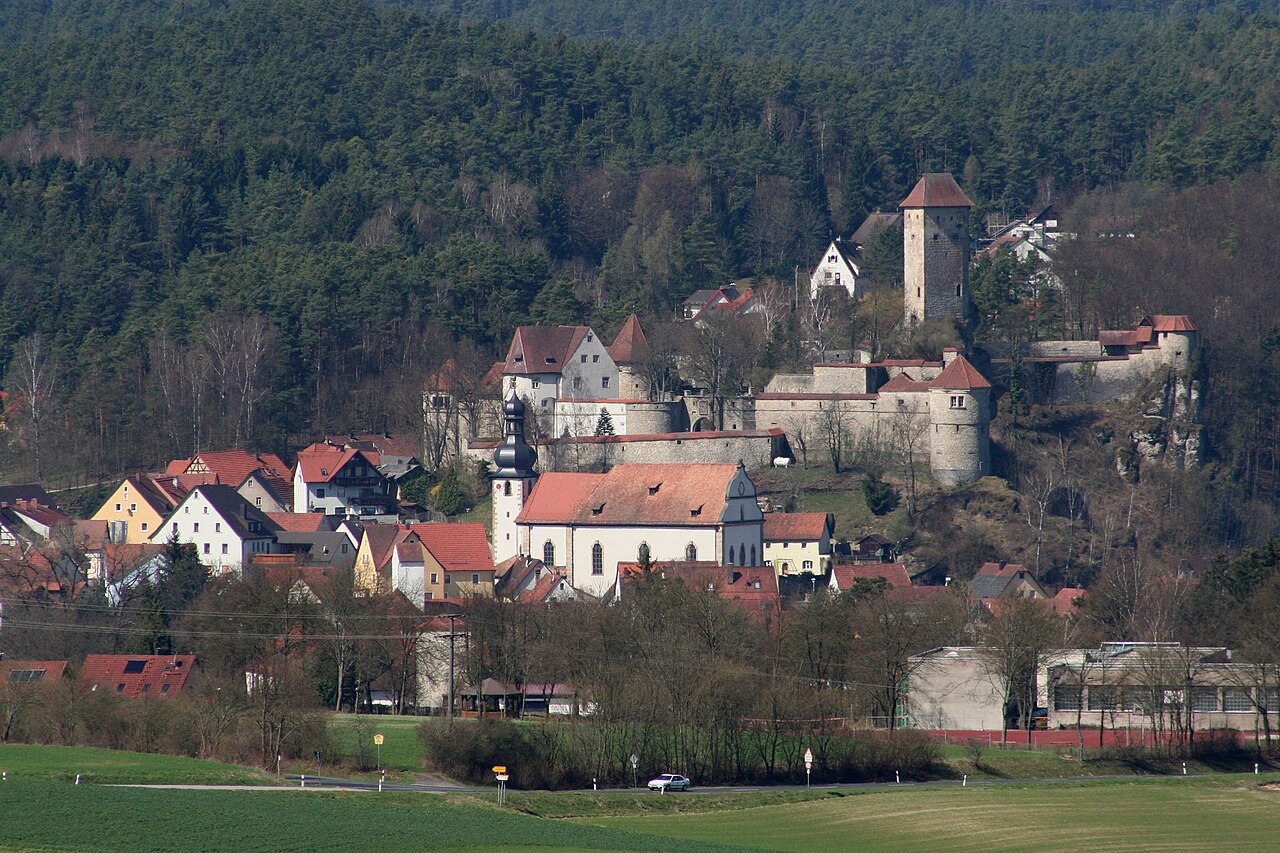
Dagestein Castle
Dagestein Castle stands as a remarkable example of a high medieval hill castle located in the town of Vilseck, in the Upper Palatinate region of modern-day Germany. Constructed in the 12th century, this fortress has witnessed centuries of historical developments, architectural transformations, and regional conflicts, making it a significant cultural landmark. The castle’s origins are closely tied to the noble Dagestein family, whose presence is documented as early as 1205, linking the site to the medieval aristocracy of the region.
The castle’s most prominent feature is its Romanesque keep, a towering structure built around 1200 from carefully cut sandstone blocks with rusticated bossage. This five-story tower was designed not only for defense but also for administrative and residential purposes. Its thick walls, measuring approximately two meters, and elevated entrance reflect typical medieval defensive strategies. The keep’s interior includes a vaulted ground floor with ribbed arches and a chapel dedicated to Saint George on the second floor, highlighting the castle’s dual military and religious functions.
Historical context and medieval origins
Although the exact date of Dagestein Castle’s initial construction remains uncertain due to limited early documentation, the first written mention of Vilseck dates to 1185, and references to Megelaus of Dagestein in 1205 firmly establish the castle’s medieval heritage. Archaeological investigations have not uncovered evidence of earlier foundations, confirming the castle’s origin in the high medieval period.
The castle served as the seat of the Dagestein family until their lineage ended, after which the fortress became closely associated with the growing settlement of Vilseck. This transition reflects the castle’s evolving role from a noble residence to a community stronghold. In the 15th century, Dagestein was converted into a water castle by incorporating surrounding moats, enhancing its defensive capabilities.
Sieges, conflicts, and reconstruction
Dagestein Castle’s strategic importance is underscored by its involvement in regional conflicts. In 1512, it was looted and burned during a feud involving the renowned knight Götz von Berlichingen and the Bishop of Bamberg. This violent episode caused significant damage, necessitating extensive rebuilding efforts. The castle’s resilience was demonstrated through this reconstruction, which restored its defensive and residential functions.
In 1552, the castle was seized by Margrave Albrecht Alcibiades of Brandenburg-Kulmbach, marking a shift in its use from a noble residence to more practical roles such as a granary and prison. This change reflects broader political and social transformations in the region during the Renaissance period.
Architectural features and defensive elements
The keep and its construction
The keep is the castle’s architectural centerpiece, constructed from finely dressed Seugast sandstone blocks. Its walls bear numerous mason’s marks, some identical to those found in the crypt of Bamberg Cathedral, suggesting skilled craftsmanship and possible collaboration among medieval builders. The ground floor is a vaulted room without windows, designed for security and storage, while the elevated entrance provided protection against invaders.
Gatehouse and fortifications
The castle’s gatehouse originally featured a chapel above it, serving an apotropaic function believed to protect the fortress from evil. In the 14th century, this gatehouse was heightened to become a secondary keep, combining the Romanesque base with a late Gothic upper section. The gatehouse was modified during Vilseck’s town fortifications starting in 1332, including the closure of most original gate openings and the addition of a town-side entrance. The interior space was used as a prison until the 18th century.
Outer defenses and moat
Dagestein Castle was protected by a ring wall (enceinte) enclosing a central courtyard, a zwinger or outer ward defending vulnerable approaches, and a moat surrounding the east and west sides. Although the moat has since been filled in, its original presence was crucial for defense. The castle’s layered fortifications demonstrate its military importance throughout the medieval period.
Later history and modern restoration
Following the secularization processes of 1802, parts of the castle property were sold to local residents, reflecting changing ownership and uses. The castle also held notable prisoners, including the bandit leader Franz Troglauer in the late 18th century.
Today, Dagestein Castle is owned by the city of Vilseck. Between 1999 and 2002, extensive restoration focused on preserving the main tower (Bergfried) and the tithe barn (Zehntkasten). These efforts have maintained the castle’s historical and architectural integrity, allowing it to serve as a cultural and community site.
Architectural significance and cultural heritage
Dagestein Castle exemplifies the evolution of medieval fortifications in Bavaria, blending Romanesque and Gothic architectural elements. Its well-preserved keep, gatehouse, and defensive structures offer valuable insights into medieval construction techniques, defensive strategies, and the social history of the region. The castle’s connection to notable historical figures and events further enhances its cultural importance.
Visitors to Dagestein Castle can appreciate the layered history visible in its architecture and the surrounding town of Vilseck, which grew in tandem with the fortress. The castle remains a testament to the region’s medieval heritage and the enduring legacy of its builders and inhabitants.
Frequently asked questions (FAQ)
- How do I get to Dagestein Castle in Vilseck?
- Dagestein Castle is located in the town of Vilseck, Bavaria, Germany. It is accessible by car via local roads, and public transportation options include regional buses connecting Vilseck with nearby cities. Visitors should check local transit schedules for the most convenient routes.
- What are the main architectural features of Dagestein Castle?
- The castle features a prominent Romanesque keep built around 1200, a gatehouse with Gothic modifications, a defensive ring wall, a zwinger, and remnants of a moat. The keep includes a vaulted ground floor and a chapel dedicated to Saint George on the second floor.
- When was Dagestein Castle built and who built it?
- Dagestein Castle was constructed in the 12th century by medieval settlers associated with the noble Dagestein family. The earliest written records mentioning the castle date to the early 13th century.
- Can I visit the interior of the keep at Dagestein Castle?
- Access to the interior of the keep may be limited due to preservation efforts. Visitors can explore the castle grounds and view the exterior of the keep, with guided tours available during certain times of the year. It is recommended to check with the local tourist office for current visiting options.
- Why was Dagestein Castle converted into a water castle in the 15th century?
- The conversion into a water castle involved adding moats around the castle to enhance its defensive capabilities. This adaptation reflected the evolving military strategies of the 15th century, aiming to better protect the fortress against siege warfare.
- Is Dagestein Castle open year-round?
- Visiting hours may vary seasonally. Typically, the castle is open to visitors during the warmer months, with possible closures in winter. It is advisable to check the official Vilseck city website or tourist information for up-to-date opening times.
Information
Sources & official resources
Verify the information above using these authoritative references.
Loading map...
Visitor reviews
No reviews yet. Been here? Write the first review and help other travelers!
Write the first reviewVisited this castle? Share your experience
Your review helps other travelers and adds first-hand knowledge to our encyclopedia.