Czocha
Czocha Castle, located in the village of Czocha in Poland, is a remarkable example of a late medieval bastioned fortress with a complex and layered history spanning several centuries. Perched on a natural granite outcrop above the Kwisa River and the Leśniańskie Reservoir, the castle's strategic location has played a vital role in its historical significance as a defensive stronghold and noble residence.
The origins of Czocha Castle date back to the mid-13th century, with the earliest mentions appearing in 1329. While the exact founding date and builder remain uncertain, it is widely believed that the initial fortification was erected between 1241 and 1247, possibly under the auspices of King Wenceslaus I of Bohemia. Initially, the castle was a modest stone fortress laid out on a quadrangular plan with a cylindrical tower at the northwest corner, constructed on the sturdy gneiss rock that forms the foundation of the site. This early design reflects typical medieval defensive architecture, combining natural topography with man-made fortifications.
Early history and medieval significance
Throughout the 13th and 14th centuries, Czocha Castle's ownership changed several times, reflecting the turbulent political landscape of the region. In 1253, the castle was granted to Konrad von Wallhausen, Bishop of Meissen, after briefly coming under the control of the Margraviate of Brandenburg. By 1319, the castle became part of the Duchy of Jawor, ruled by Henry I of Jawor, and following his death, it passed to his nephew Bolko II the Small, Duke of Świdnica. Both rulers played crucial roles in fortifying the castle and maintaining its strategic importance along the border between Silesia and Lusatia.
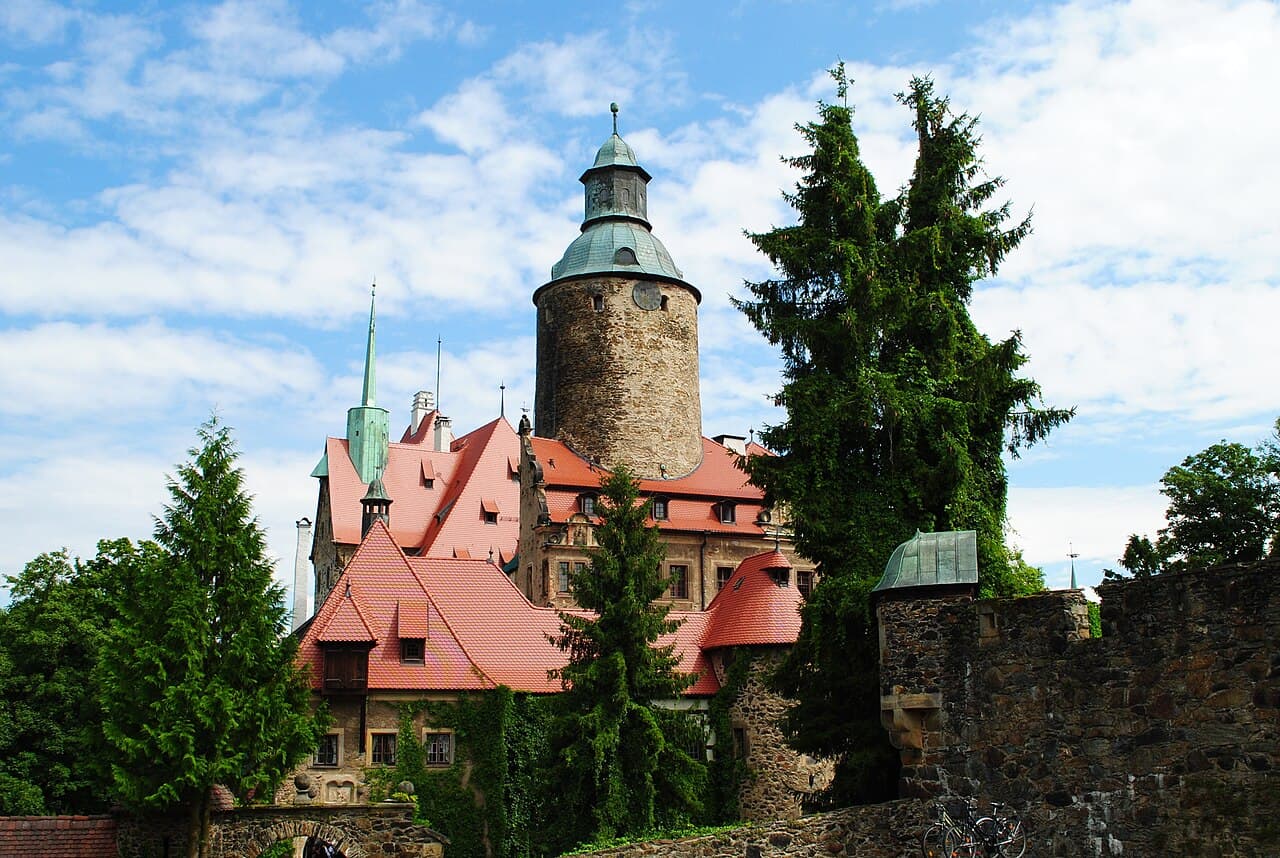
During this period, the castle evolved from a purely military fortress to a noble residence. The residential building, trapezoidal in plan and rising four stories high, was added, enhancing the castle's livability while maintaining its defensive capabilities. The cylindrical tower, a dominant feature of the complex, was topped with a Renaissance helmet during later renovations, symbolizing the blend of medieval and Renaissance architectural influences.
Hussite wars and noble ownership
In the early 15th century, Czocha Castle witnessed military action during the Hussite Wars. In 1433, while the owner Hartung von Klüx was absent, the castle was temporarily seized by Hussite forces under the command of Hans von Czirna from nearby Niesytno. However, the castle was reclaimed by von Klüx the following year. The castle then passed into the hands of the von Nostitz family in 1451, who owned it for approximately 250 years. Under their stewardship, the castle underwent significant Renaissance-style renovations in 1525, including the addition of bastions and modernization of fortifications to adapt to evolving military technology.
Renaissance and baroque transformations
The 16th and early 17th centuries were a period of architectural transformation for Czocha Castle. The 1525 renovations by Johann von Nostitz introduced Renaissance elements, reflecting contemporary tastes and defensive needs. Around 1611, further remodeling took place, continuing to enhance the castle's fortifications and residential quarters.
In 1700, the castle was sold to Johan Hartwig von Uechtritz, a counselor to King Augustus II the Strong. Under von Uechtritz's ownership, the castle suffered a devastating fire on August 17–18, 1793, which destroyed roofs, the tower, interior furnishings, archives, and the armory. The subsequent reconstruction introduced a four-sided Baroque roof covered with slate, replacing the earlier tiled medieval roofs, and the castle tower was heightened to its present form.
20th-century restoration and modern use
In 1905, the castle was acquired by Ernest Friedrich Gütschow, a Dresden banker and industrialist, who commissioned a comprehensive restoration led by the renowned Berlin architect Bodo Ebhardt. This renovation, completed in the early 20th century, transformed Czocha Castle into a neo-Gothic residence with richly decorated interiors, blending historical styles with modern comforts. The restoration was guided by a 1703 painting of the castle, aiming to revive its historic character while adding romanticized Gothic elements popular at the time.
During World War II, the castle was reportedly used by the German military, with unconfirmed reports suggesting it may have housed an Abwehr cipher school. After the war, the castle was looted and suffered damage from both Soviet troops and Polish thieves. In the late 1940s and early 1950s, it served as a refuge for Greek political refugees. From 1952, the Polish Army used the castle as a military vacation resort, during which time it was removed from official maps for security reasons.
Since 1996, Czocha Castle has been open to the public as a hotel and conference center, offering visitors a unique opportunity to experience its historic ambiance. The castle's picturesque setting, well-preserved architecture, and rich history have made it a popular location for films and cultural events. It also hosts the College of Wizardry, a live-action role-playing game inspired by fantasy literature, attracting enthusiasts from around the world.
Architectural features and layout
Czocha Castle's layout reflects its evolution from a medieval fortress to a Renaissance residence and later a neo-Gothic romanticized structure. The complex consists of two lower baileys and the upper castle, accessible via a stone bridge spanning a dry moat. The oldest surviving element is the cylindrical tower, crowned with a Renaissance helmet, which dominates the silhouette of the castle.
The inner courtyard features a historic well known as the "well of unfaithful wives," dating back to the castle's original construction. The main entrance is adorned with an early Baroque portal embellished with heraldic cartouches, reflecting the noble families who owned the castle over the centuries.
One of the most notable interiors is the Knight's Hall, a two-story chamber featuring a white neo-Gothic fireplace and an oak beam ceiling. Along the southern and western walls runs a beautifully carved wooden balcony supported by corbels and Ionic columns, showcasing exquisite craftsmanship from the early 20th-century restoration.
The castle also contains stained glass windows created by the artist Eduard Stritt, who worked between 1870 and 1937, adding to the historic atmosphere of the interiors. Heraldic decorations throughout the castle commemorate the von Nostitz, von Üchtritz, von Seydlitz, and von Gütschow families, linking the architecture to its rich lineage.
Defensive elements
Originally designed as a border fortress, Czocha Castle incorporated numerous defensive features, including bastions added during the Renaissance renovations, thick stone walls, and strategically placed towers. The dry moat surrounding the upper castle and the stone bridge controlling access are typical of fortifications designed to withstand sieges and artillery attacks.
Cultural significance and tourism
Czocha Castle is one of Poland's most famous and picturesque castles, frequently featured in calendars, books, and films. Its romantic architecture and dramatic history attract visitors interested in medieval and Renaissance heritage. The castle offers a variety of attractions, including guided tours, night tours that explore its hidden corners and legends, and themed events.
Recognized for its unique blend of history and contemporary cultural activities, Czocha Castle was named one of the "7 new wonders of Poland" by National Geographic Traveler in 2012. It is also a pet-friendly destination, welcoming visitors who travel with animals.
For those seeking a romantic getaway, the castle hotel provides an atmospheric experience with candlelit dinners, live music, and elegant accommodations. Adventure seekers can enjoy immersive night tours that reveal the castle's mysteries and ghost stories, making a visit to Czocha Castle an unforgettable experience.
In summary, Czocha Castle stands as a testament to the region's turbulent history, architectural evolution, and cultural vitality. Its well-preserved structures, layered historical narratives, and vibrant modern use make it a must-visit landmark in Poland's castle heritage.
Frequently asked questions (FAQ)
- How do I get to Czocha Castle?
- Czocha Castle is located in the picturesque village of Czocha, Poland. You can reach it by car from major cities like Wrocław or Jelenia Góra, with ample parking available on-site. Public transportation options may include local buses, but checking schedules in advance is recommended.
- What is the historical significance of Czocha Castle?
- Czocha Castle dates back to the 13th century and has a rich history involving various noble families and significant historical events. It served as a defensive fortress and later as a residence, playing a role in regional politics and military strategies. Today, it stands as a testament to medieval architecture and heritage.
- When was Czocha Castle built?
- Czocha Castle was constructed in the late 13th century, with its earliest mentions recorded in 1292. Over the centuries, it underwent numerous renovations and expansions, reflecting the architectural styles of the different periods. This long history makes it one of the most interesting landmarks in Poland.
- Can I take a guided tour of Czocha Castle?
- Yes, Czocha Castle offers guided tours that provide insights into its history, architecture, and legends. These tours are available in multiple languages and are led by knowledgeable guides who bring the castle's past to life. It's advisable to check the schedule and book in advance, especially during peak tourist seasons.
- Why is Czocha Castle a popular tourist destination?
- Czocha Castle attracts visitors due to its stunning architecture, scenic location, and captivating history. It also hosts various events, exhibitions, and reenactments that immerse guests in the medieval experience. The castle's beautiful surroundings and unique charm make it a must-visit site for both history enthusiasts and casual tourists.
- Is it possible to stay overnight at Czocha Castle?
- Yes, Czocha Castle offers accommodation options for visitors who want to experience the castle's ambiance overnight. You can choose from various themed rooms that provide a unique experience. Staying overnight allows guests to enjoy the castle after hours and take in the serene atmosphere.
- What are the opening hours of Czocha Castle?
- Czocha Castle typically opens to visitors from 10 AM to 6 PM, but hours may vary based on the season and special events. It is recommended to check the castle's official website for the most current opening hours and any potential changes. Planning your visit around these hours can enhance your experience.
- What are the ticket prices for visiting Czocha Castle?
- Ticket prices for Czocha Castle vary depending on age and the type of tour chosen. Generally, adult tickets are priced around 20 PLN, while discounts are available for children and students. Special events may have different pricing, so it's best to consult the official website for detailed information.
- What is the best time to visit Czocha Castle?
- The best time to visit Czocha Castle is during the spring and early autumn months when the weather is mild and the surrounding scenery is particularly beautiful. Summer months can be crowded, while winter offers a magical, quiet atmosphere if you enjoy a winter wonderland. Each season provides a unique perspective on the castle and its surroundings.
Photo gallery

Information
Website
Visit websiteSources & official resources
Verify the information above using these authoritative references.
Loading map...
Visitor reviews
No reviews yet. Been here? Write the first review and help other travelers!
Write the first reviewVisited this castle? Share your experience
Your review helps other travelers and adds first-hand knowledge to our encyclopedia.