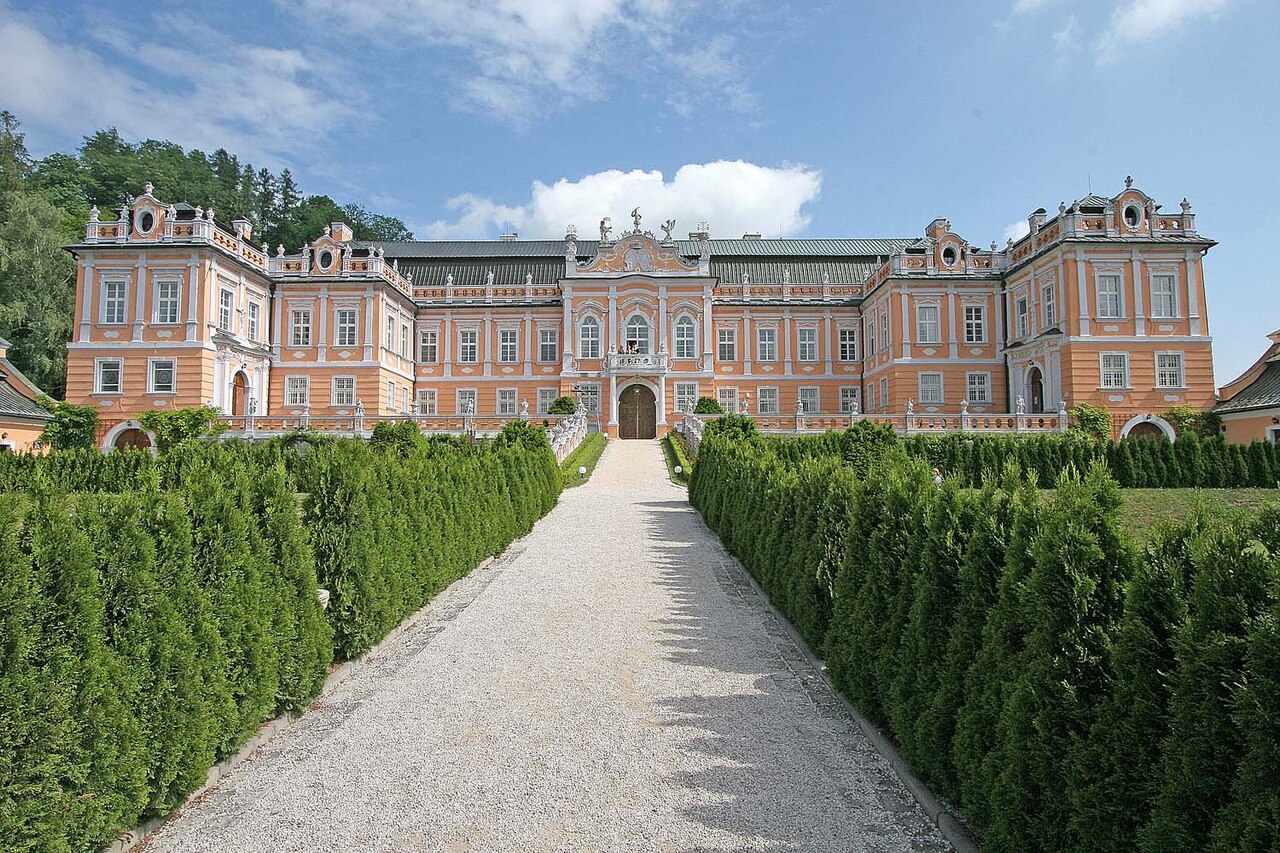
Cuknštejn Fortress
Cuknštejn Fortress stands as a remarkable example of a late Gothic hill castle nestled near the village of Světví within the municipality of Nové Hrady in the South Bohemian Region of the Czech Republic. This fortress, with origins tracing back to the medieval period, served as both a fortified noble residence and an administrative center, reflecting the complex feudal history and architectural evolution typical of the region.
Medieval origins and early history
The earliest known association of the site dates to the 14th century, when the noble family of Žestovci from Světví likely maintained a manor house here. Historical documents from 1383 mention Petr and Zachař of Žestov, indicating the presence of local lords connected to the estate. This initial manor would have been a modest fortified residence, typical of the period, designed to assert control over the surrounding lands.
Following the upheavals of the Hussite Wars in the early 15th century, the fortress changed hands several times, illustrating the turbulent political landscape of Bohemia. Prominent families such as Erazim of Michnice and Janko Žestovec of Svébohy became owners, each contributing to the estate's development and fortification, adapting it to the needs of defense and noble residence.
Late Gothic transformation under the Pouzar family
The most significant phase of construction occurred between 1488 and 1491, when Vilém Pouzar of Michnice, son of Erazim, undertook extensive building works that established the core of the fortress in its characteristic late Gothic style. The Pouzar family, influential landowners controlling multiple estates, transformed the site into a robust stronghold with a roughly rectangular layout, enclosing a small square courtyard.
This period saw the construction of the fortress's four wings, arranged around the courtyard, with the western and eastern wings being the oldest and mostly one story high. The architectural design incorporated defensive features such as thick stone walls, a stone-lined moat, and an earth embankment, reflecting the military architectural principles of the late medieval period.
Architectural features and defensive design
Cuknštejn Fortress is notable for its stone gallery (pavlač) that wraps around three sides of the courtyard on the upper floor, accessible via two symmetrical staircases on the northern side. This feature allowed covered movement between rooms and provided a vantage point for surveillance and defense.
The southern wing is taller, with two stories, and contains the main entrance through a Gothic-style portal. This wing was built over an earlier entrance tower, which was integrated into the outer defensive walls, enhancing the fortress's security. At the northwest corner stands a younger, two-story octagonal tower, rising above the surrounding wings and serving as a lookout and defensive strongpoint.
The fortress was originally surrounded by a stone-lined moat and an earth embankment, typical defensive measures for hill castles of the period. Although the moat on the southern side has been filled in, the remaining sections illustrate the fortress’s strategic design to repel attackers.
Historical events and ownership changes
During the 16th century, ownership of Cuknštejn Fortress changed several times, reflecting the shifting political and social landscape. By 1570, Jiřík Kába of Rybňany became the owner, maintaining possession until his death in 1620.
The early 17th century brought significant turmoil during the Bohemian Revolt (1618–1620) against Habsburg rule. In the conflict's early phase, imperial troops set fire to Cuknštejn, causing considerable damage. The estate was confiscated from Georg Gaba of Ribnian, who had sided with the rebellious Bohemian Estates. In 1621, the property was granted to Count Charles Bonaventure de Bucquoy, and the Buquoy family retained ownership for over three centuries.
Under the Buquoys, the fortress was repaired after the fire but ceased to function as a noble residence. Instead, it was repurposed primarily as housing for estate employees. Nearby, a small village named Cuknštejn existed during the late 15th century but was deserted by 1654, likely due to the widespread devastation caused by the Thirty Years' War.
Later history and modern restoration efforts
Following World War II, the fortress was expropriated and became state property. In the late 1950s, it was adapted to serve as a recreational facility for trade unions, a process that introduced modern materials and altered many original architectural features. Although plans in the 1970s aimed to convert Cuknštejn into a museum, these were not realized, leading to gradual deterioration.
In 2000, the fortress entered private ownership, initiating restoration efforts that have preserved and revealed its historical layers. These efforts have focused on uncovering original Gothic elements while respecting the site's complex history.
Architectural details and interior features
Excavations in 2002 within the western wing uncovered a small chapel with traces of original fresco decorations, offering insight into the spiritual life of the fortress inhabitants. This wing also revealed finely crafted stone elements such as saddle-shaped and pointed arch portals, windows with projecting sills, and decorative carvings on the southern façade, all characteristic of late Gothic craftsmanship.
A particularly noteworthy interior feature is a Renaissance-style cross vault in a ground-floor room of the western wing, dating to the late 16th century. This vault illustrates the architectural adaptations made during the fortress's later occupation phases, blending Gothic and Renaissance influences.
The roof structures and wooden ceilings largely date from the late 18th or early 19th centuries, indicating ongoing maintenance and modifications. However, the 1950s renovations introduced modern plaster, paint, doors, windows, and partition walls made from Heraklit, as well as concrete tile flooring, which often obscured original elements.
Significance and preservation status
Cuknštejn Fortress preserves several key late Gothic military architectural features, including connecting defensive walls, a foregate with an entrance tower projecting outward, and integrated moat defenses combined with earth embankments. These features highlight the fortress’s strategic design and its adaptation over centuries to evolving military and residential needs.
Today, the fortress stands as a valuable cultural monument within the South Bohemian landscape, offering insights into medieval fortification techniques, noble residence layouts, and the region's turbulent history. Restoration efforts continue to balance preservation with accessibility, ensuring that Cuknštejn remains a significant heritage site for future generations.
Frequently asked questions (FAQ)
- How do I get to Cuknštejn Fortress?
- Cuknštejn Fortress is accessible by car and public transport from nearby towns. The closest bus stop is within a short walking distance, making it easy for visitors to reach the fortress. For those driving, ample parking is available near the entrance.
- What is the historical significance of Cuknštejn Fortress?
- Cuknštejn Fortress dates back to the 13th century and played a crucial role in the defense of the region against invasions. It served as a residence for nobility and has witnessed various historical events that shaped the area. Today, it stands as a testament to medieval architecture and history.
- When was Cuknštejn Fortress built?
- The construction of Cuknštejn Fortress began in the early 13th century, with various expansions and renovations over the centuries. Its strategic location allowed it to serve as a stronghold during numerous conflicts. The fortress showcases elements from different architectural styles due to its long history.
- Can I enter Cuknštejn Fortress with a wheelchair?
- While Cuknštejn Fortress has some accessible pathways, certain areas may be challenging for wheelchair users due to uneven terrain and stairs. It is advisable to check with the visitor center for specific accessibility options and assistance. Staff are available to help ensure a pleasant visit.
- Why is Cuknštejn Fortress a popular tourist destination?
- Cuknštejn Fortress attracts visitors due to its rich history, stunning architecture, and picturesque views of the surrounding landscape. The fortress is often featured in guided tours and local sightseeing itineraries. Its historical significance, along with engaging exhibitions, makes it a must-visit for history enthusiasts.
- Is it possible to take guided tours of Cuknštejn Fortress?
- Yes, guided tours are available at Cuknštejn Fortress, providing a deeper insight into its history and architecture. Tours are conducted by knowledgeable guides who share fascinating stories and facts about the fortress. It’s recommended to check the schedule in advance to secure a spot.
- What are the opening hours for Cuknštejn Fortress?
- Cuknštejn Fortress is open to visitors from April to October, typically from 9 AM to 6 PM. During the off-peak months, hours may vary, so it’s best to check the official website for the most current information. Special hours may apply on holidays.
- What are the ticket prices for Cuknštejn Fortress?
- Ticket prices for Cuknštejn Fortress are generally affordable, with discounts available for students and seniors. Children under a certain age may enter for free. It’s advisable to purchase tickets at the entrance or online to avoid any wait times.
- What nearby attractions can I visit after Cuknštejn Fortress?
- After visiting Cuknštejn Fortress, you can explore several nearby attractions, including beautiful hiking trails and other historical sites. The charming town of Český Krumlov, known for its well-preserved medieval architecture, is also a short drive away. There are plenty of opportunities for sightseeing and enjoying the natural beauty of the area.
Information
Website
Visit websiteSources & official resources
Verify the information above using these authoritative references.
Loading map...
Visitor reviews
No reviews yet. Been here? Write the first review and help other travelers!
Write the first reviewVisited this castle? Share your experience
Your review helps other travelers and adds first-hand knowledge to our encyclopedia.