Csókakő Castle
Csókakő Castle stands as a remarkable example of a medieval hill castle situated in the municipality of Csókakő, Hungary. Its strategic position atop a rocky plateau on the slopes of Csóka Hill at 479 meters elevation provided commanding views over a historic military route and natural defensive advantages. Constructed in the late 13th century, the castle was originally established by Hungarian nobility during the Kingdom of Hungary era, serving both as a military stronghold and noble residence.
The earliest surviving written record of Csókakő Castle dates to 1299, when it was owned by István, son of Márk, a loyal supporter of King Charles I of Anjou. This early connection illustrates the castle's role in the power struggles that helped solidify Anjou rule in Hungary. In 1326, King Charles I himself acquired the castle to prevent it from becoming a base for local magnates who might challenge royal authority. Subsequently, the castle was administered by the royal ispán (county head) of Fejér County, who also served as the castellan, overseeing both the fortress and the surrounding population.
Historical significance and ownership through the centuries
During the 15th century, the castle came under the stewardship of István Rozgonyi, a distinguished nobleman and castellan renowned for saving the king’s life at the 1428 Battle of Galambóc against Ottoman forces. The Rozgonyi family’s tenure marked a period of expansion and fortification, reflecting the castle's ongoing military importance amid rising Ottoman threats.
Following the extinction of the Rozgonyi lineage, ownership passed through several notable hands, including János Corvinus, the illegitimate son of King Matthias Corvinus, and Tamás Bakócz, a prominent church figure and statesman. These transitions illustrate the castle's continued relevance as a noble residence and administrative center during the late medieval period.
However, the rise of the Ottoman Empire in the 16th century diminished the castle’s military significance. Its relatively small size and outdated fortifications were inadequate against the evolving artillery technology and the expanding Ottoman military presence. After the fall of the strategic city of Székesfehérvár to the Ottomans in 1543, Csókakő Castle was surrendered without resistance in 1544. Under Ottoman control, the castle served as a forward observation post and garrison, housing 33 janissaries, as documented in a 1552 payroll.
The castle remained under Ottoman rule until the autumn of 1687, when it was liberated during the Habsburg-led campaign to expel the Turks from Hungary. Following its liberation, Csókakő Castle ceased to fulfill any significant military role, marking the end of its active defensive history.
Architectural features and layout
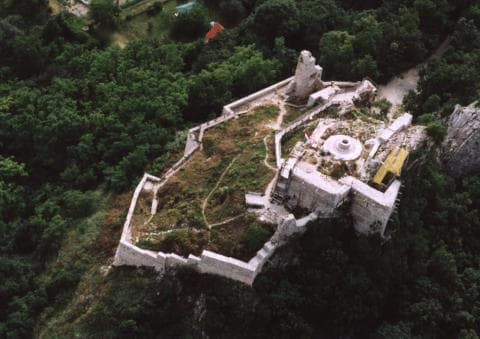
Csókakő Castle is perched on a rocky plateau surrounded on three sides by steep natural rock cliffs, which provided formidable natural defenses. These were supplemented by artificial moats carved directly into the rock, enhancing the castle’s protection against attackers.
The oldest part of the castle, known as the upper castle, dates back to the 13th century and occupies a roughly rectangular area measuring approximately 28 by 15 meters. This core fortress included a distinctive three-story trapezoidal tower at the northeastern corner, which was connected to a palace wing. This wing served dual purposes as a fortified lookout and residential quarters for the noble occupants.
South of the tower lay the castle courtyard, featuring a centrally located cistern house designed to collect and store rainwater, an essential resource for sustaining the castle’s inhabitants during prolonged sieges.
In the 15th century, the castle was expanded by the Rozgonyi family through the construction of a larger outer enclosure known as the lower castle. This expansion nearly tripled the castle’s footprint and included the addition of a gate tower that served as the main entrance during that period. The increased size reflected evolving defensive needs and the desire for more extensive residential and administrative spaces.
Between the upper and lower castles, on a terrace, a chapel was established in the 15th century. Although only the sanctuary’s pillars survive today, the chapel’s presence highlights the importance of religious life within the castle walls.
Ottoman period adaptations
During the Ottoman occupation, historical sources such as a 1690 sketch and the travel diary of Evliya Çelebi, a renowned Ottoman traveler, mention the existence of a mosque within the castle. While formal archaeological excavations have yet to confirm the mosque’s remains, these accounts suggest the castle was adapted to accommodate the religious and administrative needs of its Ottoman garrison.
Archaeological research and conservation efforts
Interest in the cultural and historical value of Csókakő Castle reemerged in the mid-19th century, led by archaeologist Flóris Rómer, who recognized its significance as a heritage monument. The first official archaeological survey was conducted in 1885 by József Könyöki, followed by further studies by Géza Csernó in 1897. These early investigations laid the groundwork for understanding the castle’s complex history and architecture.
In 1953, the castle was officially designated as a protected monument, reflecting its importance in Hungarian cultural heritage. Partial excavation and restoration efforts took place from 1960 to 1963 but were interrupted before full completion.
Renewed conservation initiatives began in 1995, spearheaded by the Csókakő Castle Friends Society. This group organized further archaeological excavations and restoration projects, supported by significant funding that enabled ongoing preservation work into the 21st century. Since 2017, the castle’s renovation has been incorporated into Hungary’s National Castle Program, ensuring sustained efforts to protect and showcase this historic fortress.
Visitor experience and cultural significance
Today, the ruins of Csókakő Castle offer visitors a vivid glimpse into Hungary’s medieval and Ottoman past. The site’s dramatic setting atop a rocky hill, combined with the remnants of its fortified walls, towers, and chapel pillars, provides an evocative atmosphere for exploration and education.
The castle’s layered history—from its origins as a noble stronghold through its Ottoman occupation and eventual liberation—makes it a valuable cultural landmark. Visitors can appreciate the architectural evolution of a hill castle adapted to changing military and residential needs over several centuries.
Ongoing archaeological research continues to reveal new insights into the castle’s past, contributing to a deeper understanding of Hungary’s regional history and the broader dynamics of medieval and early modern Central Europe.
Csókakő Castle remains a testament to the resilience and strategic importance of hill castles in Hungary’s historical landscape, embodying centuries of military, political, and cultural transformations.
Frequently asked questions (FAQ)
- What is the historical significance of Csókakő Castle?
- Csókakő Castle, built in the 13th century, is a remarkable example of medieval architecture in Hungary. It played a strategic role in the defense against invasions and has witnessed numerous historical events, making it a key site for understanding Hungary's past.
- When was Csókakő Castle constructed?
- The construction of Csókakő Castle began in the 13th century, specifically around the year 1260. It was built during a time when many castles were erected in Hungary to protect against external threats and to assert local power.
- What are the opening hours for visiting Csókakő Castle?
- Csókakő Castle is typically open to visitors from 10 AM to 5 PM during the tourist season, which runs from April to October. It is advisable to check their official website or contact local tourist information for any changes in hours or seasonal closures.
- Can I access Csókakő Castle with public transportation?
- Yes, you can reach Csókakő Castle via public transportation, with bus services available from nearby towns. However, the castle is located on a hill, so be prepared for a short hike to reach it from the nearest bus stop.
- What is the best time to visit Csókakő Castle?
- The best time to visit Csókakő Castle is during the spring and early autumn months, from April to June and September to October. During these periods, the weather is generally pleasant, making it ideal for exploring the castle and its beautiful surroundings.
- Is it possible to purchase tickets online for Csókakő Castle?
- Yes, tickets for Csókakő Castle can be purchased online through the official website, allowing visitors to skip long lines at the entrance. It is recommended to buy tickets in advance, especially during peak tourist season, to ensure entry.
- Are there any nearby attractions to visit while at Csókakő Castle?
- Yes, nearby attractions include the picturesque village of Csókakő and other historical sites such as the town of Székesfehérvár. These locations offer additional cultural experiences and beautiful scenery, making for a perfect day trip.
- What architectural features should I look for at Csókakő Castle?
- Csókakő Castle showcases classic medieval architecture, including sturdy stone walls, a rectangular layout, and remnants of defensive structures. Visitors should pay special attention to its towers and the well-preserved ruins that highlight its historical significance.
Photo gallery

Information
Website
Visit websiteSources & official resources
Verify the information above using these authoritative references.
Loading map...
Visitor reviews
No reviews yet. Been here? Write the first review and help other travelers!
Write the first reviewVisited this castle? Share your experience
Your review helps other travelers and adds first-hand knowledge to our encyclopedia.