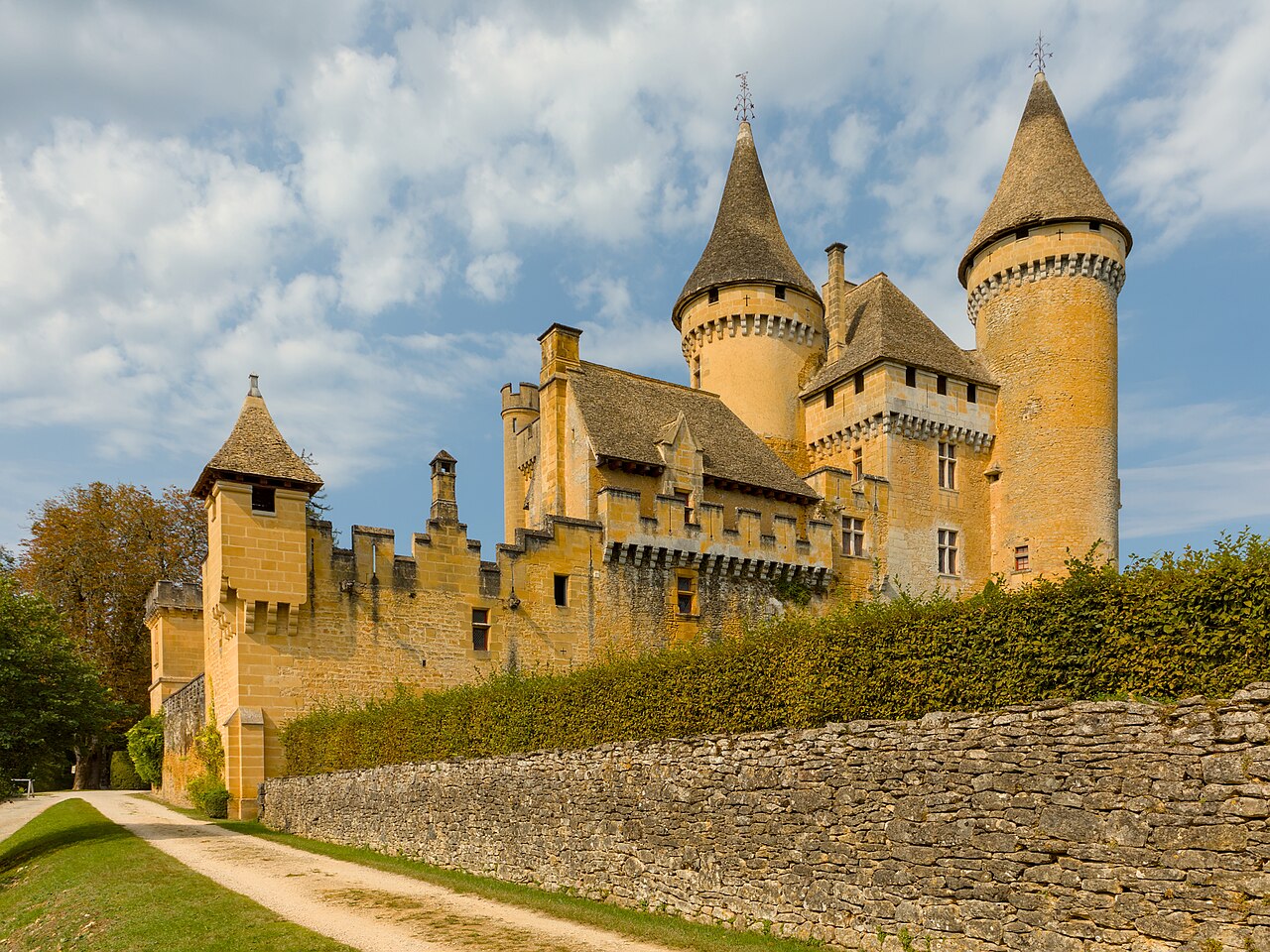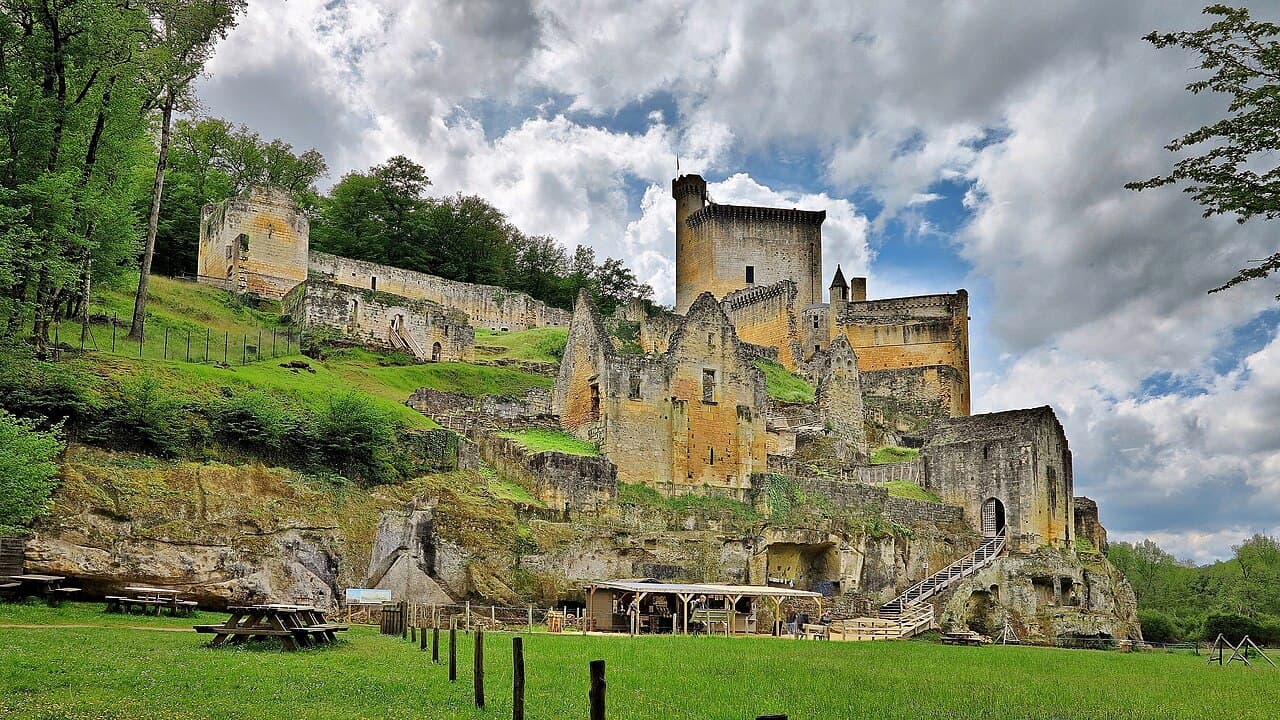
Commarque Castle
Commarque Castle stands as a captivating relic of medieval fortification nestled in the heart of the Dordogne region, specifically in the Périgord Noir area of Nouvelle-Aquitaine, France. This hill castle occupies a strategic rocky outcrop overlooking the valley of the river La Beune within the Vézère valley. Its location at the crossroads of historic commercial routes between Périgueux and Cahors, and Brive-la-Gaillarde and Bergerac, underscores its historical importance as a military and economic stronghold.
Originally founded in the 12th century, the castle evolved from a simple wooden tower, likely commissioned by the abbots of Sarlat, into a complex fortified ensemble. This transformation reflects the turbulent medieval period marked by feudal conflicts and shifting allegiances. The castle's architecture embodies the high medieval style, with its concentric defenses, multiple moats, and a towering stone keep that rises dramatically approximately 80 meters above the valley floor.
Early origins and foundation
The foundation of Commarque Castle is traditionally linked to the abbots of Sarlat, possibly Garin or Randulphe de Commarque, who served in the early 12th century. The initial fortification was a wooden dungeon, serving as a defensive refuge and symbol of seigneurial authority. The first lord, a "castri milites" or knight, was a vassal of the abbey of Sarlat, indicating the castle's ecclesiastical connections.
By around 1116, Gérard de Commarque, head of the eldest family branch, became a knight of the newly established Order of Saint John of Jerusalem (Hospitallers). This affiliation led to Commarque becoming a commandery of the order, with the chapel dedicated to Saint John reflecting this heritage. The Hospitallers' influence is evident in the castle's fortifications and religious structures, underscoring its dual military and spiritual roles.
Medieval expansion and architectural complexity
Throughout the 12th to 14th centuries, Commarque Castle expanded into a fortified village with multiple towers inhabited by various seigneurial families, creating a unique "co-seigneury" system. Each tower functioned as an independent stronghold with its own enclosure, entrances, and defensive ditches, illustrating the complex feudal relationships and the need for mutual defense.
The castle's defenses were progressively enhanced, featuring successive moats and concentric ramparts that exemplify medieval military architecture. The most striking feature is the stone keep, which underwent significant heightening and reinforcement between 1370 and 1380. This included the addition of a crown of machicolations inspired by the Palais des Papes in Avignon, providing formidable protection against attackers.
Strategic significance during the hundred years' war
During the Hundred Years' War, Commarque Castle was a focal point of conflict. The Beynac family, prominent lords of the region, were staunch supporters of the French crown. Pons de Beynac, a key figure, leveraged extensive political alliances and defended the castle against English incursions. The castle was briefly occupied by English forces, and Pons himself was captured in 1406, with a ransom imposed on the local population for his release.
The Beynacs' influence expanded in the 14th century as they consolidated power around Commarque, acquiring justice rights over neighboring territories. However, their fortunes declined in the 15th and 16th centuries, with reports of the family engaging in banditry and ransom-taking, reflecting the chaotic post-war period.
Religious conflicts and decline
In the 16th century, the castle became embroiled in the French Wars of Religion. The Beynacs supported the Protestant Reformation, aligning with notable figures such as Geoffroy de Vivans. From Commarque, they launched attacks on Catholic strongholds, including a temporary seizure of Sarlat.
In 1569, Catholic forces besieged and captured Commarque. The ensuing damage included the collapse of the vaulted hall, and King Charles IX ordered the castle's demolition. However, a member of the Commarque family successfully petitioned for the revocation of this order, sparing the castle from complete destruction.
Following these events, the castle gradually fell into disuse. By the 16th century, the younger branch of the Commarque family had relocated to the Château de Laussel, signaling the decline of Commarque as a noble residence. The castle remained largely abandoned for centuries thereafter.
Archaeological significance and restoration
Commarque Castle is not only a medieval fortress but also a site of prehistoric importance, with caves beneath the castle containing significant archaeological remains. This adds a layer of cultural heritage value to the site, connecting it to human history stretching back thousands of years.
Recognizing its historical and architectural significance, Commarque Castle was listed as a monument historique by the French Ministry of Culture in 1943. Restoration efforts began seriously in 1994, led by descendants of the original Commarque family, aiming to preserve and stabilize the ruins. These efforts have focused on maintaining the structural integrity of the keep, walls, and towers, as well as making the site accessible to visitors.
Visitor experience and cultural importance
Today, visitors to Commarque Castle can explore the evocative ruins set within a protected natural landscape. The site offers a glimpse into the complex feudal structures of medieval France, the military architecture of the period, and the intertwined religious and political histories. The castle's dramatic setting and well-preserved features make it a compelling destination for those interested in medieval history, archaeology, and architecture.
The ongoing restoration and archaeological work continue to reveal new insights into the castle's past, ensuring that Commarque remains a vital link to France's rich medieval heritage.
Frequently asked questions (FAQ)
- How do I get to Commarque Castle?
- Commarque Castle is located near Les Eyzies-de-Tayac-Sireuil in France, easily accessible by car or public transport. The nearest major city is Sarlat-la-Canéda, from where you can take a scenic drive through the Dordogne region. There is ample parking available on-site for visitors.
- What is the historical significance of Commarque Castle?
- Commarque Castle dates back to the 12th century and played a crucial role during the Hundred Years' War. It served as a strategic fortification and a residence for noble families, showcasing the turbulent history of the region. Today, it stands as a testament to medieval architecture and the rich heritage of the Dordogne.
- When was Commarque Castle built?
- Construction of Commarque Castle began in the 12th century, with significant modifications made in the following centuries. Its architectural style reflects the evolution of medieval fortifications and residential design over time. The castle has endured various historical events, making it a fascinating site for history enthusiasts.
- Can I enter the castle grounds?
- Yes, visitors can explore the castle grounds, which include the ruins of the castle and its beautiful surrounding landscape. Guided tours are available, providing insights into the castle's history and architecture. Make sure to check for any specific access restrictions or areas that may not be open to the public.
- Why is Commarque Castle a popular tourist destination?
- Commarque Castle attracts visitors due to its stunning medieval architecture and its picturesque location within the Dordogne valley. The castle offers a unique glimpse into the region's history and provides breathtaking views of the surrounding countryside. Additionally, its proximity to other historical sites makes it an excellent stop for tourists exploring the area.
- Is it possible to visit Commarque Castle year-round?
- Commarque Castle is open to visitors from March to November, with varying hours depending on the season. It's advisable to check the official website for specific opening hours prior to your visit. During the winter months, the castle may be closed for maintenance and preservation efforts.
- What are the ticket prices for Commarque Castle?
- Ticket prices for Commarque Castle vary depending on age and time of visit, with discounts available for children and groups. Typically, adult tickets range from €7 to €10, while children under a certain age may enter for free or at a reduced rate. Be sure to check the official site for the latest pricing and any special offers.
- What is the best time to visit Commarque Castle?
- The best time to visit Commarque Castle is during the spring and early autumn months when the weather is mild and the surrounding nature is in full bloom. This period often sees fewer crowds compared to the peak summer season. Additionally, this timing allows you to enjoy the beautiful landscape and take part in various outdoor activities in the area.
- Are there any nearby attractions to Commarque Castle?
- Yes, there are several attractions near Commarque Castle, including the famous Lascaux Caves and the charming village of Les Eyzies-de-Tayac-Sireuil. The Dordogne region is rich in prehistoric sites, charming towns, and beautiful natural scenery, making it a perfect destination for day trips. Don't miss the chance to explore the local cuisine and culture while visiting nearby attractions.
Photo gallery

Information
Website
Visit websiteSources & official resources
Verify the information above using these authoritative references.
Loading map...
Visitor reviews
No reviews yet. Been here? Write the first review and help other travelers!
Write the first reviewVisited this castle? Share your experience
Your review helps other travelers and adds first-hand knowledge to our encyclopedia.