Commarin Castle
Commarin Castle, also known as Château de Commarin, is a remarkable historic château located in the village of Commarin in the Côte-d'Or department of France. This castle has a rich history spanning over eight centuries and remains one of the rare examples of a noble residence continuously owned by the same extended family line for 26 generations. Its origins date back to the early 13th century, and it has undergone significant architectural transformations reflecting various historical periods and styles.
The site originally hosted a probable Gallo-Roman villa rustica, indicative of rural estates common in Roman Gaul. The first documented mention of the castle dates to 1214, when it was described not as a full castle but as a fortified house or maison forte. This early structure was owned by Aubert de Commarin and laid the foundation for the château's later development.
Medieval origins and lineage transitions
During the 14th century, the castle evolved from a fortified house into a more formidable fortress. In 1346, following the death of the last male heir of the Commarin family, the estate passed through marriage to the Cortiambles family. Later, in 1419, it was inherited by the Jaucourt de Dinteville family, also through marriage. The castle's owners continued to enhance its defenses, including the addition of a square enclosure with round towers and double moats under Jacques de Courtiamble, who served as chamberlain to Duke Philippe le Hardi of Burgundy.
Fortifications and defensive features
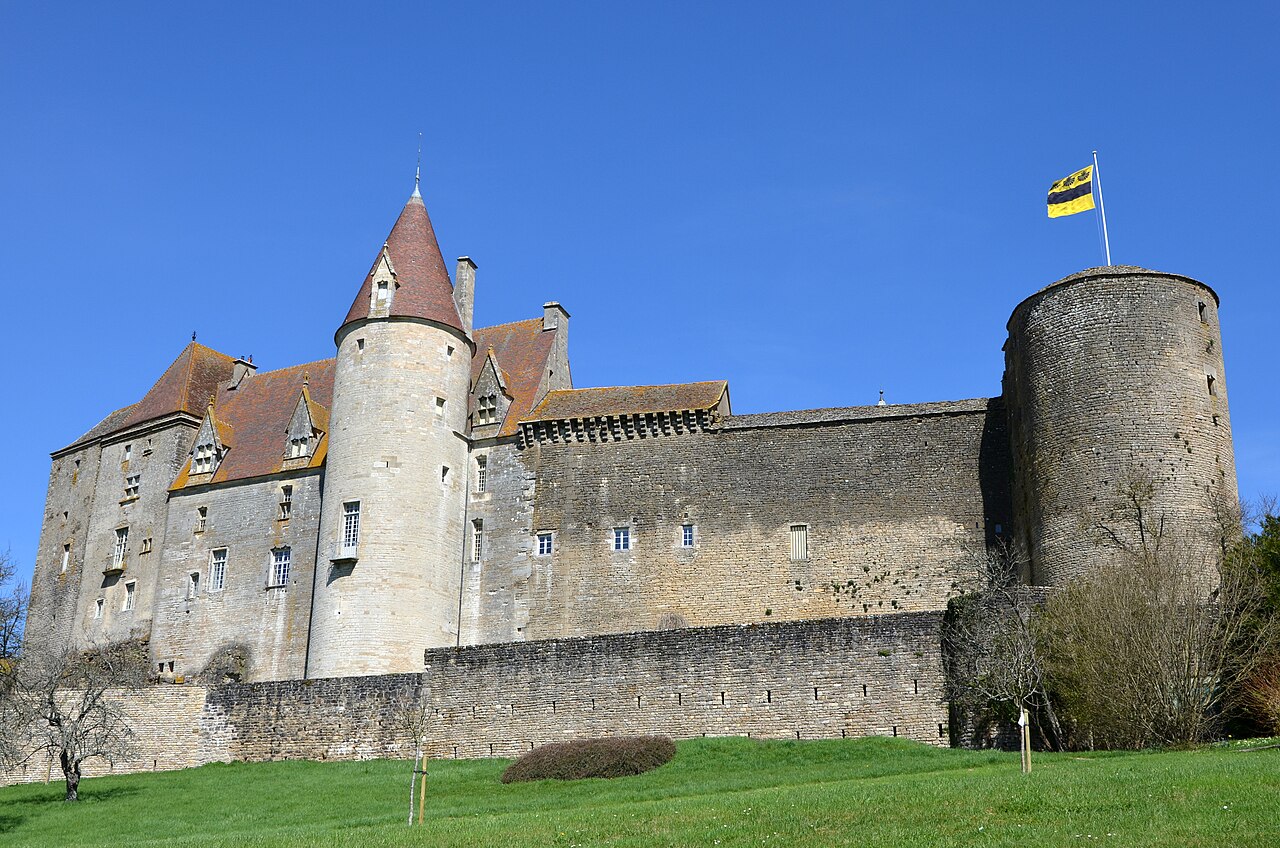
The medieval château was characterized by double moats surrounding an island setting, a square enclosure with multiple round towers, and robust defensive walls. These features were typical of hill castles designed for protection during the turbulent feudal conflicts of the Middle Ages. The presence of vaulted cellars within the towers and the use of Gothic pointed arch windows (Kielbogen) further highlight its medieval architectural heritage.
Renaissance and early modern transformations
In the 16th century, the château began to shift focus from purely military defense to residential comfort and artistic embellishment. Walls were adorned with tapestries featuring heraldic and alchemical motifs dating from approximately 1515 to 1522. A notable triptych from 1526 depicting Girard de Vienne and his wife enriches the château's artistic legacy. The chapel was also enhanced with decorative elements from this period.
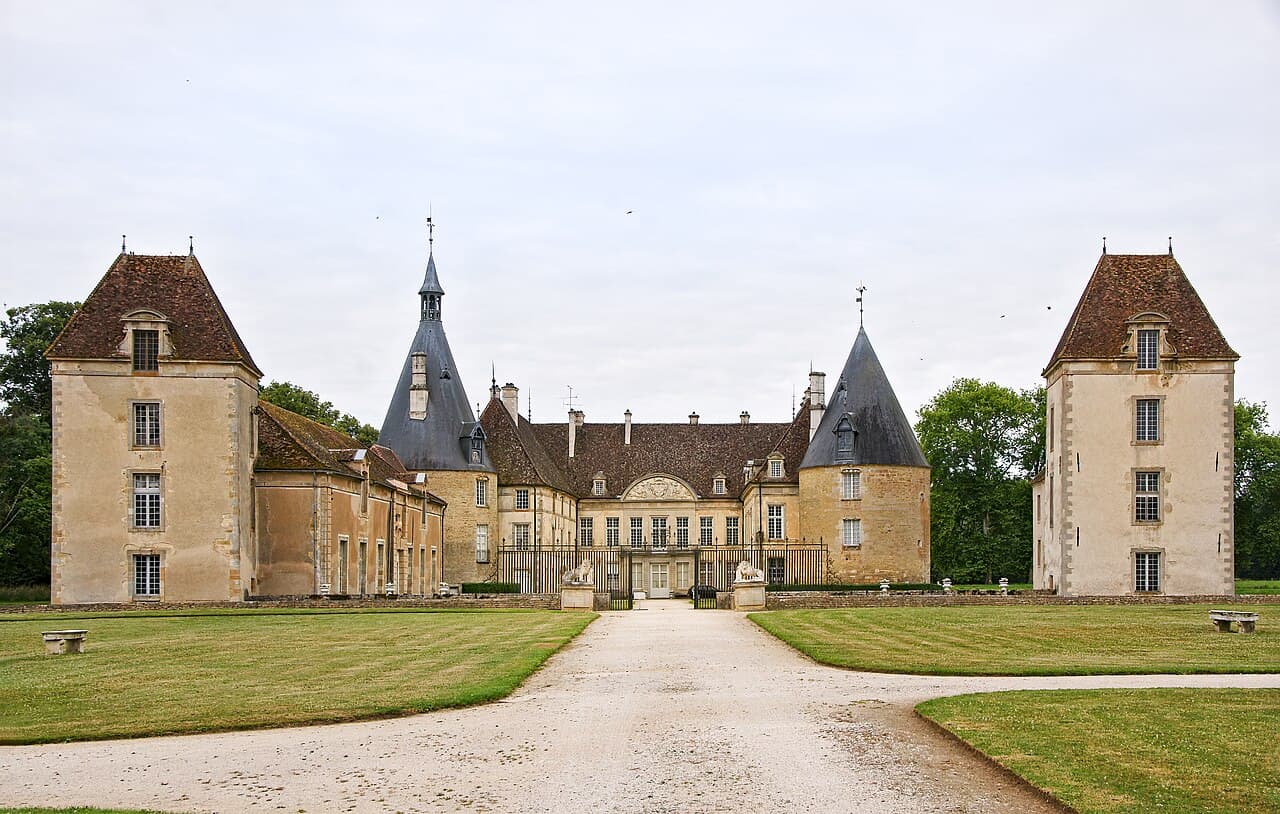
Throughout the 17th and early 18th centuries, the Vienne family undertook extensive rebuilding efforts. Charles I de Vienne rebuilt the east wing and removed the north wing, creating a U-shaped layout with a cour d’honneur (honor courtyard). After a corner tower collapsed around 1700, Charles II de Vienne commissioned architect Philippe Pâris between 1702 and 1713 to reconstruct the southern and western wings, giving the château its present classical Baroque appearance.
Architectural features of the present château
The château features two massive cylindrical towers at the corners of the wings, each topped with conical slate roofs. The southern tower, known as the Tour d’horloge, is crowned with a distinctive lantern. The building's façade is marked by a projecting risalit with a balcony and heraldic reliefs, including the combined coat of arms of Charles I de Vienne and Marguerite Fauche de Domprel.
The château's interior includes an 18th-century furnished apartment in one of the towers, a grand staircase with a barrel vault ceiling and stucco decorations, and a Grand Salle spanning approximately 200 square meters with leaf-patterned tiled floors. The château's library houses a complete edition of the Encyclopédie by Diderot and d’Alembert, reflecting the intellectual pursuits of its owners.
Preservation and cultural significance
Remarkably, Commarin Castle escaped damage during the French Revolution and later during World War II, when it was occupied by German forces but left intact. The château's grounds were transformed in the 19th century from formal French parterre gardens to an English-style landscaped park, aligning with changing tastes in garden design.
Since 1949, the château has been classified as a Monument Historique, recognizing its architectural and historical importance. Restoration efforts have been ongoing since the late 20th century to preserve its unique heritage. Today, Commarin Castle is open to the public for guided visits, offering a glimpse into centuries of French noble life and architectural evolution.
Access and visitor experience
Visitors can access the château via a six-arched stone bridge spanning the moat, leading to a forecourt enclosed by a low wall with decorative niches called aediculae. The entrance portal, dating from the 17th century and relocated in the 19th century, features a round-arched gateway framed by Tuscan columns and bears the family motto "TOUT BIEN A VIENNE."
The extensive park covers over five hectares and includes the outer bailey or basse-cour, which houses 18th-century stables connected to the south tower by a two-story pavilion. The château's layout and preserved interiors provide a comprehensive representation of noble residential architecture from medieval fortifications to classical Baroque refinement.
Frequently asked questions (FAQ)
- How do I get to Commarin Castle?
- Commarin Castle is located in the picturesque village of Commarin, France, easily accessible by car or public transport. If you're driving, take the A6 motorway and follow the signs to Commarin. For public transport, the nearest train station is in Montbard, from where you can take a taxi or a local bus to the castle.
- What is the historical significance of Commarin Castle?
- Commarin Castle dates back to the 12th century and has a rich history linked to the nobility of Burgundy. It has been beautifully preserved and showcases the architectural evolution over the centuries. The castle is also known for its historical gardens and role in several local legends.
- When was Commarin Castle built?
- Construction of Commarin Castle began in the 12th century, with subsequent renovations and expansions occurring throughout the Middle Ages and Renaissance. Its architecture reflects various styles, showcasing the artistic trends of its time. Today, it stands as a prominent example of feudal architecture in France.
- Can I take guided tours of Commarin Castle?
- Yes, guided tours are available and highly recommended for visitors to fully appreciate the castle's history and architecture. Tours typically last about an hour and provide insights into the castle's past and its significance in the region. Audio guides are also available for those who prefer to explore at their own pace.
- Is Commarin Castle accessible for visitors with disabilities?
- Yes, Commarin Castle is committed to providing accessibility for all visitors. There are designated paths and facilities to accommodate those with mobility challenges. However, some areas may still have limited access due to the castle's historical architecture.
- What are the opening hours of Commarin Castle?
- Commarin Castle is open to visitors from April to October, typically from 10 AM to 6 PM. During the peak summer months, the hours may be extended, so it's advisable to check the official website for the most current information. The castle is closed on certain public holidays, so plan your visit accordingly.
- What are the ticket prices for Commarin Castle?
- Tickets for Commarin Castle typically cost around €10 for adults, with discounts available for students and seniors. Children under the age of 12 can enter for free when accompanied by an adult. Group rates are also available, making it a great option for school trips or family outings.
- When is the best time to visit Commarin Castle?
- The best time to visit Commarin Castle is during the spring and early autumn months when the weather is mild and the gardens are in full bloom. Visiting during weekdays can help avoid the larger crowds often seen on weekends. Special events and exhibitions are frequently held in the summer, enhancing the experience for visitors.
- Are there any nearby attractions to visit after Commarin Castle?
- Yes, after visiting Commarin Castle, you can explore other nearby attractions such as the historic town of Montbard and the Abbey of Fontenay, a UNESCO World Heritage site. The region is also known for its beautiful vineyards and scenic walking trails, ideal for a full day of exploration.

Information
Sources & official resources
Verify the information above using these authoritative references.
Loading map...
Visitor reviews
No reviews yet. Been here? Write the first review and help other travelers!
Write the first reviewVisited this castle? Share your experience
Your review helps other travelers and adds first-hand knowledge to our encyclopedia.