Cleydael Castle
Cleydael Castle, locally known as Kasteel Cleydael, is a remarkable example of a late medieval moated castle located west of Aartselaar in the province of Antwerp, within the Flemish region of Belgium. Nestled on an island created by two branches of the Benedenvliet river, the castle's strategic position reflects its original purpose as a fortified water castle. Its origins likely date back to the mid-13th century, with documentary evidence of ownership by the Sanders van Hemessen family in 1259. The castle is a significant cultural and historical monument, illustrating the evolution of fortified residences in the region from the medieval period through subsequent centuries.
The castle's earliest recorded mention was in 1372, when it was owned by Geeraert van der Elst. The ownership history is marked by disputes between the Sanders and Van der Elst families, reflecting the complex feudal dynamics of the time. Through mediation by Joanna of Brabant and subsequent transactions, the Sanders family regained control in the 15th century. The castle's history is intertwined with notable historical figures, including Corneel Sanders van Hemessen, who was executed in 1459 by order of Philip the Good, Duke of Burgundy, for his involvement in political intrigues.
Architectural evolution and structural features
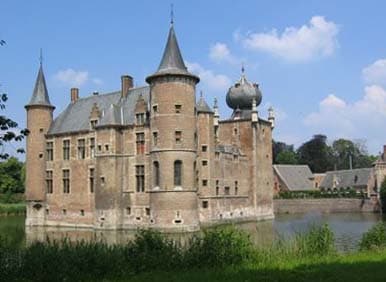
Cleydael Castle exhibits a square plan consisting of four wings that enclose a central courtyard, a typical layout for fortified residences of its era. Its substructure dates from around 1350, while the upper parts were constructed and modified during the 16th and 17th centuries using locally sourced brick and sandstone, characteristic of Brabantine architecture. The castle is surrounded by a moat, emphasizing its defensive nature and water castle classification.
Towers and fortifications
The castle is distinguished by its four corner towers, each uniquely shaped and named, reflecting both functional and symbolic aspects. The two eastern towers are notably more massive, with the northeastern tower known as the Vossentoren (Fox Tower) featuring walls over one meter thick and topped with an onion-shaped spire. The southeastern Kapeltoren (Chapel Tower) houses a chapel with a distinctive star-shaped vaulted ceiling, lending the tower its name.
The western towers are called the Uilentoren (Owl Tower) and Kattentoren (Cat Tower), each contributing to the castle's defensive capabilities and aesthetic character. The variety in tower shapes and sizes illustrates the castle's phased construction and adaptation over centuries.
The nederhof and ancillary buildings
The castle's nederhof or lower courtyard is trapezoidal and was originally completely surrounded by moats. Access to the complex is gained via a drawbridge on the east side leading to the main entrance gate. Adjacent to the gate is a building that served as the bailiff's house and later the gamekeeper's residence, highlighting the administrative functions of the estate.
On the west side of the nederhof stands a square watchtower flanked by barns, stables, and a brewery, forming a picturesque ensemble that complements the main castle. These outbuildings are constructed in the same Brabantine brick and sandstone style, maintaining architectural harmony across the estate.
Historical significance and ownership lineage
The castle's ownership history reflects its importance in regional politics and society. After the Sanders and Van der Elst families, the castle passed through various hands, including Pieter van der Straeten in the early 16th century, who undertook significant restoration and expansion efforts to modernize the residence.
In 1556, Antonio del Rio, treasurer under Fernando Álvarez de Toledo, the 3rd Duke of Alba and Governor of the Netherlands, acquired the castle. His tenure ended abruptly in 1576 when the castle was besieged and plundered by troops of the States General of the Netherlands led by Philip de Lalaing. Del Rio fled to Spain, and the castle fell into disrepair, even serving as a refuge for vagabonds until restoration began in 1613 under the Hellemans family.
The 17th century saw further renovations under the ownership of Frans Paschier van den Cruyce, mayor of Antwerp, who purchased the castle in 1644 and marked the entrance with a coat of arms in 1650. The Van den Cruyce family maintained the estate for three generations before it passed to Jean Gilles Peeters through marriage in 1747, who acquired the lordship of Aartselaar and Cleydael.
Subsequent owners included the De Stier, Van Havre, De Bergeyck, Guiette, and Frank families. After World War I, Antwerp shipowner Christiaan Sheid bought the castle and initiated restoration work in the 1950s. His widow remained there until her death, during which time a golf course was established on the estate grounds, integrating the historic site into modern recreational use.
Modern use and preservation
Declared a protected monument in 1977, Cleydael Castle has undergone several phases of restoration to preserve its historical and architectural integrity. In 2001, the castle ceased commercial use and was restored as a private residence by Cornelis Marks of Cleydael Invest NV. The estate covers over 11 hectares, with some outbuildings leased to the golf club, including a restaurant and clubhouse that were rebuilt after a fire in 2004.
Currently, the castle is private property and is not open to public visitation. However, the surrounding domain functions as a golf club, with the castle serving as a striking historical centerpiece within the landscape. Its well-preserved state and distinctive architectural features make it a valuable heritage site reflecting centuries of Belgian history.
Architectural and cultural importance
Cleydael Castle stands as a testament to the evolution of medieval water castles in the Low Countries. Its combination of defensive features, such as the moat and robust towers, alongside residential and ceremonial spaces like the chapel tower, exemplifies the multifunctional nature of such estates. The castle's layered history, from feudal stronghold to noble residence and modern private estate, encapsulates broader historical trends in Belgian aristocratic life.
The castle's distinctive towers, varied masonry techniques, and integration with the natural water landscape contribute to its architectural significance. The preservation of the chapel with its star vault and the maintenance of the moat system highlight the attention to both spiritual and defensive needs of its inhabitants.
Local tradition suggests a Roman military presence near the site, although no documentary evidence confirms this. Nonetheless, the castle's location near the Schelde river and its strategic water defenses underscore the importance of controlling waterways in medieval and early modern military strategy.
Frequently asked questions (FAQ)
- What is the historical significance of Cleydael Castle?
- Cleydael Castle is a late medieval moated castle with a rich history of noble ownership, sieges, and restorations, reflecting regional political and architectural evolution.
- Can visitors tour Cleydael Castle and its grounds?
- Cleydael Castle is currently private property and not open to public tours. The surrounding domain operates as a golf club, but the castle itself cannot be visited.
- What are the distinctive architectural features of Cleydael Castle?
- The castle features a square layout with four uniquely shaped corner towers, a moat, a chapel with a star-vaulted ceiling, and Brabantine brick and sandstone construction.
- When was Cleydael Castle built and what periods influenced its architecture?
- The castle's substructure dates from the 14th century, with significant additions and renovations in the 16th and 17th centuries, resulting in a mixed architectural style.
- Is there any connection between Cleydael Castle and local legends or traditions?
- Local tradition suggests a Roman military camp near the site, though no documentary evidence supports this. The castle's strategic location highlights its historical military importance.
- What is the current condition and use of Cleydael Castle?
- Cleydael Castle is well preserved and serves as a private residence. The estate includes a golf club, with some outbuildings adapted for recreational use.
Photo gallery

Photo by Cleydael castle•Public domain
Information
Sources & official resources
Verify the information above using these authoritative references.
Loading map...
Visitor reviews
No reviews yet. Been here? Write the first review and help other travelers!
Write the first reviewVisited this castle? Share your experience
Your review helps other travelers and adds first-hand knowledge to our encyclopedia.