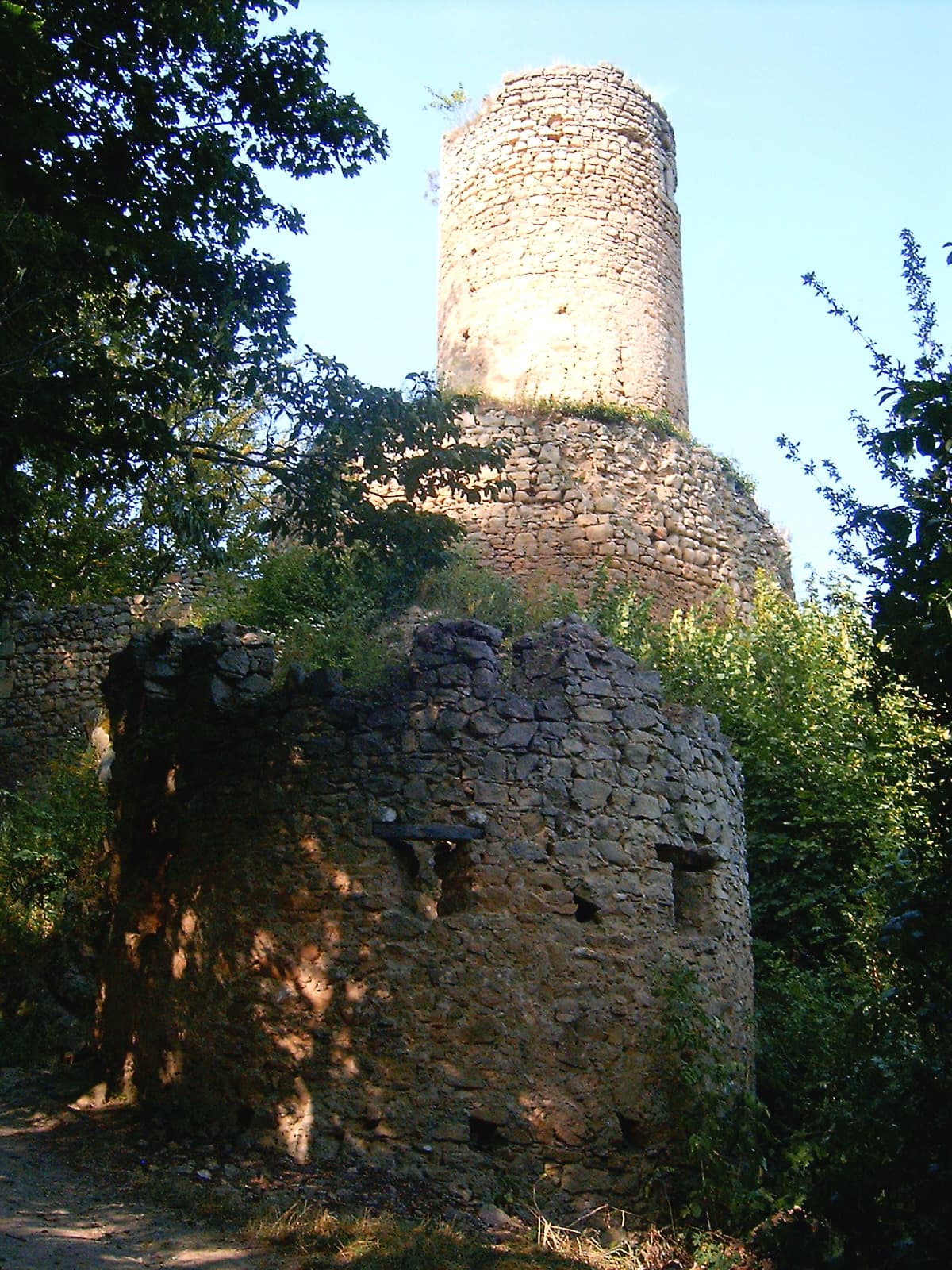
Cimburk Castle
Cimburk Castle stands as a significant example of a Gothic hill castle in the historic region of Moravia within the modern Czech Republic. Founded in the early 14th century, this fortress encapsulates the architectural and historical evolution of medieval Central Europe, reflecting both defensive military design and noble residential functions. Its strategic location and robust construction made it a key stronghold for Moravian nobility and an important player in regional conflicts.
The founding and early history of Cimburk Castle
The castle was constructed between 1327 and 1333 by Bernard of Cimburk, a member of the Moravian nobility. He relocated from the original Cimburk near Svitavy to establish this new residence, which became a focal point of his family's power by 1348. The castle's initial design featured hallmark elements of Gothic military architecture, including thick stone walls and defensive towers, suited to the turbulent political landscape of the time.
In 1358, ownership passed to Moravian Margrave Jan Jindřich, brother to the Holy Roman Emperor Charles IV. This transfer placed Cimburk within the orbit of imperial influence, underscoring its importance. Subsequently, the castle changed hands several times, including a pledge to Čeněk of Drahotuš in 1398 and seizure by Vok IV of Holštejn around 1407-1408. These transitions reflect the castle's role as a valuable asset amid shifting noble alliances.
Architectural features and defensive structures
Cimburk Castle's layout is characterized by an elongated plan dominated by two imposing bergfrieds—tall, freestanding defensive towers typical of the period. These towers served as lookout points and last-resort refuges during sieges. The western tower, notably well-preserved, exemplifies the advanced stonemasonry and fortification techniques of the 14th century, designed to resist artillery and prolonged attacks.
The castle's main gate, though surviving only in fragments, reveals a sophisticated controlled entry system combining functional defense with Gothic decorative elements such as pointed arches and carved stone details. The gate's design would have been integral to the castle's security strategy, channeling visitors and potential attackers through defensible choke points.
Residential and administrative buildings within the castle complex also retain traces of Gothic ornamentation, indicating that the fortress was not solely military but also a noble residence. Walls adorned with carved stonework and window tracery suggest chambers designed for comfort and status, reflecting the castle's dual role as a home and stronghold.
Renaissance expansions and adaptations
After the castle was acquired by the Víckov family post-1523, significant expansions were undertaken to adapt to the evolving military technology and Renaissance architectural trends. These included the construction of a lower castle section with additional defensive towers and bastions. These new fortifications were designed to counter the threat posed by artillery, featuring angled bastions and thicker walls to absorb cannon fire.
The blend of Gothic and Renaissance elements in Cimburk Castle illustrates the transition in castle architecture from medieval fortresses to early modern strongholds, combining aesthetic refinement with enhanced military functionality.
Historical significance and role in regional conflicts
Cimburk Castle played a notable role during the Hussite Wars and subsequent power struggles for control of the Bohemian and Hungarian thrones. Its occupation by King Matthias Corvinus of Hungary highlights its strategic importance during these conflicts, serving as a military base and symbol of authority in contested territories.
Throughout the 15th and 16th centuries, the castle remained within influential noble families, including the Holštejn lineage, maintaining its status as a regional power center. Its fortifications and location made it a key asset in controlling surrounding lands and trade routes.
Decline, abandonment, and preservation efforts
The castle's decline began in the late 17th century when Gabriel Horecký, the last lord to reside there, moved his seat to a nearby palace in Koryčany around 1674. Following his departure, Cimburk was abandoned and fell into disrepair. By 1709, it was deserted permanently, and centuries of neglect led to structural collapses and decay.
In the late 20th century, the ruins suffered further damage due to natural deterioration. Since 1994, a local civic group named Polypeje has been actively involved in stabilizing and preserving the remains. Their work has helped protect the site from further collapse and maintain its historical significance for future generations.
Current condition and visitor experience
Today, Cimburk Castle stands as a ruined Gothic fortress with many architectural details still visible, including the prominent western bergfried, gate fragments, and sections of both the upper and lower castle fortifications. Visitors can explore the site to appreciate its layered history and architectural evolution.
The castle's ruins offer insight into medieval defensive design and noble life in Moravia, making it a valuable cultural heritage site. While no elaborate visitor facilities exist, the site attracts history enthusiasts and scholars interested in Gothic and Renaissance military architecture.
Architectural legacy and cultural importance
Cimburk Castle exemplifies the fusion of medieval Gothic and Renaissance architectural styles, reflecting broader trends in Central European castle construction. Its bergfrieds and bastions illustrate the adaptation of fortifications to changing warfare technologies. The castle's history is intertwined with significant regional events and noble families, underscoring its importance in Moravian heritage.
Preservation efforts continue to emphasize the site's educational and cultural value, ensuring that the castle remains a tangible link to the medieval past and a testament to the craftsmanship of its builders.
Frequently asked questions (FAQ)
- How do I get to Cimburk Castle?
- Cimburk Castle is located in the municipality of Cimburk in Moravia, Czechia. It is accessible by local roads from nearby towns, and visitors typically reach it by car or regional bus services.
- What are the opening hours of Cimburk Castle?
- As a ruin, Cimburk Castle does not have formal opening hours. Visitors can explore the site freely during daylight hours, but it is advisable to visit during the day for safety and visibility.
- Is there an entrance fee to visit Cimburk Castle?
- Visiting Cimburk Castle is generally free of charge as it is an open ruin without staffed facilities or ticketed entry.
- What architectural styles are represented at Cimburk Castle?
- Cimburk Castle primarily exhibits Gothic architectural features from its original 14th-century construction, with later Renaissance additions such as bastions and lower castle expansions from the 16th century.
- Can I explore the towers of Cimburk Castle?
- Due to the ruinous condition of Cimburk Castle, access to the towers is restricted for safety reasons. Visitors can view the towers from the outside and explore the surrounding ruins.
Photo gallery

Photo by This image is a work by Mercy. When reusing, please credit me as: Mercy from Wikimedia Commons. I would appreciate being notified if you use my work outside Wikimedia. Do not copy this image illegally by ignoring the terms of the license below, as it is not in the public domain. If you would like special permission to use, license, or purchase the image please contact me to negotiate terms. More of my work can be found in my personal gallery.•CC BY-SA 3.0
Information
Website
Visit websiteSources & official resources
Verify the information above using these authoritative references.
Loading map...
Visitor reviews
No reviews yet. Been here? Write the first review and help other travelers!
Write the first reviewVisited this castle? Share your experience
Your review helps other travelers and adds first-hand knowledge to our encyclopedia.



