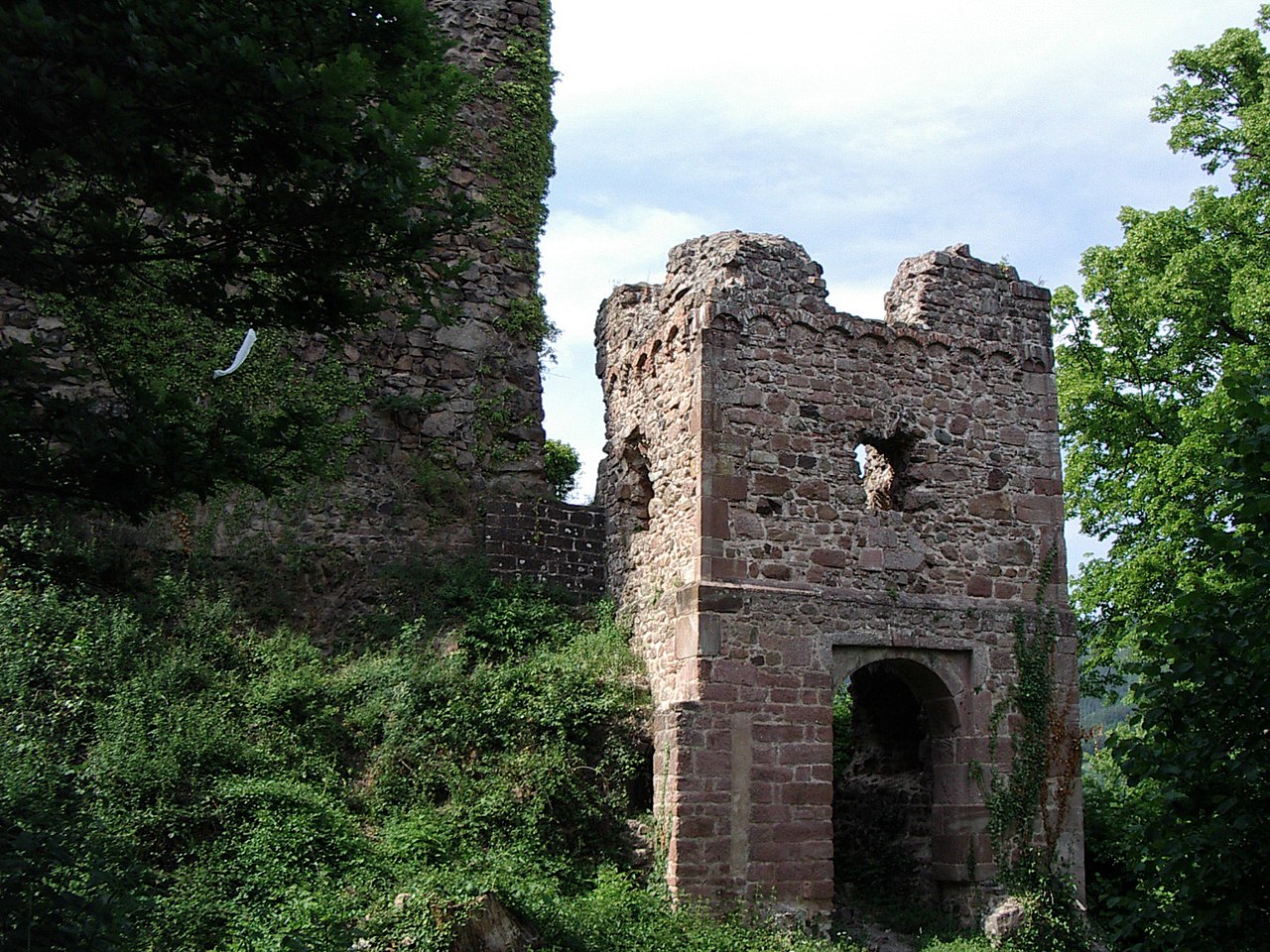
Château de Wildenstein
The Château de Wildenstein is a late medieval fortress situated on a prominent glacial moraine known as the Schlossberg, overlooking the road from the Oderen Pass towards Lorraine. This strategic position made it an important site for surveillance and defense during the Middle Ages. The castle's earliest recorded mention dates to 1312, when it was owned by Ulrich III, count of Ferrette. A notable agreement from that year involved Ulrich promising not to build castles on the territory of the abbey of Murbach, in exchange for granting Pierre de Bollwiller free rein at Wildenstein. The castle was subsequently held as a fief by the Bollwiller family until 1536.
Historical background and ownership
By the mid-16th century, the Château de Wildenstein had fallen into a state of near ruin. The abbot of Murbach repurchased the castle and undertook significant reconstruction and restoration efforts to adapt it to the evolving requirements of warfare, particularly the use of firearms. During this period, a chapel dedicated to the Holy Cross was also constructed within the castle grounds, reflecting its dual military and religious functions.
The castle's strategic importance continued through the Thirty Years' War (1618–1648), during which it changed hands multiple times between Swedish and French forces. Ultimately, the Swedes destroyed the castle in 1644. Following its destruction, the castle was largely abandoned and from the late 17th century onward, it served as a convenient source of building materials for nearby villages, including for the construction of the church at Oderen.
Architectural features and layout
The castle occupies the entire summit of the rocky outcrop, with the natural rock formation playing a key role in its defense. A distinctive feature is a tunnel pierced through the rock that provides access to the lower courtyard, which was artificially enlarged during the 16th century restoration. The castle's fortifications included round towers, defensive walls, and staircases cut directly into the rock leading to the upper terrace.
Today, the remains of the castle are sparse. Visitors can observe traces of the round towers, low sections of defensive walls, and the rock-cut staircases. The only well-preserved structure is a retaining wall located to the east of the lower courtyard. Despite its considerable size, the castle is one of the least accessible and least known in the Alsace region.
Archaeological investigations and preservation
In 1995, archaeological excavations and preservation efforts were carried out to better understand and protect the site. Historical plans, such as those published by abbé Sifferlen in his studies of the Saint-Amarin valley, provide valuable insights into the castle's original layout, although much of the structure is difficult to discern on the ground today.
Military significance and strategic location
The castle's location on the Schlossberg gave it commanding views of the surrounding landscape, crucial for monitoring the important trade and military route from the Oderen Pass to Lorraine. This vantage point allowed its occupants to control movement through the valley and served as a deterrent against invading forces.
Its fortifications were adapted over time to meet changing military technologies, particularly the advent of firearms in the 16th century. The restoration efforts by the abbot of Murbach reflect this transition, as the castle was modified to better withstand artillery attacks.
Current condition and visitor experience
Today, Château de Wildenstein remains in a state of partial ruin. The site offers a rugged and evocative glimpse into medieval fortification techniques and the turbulent history of the Alsace region. Visitors interested in medieval military architecture and history will find the castle's remains and the surrounding landscape of interest, although the site is not extensively developed for tourism.
The castle's remote location and limited visible remains mean that it is less frequented than other regional castles, preserving a sense of solitude and authenticity. Interpretive materials and guided tours are limited, so visitors often explore the site independently, appreciating the natural setting and historical ambiance.
Frequently asked questions (FAQ)
- What is the historical significance of Château de Wildenstein?
- Château de Wildenstein is a remarkable example of medieval architecture that dates back to the 13th century. It played a crucial role in regional defense and has witnessed various historical events throughout its existence, making it a fascinating site for history enthusiasts.
- When was Château de Wildenstein built?
- The construction of Château de Wildenstein began in the early 13th century, around 1250. Over the centuries, it has undergone several renovations and restorations, reflecting the architectural styles of different eras.
- Can I visit Château de Wildenstein?
- Yes, Château de Wildenstein is open to visitors, allowing them to explore its rich history and stunning architecture. Guided tours are available, providing insights into the castle's past and its significance in the region.
- What are the opening hours for Château de Wildenstein?
- Château de Wildenstein is typically open to visitors from 10 AM to 6 PM, but it is advisable to check the official website for any seasonal changes or special closures. Planning your visit in advance ensures you have ample time to enjoy the castle and its surroundings.
- Is it possible to access Château de Wildenstein with limited mobility?
- Château de Wildenstein has some accessibility features, but due to its historical nature, certain areas may be challenging for visitors with limited mobility. It is recommended to contact the castle administration before your visit to inquire about specific accommodations.
- What is the best time to visit Château de Wildenstein?
- The best time to visit Château de Wildenstein is during the spring and early fall when the weather is mild and pleasant for exploring the grounds. Additionally, these seasons offer beautiful scenery as the surrounding landscape comes alive with color.
- What are the ticket prices for visiting Château de Wildenstein?
- Ticket prices for Château de Wildenstein vary depending on age and group size, with discounts available for students and seniors. It's best to check the official website for the most current pricing information and any special promotions.
- Are there any nearby attractions to Château de Wildenstein?
- Yes, visitors to Château de Wildenstein can explore nearby attractions such as the beautiful Vosges Mountains and the picturesque village of Kruth. The area is rich in hiking trails, scenic views, and other historical sites, making it an ideal destination for a full day of exploration.
Information
Loading map...
Visitor reviews
No reviews yet. Been here? Write the first review and help other travelers!
Write the first reviewVisited this castle? Share your experience
Your review helps other travelers and adds first-hand knowledge to our encyclopedia.