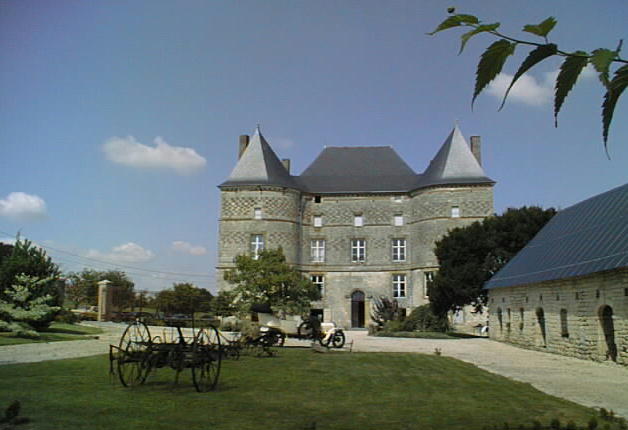
Château de Thugny-Trugny
The Château de Thugny-Trugny stands as a remarkable example of a 16th-century French château that embodies the transition from medieval fortification to Renaissance residential elegance. Located in the village of Thugny-Trugny within the Hauts-de-France region, this estate reflects centuries of architectural evolution, noble lineage, and historical events that shaped northern France.
Constructed in the latter half of the 16th century under the direction of Jean-Jacques de Suzanne, count of Cerny-en-Laonnois, the château replaced earlier defensive structures that once crowned a nearby hill. This shift from purely military fortifications to a more representational and comfortable residence marks the influence of Renaissance ideals on French aristocratic architecture. The château's design integrates defensive features such as a fortified gatehouse with machicolations and turreted towers, while embracing classical symmetry and ornamental stonework typical of the period.
Historical significance and noble connections
The château's history is deeply intertwined with prominent noble families and key historical figures. In the late 16th century, it became associated with the influential Moÿ family through the birth of Claude de Moÿ, who married Henri de Lorraine-Chaligny in 1585. Henri was a prince of the Holy Roman Empire, highlighting the estate's importance as a nexus of European aristocratic alliances.
Throughout the turbulent Wars of Religion and the subsequent civil conflicts such as the Fronde, the château maintained strategic and symbolic prominence. In 1653, it hosted notable figures including Marshal Turenne and Cardinal Mazarin, key military and political leaders during a period marked by internal strife and Franco-Spanish tensions. These visits underscore the château's role as a center of regional power and diplomacy.
The acquisition of the estate by Antoine Crozat in 1721 marked a new era of prosperity. Crozat, a wealthy financier under King Louis XIV, enhanced the château and its grounds, transforming it into a refined residence emblematic of the Enlightenment. Under the Crozat family's stewardship, the estate became renowned for elegant social gatherings and landscape improvements, including the creation of ornamental ponds fed by diverted waters of the Aisne River.
Architectural features and layout
The château is arranged around a distinctive fortified entrance gatehouse, or châtelet, characterized by an elongated plan and defensive elements such as machicolations and small turreted towers. The gatehouse's vaulted archway was designed to allow carriage passage while maintaining security. Constructed primarily from gaize stone, a soft sandstone, the structure is reinforced with harder stone at corners and openings, providing both durability and aesthetic contrast.
Behind the gatehouse, the main building faces the Aisne River and features a classical two-story façade. It is flanked by two asymmetrical corner pavilions rising three stories high, with the larger pavilion divided into three bays. The use of stone quoins and window surrounds enhances the rectilinear yet asymmetrical composition, reflecting Renaissance architectural principles adapted to the local context.
Prior to damage sustained in World War I, the gatehouse and main building were connected by lower wings containing vaulted ground-floor rooms. Above these wings lay a terrace with balustrades, enclosing a fully enclosed inner courtyard surrounded by dry moats. The dry moats served as a subtle defensive measure, maintaining the château's fortified character while emphasizing its residential function.
Post-war restoration and alterations
The château suffered significant damage during German occupation in World War I and subsequent bombardments in 1918. Restoration efforts in the 1920s focused on rebuilding parts of the corner pavilions, while the lower connecting wings were not reconstructed. This alteration opened the courtyard, changing the original enclosed spatial arrangement and impacting the château's silhouette.
Associated structures and landscape
Near the château lies a rectangular tithe barn dating from the seigneurial period, notable for its four pepperpot-shaped turrets at each corner. Historical engravings reveal that the barn once stood within a stone enclosure wall, emphasizing its functional and symbolic importance within the estate. Currently, the tithe barn is in a state of advanced deterioration, highlighting the need for conservation efforts.
The surrounding grounds include a landscaped park featuring 18th-century ponds created by diverting the waters of the Aisne River. These water features, attributed to the Crozat family's improvements, reflect the transformation of the estate into a site of leisure and aesthetic display during the Enlightenment. The park remains an integral part of the château's heritage, blending natural and designed elements.
Modern usage and heritage protection
In the mid-20th century, from the 1950s onward, the château served as a summer camp for Polish children from northern France, a role it fulfilled for approximately three decades. This adaptation illustrates the estate's continued social relevance beyond aristocratic residence.
Since 1946, the château, its tithe barn, and the surrounding park have been officially recognized as protected historical monuments. Their designation as registered heritage sites in 1947 affirms their cultural and architectural significance. From 2007, restoration efforts led by Count Jacques de Vincens de Causans and his wife Juliette have aimed to preserve and revitalize the estate, supported by events hosted on the grounds to raise awareness and funds.
The Château de Thugny-Trugny today stands as a testament to the layered history of French noble estates, combining fortified medieval elements with Renaissance elegance and Enlightenment refinement. Its enduring presence offers valuable insights into architectural trends, historical events, and cultural transformations spanning several centuries.
Frequently asked questions (FAQ)
- How do I get to Château de Thugny-Trugny?
- Château de Thugny-Trugny is located in the picturesque region of Champagne-Ardenne, France. You can reach the castle by car, with ample parking available on-site, or by using public transport options that connect to nearby towns. For specific public transport schedules, it's best to check local transit websites.
- What is the historical significance of Château de Thugny-Trugny?
- Château de Thugny-Trugny dates back to the 15th century and is a remarkable example of medieval architecture in the Champagne region. It has housed various noble families throughout its history and played a role in the local defense strategies during tumultuous times. Its rich history attracts historians and visitors alike.
- When was Château de Thugny-Trugny built?
- The construction of Château de Thugny-Trugny began in the late 15th century, around 1480, and it reflects the architectural styles of that period. Over the centuries, it has undergone several renovations, preserving its historical character while adapting to modern needs. Its enduring structure showcases the craftsmanship of the era.
- Can I visit Château de Thugny-Trugny year-round?
- Yes, Château de Thugny-Trugny is open to visitors throughout the year, although opening hours may vary by season. It’s advisable to check the official website or contact the castle directly for the most current visiting hours. Special tours and events may also be scheduled during certain times of the year.
- Why is Château de Thugny-Trugny popular among tourists?
- Château de Thugny-Trugny attracts visitors due to its stunning architecture, rich history, and beautiful surrounding gardens. Its location in the Champagne region offers a unique cultural experience, combining history with the opportunity to explore local wine production. Additionally, the castle often hosts events that engage visitors in its storied past.
- Is it possible to access Château de Thugny-Trugny with a wheelchair?
- Château de Thugny-Trugny strives to be accessible to all visitors, but some areas may present challenges due to the castle's historical architecture. There are ramps and designated pathways, but it’s recommended to contact the castle in advance to ensure that your visit is comfortable. Staff are usually available to assist with any accessibility needs.
- What are the ticket prices for visiting Château de Thugny-Trugny?
- Ticket prices for Château de Thugny-Trugny vary based on age and the type of tour selected. Generally, adult tickets are priced around €10, while discounts may be available for children and seniors. Special group rates may also apply, so it's worth inquiring when planning your visit.
- What are the best times to visit Château de Thugny-Trugny?
- The best times to visit Château de Thugny-Trugny are during the spring and early autumn when the weather is mild and the gardens are in full bloom. These seasons also see fewer crowds compared to summer, allowing for a more enjoyable experience. Additionally, consider visiting during special events for a unique perspective on the castle.
- Are there any nearby attractions to explore when visiting Château de Thugny-Trugny?
- Yes, the region surrounding Château de Thugny-Trugny is rich with attractions, including charming villages, local vineyards, and scenic countryside. Nearby towns like Épernay and Chalons-en-Champagne offer additional historical sites and cultural experiences. Wine tasting tours are also popular in this renowned wine-producing area.
Information
Website
Visit websiteSources & official resources
Verify the information above using these authoritative references.
Loading map...
Visitor reviews
No reviews yet. Been here? Write the first review and help other travelers!
Write the first reviewVisited this castle? Share your experience
Your review helps other travelers and adds first-hand knowledge to our encyclopedia.