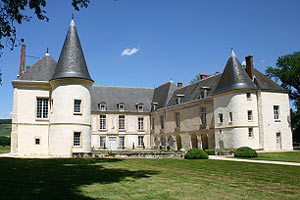
Château de Réveillon
Château de Réveillon stands as a distinguished example of Renaissance architecture in the Hauts-de-France region of northern France. Constructed between 1607 and 1617 on the foundations of a medieval fortress, this hill castle reflects the transition from fortified medieval strongholds to elegant aristocratic residences of the early modern period. Its U-shaped plan, surrounded by a moat, and complemented by extensive formal gardens, illustrates the fusion of defensive elements with refined aesthetic sensibilities typical of the Renaissance era.
The château was commissioned by Claude II d’Ancienville and his wife Judith Raguier, who sought to establish a grand residence that honored the site's medieval past while embracing contemporary architectural trends. Despite its ambitious design, records from 1640 reveal that the building was still incomplete, lacking finished windows, roofing leadwork, and interior plastering, with pigeonholes in the walls awaiting completion. This unfinished state underscores the challenges of large-scale construction projects in the period.
Historical evolution and ownership
The ownership of Château de Réveillon changed hands multiple times during the 17th and 18th centuries, each proprietor contributing to its development and embellishment. After the d’Ancienville family, the estate was held briefly by Michel Larcher and then by Jacques Galland. From 1672 to 1712, the château was under the stewardship of the Fieubet family, notably Anne de Fieubet de Launay and Paul de Fieubet de Réveillon. Subsequent ownership passed to Philippe Millien before being acquired in 1719 by René Louis Voyer de Paulmy, Marquis d’Argenson.
The Marquis d’Argenson enhanced the château's facade with a sculpted pediment featuring Minerva, the Roman goddess of wisdom and warfare, adorned with the classical motif of Medusa’s head on her shield symbolizing protection. He also refined the windows of the main building and wings, contributing to the château's elegant appearance. However, financial difficulties compelled him to sell the property in 1730.
The next owner, Jules-Robert de Cotte, the king’s architect, undertook significant repairs and enriched the interiors with wood paneling and paintings depicting scenes of rural life and agricultural activities on the estate. These artistic additions reflected the 18th-century aristocratic interest in rural improvement and the pastoral ideal.
In the 19th century, the château was purchased by Jean-Front Herbelin, a Parisian notary, whose family maintained strong artistic connections. His son married Jeanne-Mathilde Habert, a miniaturist and aunt of the celebrated flower painter Madeleine Lemaire. Lemaire later owned the château and transformed it into a cultural salon, hosting literary and aristocratic gatherings. Among her notable guests was Marcel Proust, who stayed at Réveillon during 1894 and 1895, drawing inspiration from the château and its gardens for his literary works.
Architectural features and estate layout
The château's architecture exemplifies the Renaissance style with its U-shaped layout opening onto a paved courtyard encircled by a protective moat. This design balances defensive features with the elegance of a noble residence. The estate extends beyond the main building to include formal French gardens, agricultural buildings, and several notable outbuildings that demonstrate a blend of utility and refinement.
The dovecote and agricultural buildings
Among the estate's most remarkable features is the dovecote, dating back to at least 1697. This structure is notable for its vaulted ground floor, historically used for storing farm tools, and its upper level, which housed approximately 3,500 boulins or pigeon nesting pots. The dovecote’s oak roof, weighing around 40 tons, is covered with tiles on the lower sections and lead on the lantern, showcasing the craftsmanship of the period.
The farm complex, constructed in the 17th century, features characteristic brick and white stone masonry. Additional agricultural buildings include stables and a melon house built during Jules-Robert de Cotte's ownership in the early 18th century. The melon house was an innovative structure designed to protect crops from wind and retain heat, enabling the cultivation of melons in the region's cooler climate.
Gardens and landscape design
The château's gardens are laid out in the formal French style, oriented eastward and framed by double rows of white horse chestnut trees. A charmille hedge of hornbeam trees encloses an elevated northern section, providing privacy and visual interest. To the west lies a green courtyard bordered by two pavilions, linking the main house with the agricultural buildings through paved alleys.
The grounds extend beyond the enclosure walls to include a carousel, a large vegetable garden irrigated by the Réveillon river, two elevated groves that enhance the landscape views, and a substantial orchard. The main courtyard is accessed through an honor gate in the Louis XV style, attributed to Jules-Robert de Cotte, combining grandeur with classical refinement.
Cultural significance and preservation
Throughout its history, Château de Réveillon has been a site of cultural importance, especially in the 19th century when it served as a salon under Madeleine Lemaire’s ownership. The château attracted prominent literary and artistic figures, including Marcel Proust, whose stays at Réveillon influenced his writing.
The château escaped major damage during both World Wars, although it was requisitioned by the German army in 1940. Post-war neglect led to deterioration until private restoration efforts began in 1992. Recognizing its historical and architectural value, the château was designated a protected historic monument on June 8, 1948, with the protection extended to the entire estate, including the gardens and orchards, on August 9, 1996.
Today, Château de Réveillon stands as a well-preserved example of Renaissance hill castle architecture, offering visitors a glimpse into the aristocratic life of early modern France, enriched by its agricultural heritage and cultural legacy. Its combination of elegant design, functional outbuildings, and landscaped gardens make it a significant heritage site in the Hauts-de-France region.
Frequently asked questions (FAQ)
- How do I get to Château de Réveillon?
- Château de Réveillon is easily accessible by car, located just off the D123 road in Réveillon, France. If you are using public transport, the nearest train station is a short taxi ride away, providing convenient access to the castle.
- What is the historical significance of Château de Réveillon?
- Château de Réveillon dates back to the 17th century and is known for its beautifully preserved architecture that reflects the grandeur of French noble life. It has been an important landmark in the region, witnessing significant historical events and changes in ownership over the centuries.
- When was Château de Réveillon built?
- Construction of Château de Réveillon began in the early 1600s and was completed by the latter part of the century. The castle has undergone various renovations since then, but it retains much of its original charm and historical features.
- Can I take guided tours of Château de Réveillon?
- Yes, guided tours are available at Château de Réveillon, providing visitors with an in-depth look at its history and architecture. Tours typically run throughout the day, and it's recommended to check the schedule in advance for availability.
- Why is Château de Réveillon popular among visitors?
- Château de Réveillon is popular due to its stunning architecture, rich history, and picturesque gardens. Visitors enjoy exploring the beautifully landscaped grounds as well as the interior, which showcases exquisite period furnishings and art.
- Is it possible to host events at Château de Réveillon?
- Yes, Château de Réveillon offers options for hosting private events such as weddings and corporate gatherings. The scenic backdrop and elegant settings make it an attractive venue for memorable occasions.
- What are the opening hours for Château de Réveillon?
- Château de Réveillon is typically open to visitors from 10 AM to 6 PM from March to November. It's advisable to check the official website for any seasonal variations or special closures.
- What are the ticket prices for visiting Château de Réveillon?
- Ticket prices for Château de Réveillon vary depending on age and group size, with discounts available for children and seniors. General admission is usually around €10, and family packages may offer better value for larger groups.
- When is the best time to visit Château de Réveillon?
- The best time to visit Château de Réveillon is during the spring and early fall when the weather is pleasant, and the gardens are in full bloom. Summer can be busy with tourists, so visiting during the shoulder seasons can provide a more relaxed experience.
- Are there any nearby attractions to visit along with Château de Réveillon?
- Yes, there are several nearby attractions, including charming villages and local vineyards. Visitors can explore the surrounding countryside, which is known for its beautiful landscapes and rich cultural heritage.
Information
Website
Visit websiteSources & official resources
Verify the information above using these authoritative references.
Loading map...
Visitor reviews
No reviews yet. Been here? Write the first review and help other travelers!
Write the first reviewVisited this castle? Share your experience
Your review helps other travelers and adds first-hand knowledge to our encyclopedia.