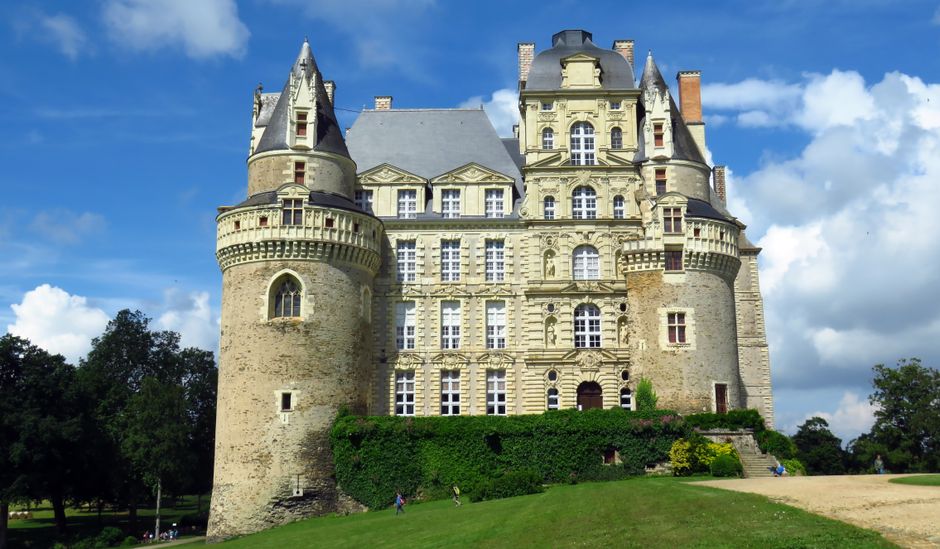
Château de Pignerolle
The Château de Pignerolle stands as a remarkable example of neoclassical architecture nestled in the commune of Saint-Barthélemy-d’Anjou, France. Constructed in the late 18th century, this château has witnessed a rich tapestry of historical events, from aristocratic leisure pursuits to pivotal roles in 20th-century military history. Its evolution reflects the broader social and political transformations of France, making it a site of both architectural beauty and profound historical significance.
Architectural design and classical influences
Designed by the architect Michel Bardoul de la Bigotière, the château exemplifies the neoclassical style that was fashionable among the French nobility in the late ancien régime period. The two-story building is elevated above a partially subterranean basement, originally intended for service functions such as kitchens. The main structure measures approximately 25 meters in length and 17 meters in width, presenting a balanced and symmetrical façade on both front and rear elevations.
The entrance is marked by a grand staircase leading to a peristyle supported by four fluted Ionic columns adorned with garlands and pendentives. Above the doorway, three finely preserved bas-reliefs depict a central figure of Apollo flanked by two goddesses, underscoring the classical inspiration integral to the château’s decorative program. The rear façade mirrors this classical rhythm with pilasters topped by Ionic capitals and walls embellished with floral and ribbon motifs. A robust entablature capped with balustrades conceals the zinc roof, completing the elegant silhouette.
Close to the main building, the orangerie, constructed circa 1831 under the ownership of Pierre-Antoine Blancler, complements the château’s style. Built of local tuffeau limestone, it features large multi-pane windows separated by ten smooth Ionic columns and framed by pilastered corners. The entablature and balustrade echo the château’s design, while a semi-circular annex at the rear housed service areas such as kitchens.
Historical ownership and early significance
The estate originally belonged to the Avril family from the mid-17th century, with Marcel Avril de Pignerolle commissioning the château in 1776 as a pleasure house or "folie." As director of the Royal Equestrian Academy of Angers, a position held by his family for over two centuries, Marcel Avril designed the château as a refined retreat reflecting the aristocratic tastes of the late ancien régime and the family’s equestrian heritage.
The French Revolution profoundly impacted the estate. The Royal Equestrian Academy was closed in 1792, and Marcel Avril was arrested and died in prison in 1793. Subsequently, the château left the Avril family’s possession, passing through various owners during the 19th century. One notable figure, Pierre-Antoine Blancler, undertook restoration efforts and adapted the château to the Empire style of the early 19th century, also expanding the grounds and enhancing the estate’s landscape.
Military and political roles in the 20th century
Headquarters of the Polish government-in-exile
In the tumultuous years leading up to and during World War II, the château assumed significant political and military importance. From 1939 to 1940, it served as the headquarters for the Polish government-in-exile and the Polish General Staff. President Władysław Raczkiewicz resided at the château from December 1939, and the Polish army formed the 125th Infantry Regiment on its grounds before deployment.
German occupation and Kriegsmarine command center
During the German occupation of France (1942–1944), the château and its extensive park were requisitioned by the Kriegsmarine, the German Navy. It became a vital western command center for U-boat operations in the Battle of the Atlantic. The occupying forces constructed a large, complex bunker facility with a three-meter-thick roof covering approximately 1,500 square meters, alongside numerous concrete and wooden military buildings designed to house up to 1,000 submarine personnel.
A distinctive feature of the military complex is a 133-meter covered tunnel linking the main command bunker directly to the château, allowing secure and discreet coordination. The bunker was equipped with teletype communication systems and supported up to 16 aerial masts for encrypted communications using the Enigma machine. These structures were unique in design, differing from the standard German Regelbau bunker types.
Post-war use and Cold War adaptations
Following liberation in August 1944, American troops utilized the château before it was repurposed as a center for the repatriation of displaced persons. From 1946 to 1964, the former military quarters housed up to 1,000 displaced individuals, creating a temporary community complete with schools and a church within the château’s orangerie.
Recognizing its historical and strategic value, the château was classified as a historic monument in 1961. The French Ministry of the Armed Forces acquired the property in 1964, preserving the bunkers as a nuclear fallout shelter intended for the French president during the Cold War. In 1969, the local urban district took ownership and initiated extensive restoration efforts that continued into the late 20th century.
The château’s gardens and ancillary structures
The château is set within an expansive 80-hectare park that artfully combines French formal gardens with English landscape-style areas. The front garden features two lawn parterres bordered by meticulously trimmed yew topiaries, while the rear garden includes traditional bowling greens edged with boxwood flower beds. A surviving segment of the original moat lines the western edge, its banks adorned with flowering plants.
The park incorporates riding paths and walking trails consistent with the English garden tradition. Garden ornaments include two sphinx statues with cherubs, now damaged, replaced Medici vases, and a statue of Diana the Huntress.
Within the park lies a one-hectare walled kitchen garden designed by the renowned gardener André Leroy. This garden includes a gardener’s lodge, water reservoir, and a vaulted garden folly. Since 2013, the kitchen garden has hosted a garden design competition engaging local horticultural and arts institutions.
Additional estate buildings include a large outbuilding with a Mansard roof and dormer windows with triangular pediments. Originally coach houses and workers’ quarters, these buildings now serve as venues for temporary exhibitions.
Preservation and public access
Several World War II-era concrete bunkers and wooden barracks remain scattered throughout the park. Constructed by German forces under the supervision of Organisation Todt, these military installations include a prominent three-part command bunker with a thick reinforced roof. While the main bunker remains closed to the public due to its Cold War use as a nuclear shelter, other bunkers are accessible and interpreted by a local memorial association dedicated to preserving the site’s wartime history.
The château’s classification as a historic monument and subsequent restoration efforts have ensured the preservation of both its architectural elegance and its layered historical narrative. Today, the site offers visitors a unique glimpse into French aristocratic life, military history, and landscape design spanning over three centuries.
Frequently asked questions (FAQ)
- What is the historical significance of Château de Pignerolle?
- Château de Pignerolle, built in the late 18th century, is a notable example of French architecture and has played a significant role in local history. It served as a military barracks during the French Revolution and later became a residence for prominent families, reflecting the social changes in France over the centuries.
- When is the best time to visit Château de Pignerolle?
- The best time to visit Château de Pignerolle is during the spring and early autumn months, when the gardens are in full bloom and the weather is pleasant. During these seasons, visitors can enjoy guided tours and various outdoor activities, making for a more enjoyable experience.
- Can I access Château de Pignerolle with a wheelchair?
- Yes, Château de Pignerolle is accessible for wheelchair users. The castle has made efforts to ensure that all visitors can enjoy its beautiful architecture and gardens, providing ramps and accessible facilities throughout the site.
- What are the opening hours for Château de Pignerolle?
- Château de Pignerolle is typically open to visitors from 10 AM to 6 PM, with extended hours during the summer months. It is advisable to check the official website or contact the site directly for any seasonal changes or special events that might affect visiting hours.
- Is there an admission fee to visit Château de Pignerolle?
- Yes, there is an admission fee to enter Château de Pignerolle, which helps support its maintenance and preservation. Ticket prices are generally reasonable, with discounts available for children and seniors, so be sure to check for any special offers.
- What nearby attractions can I visit while at Château de Pignerolle?
- While visiting Château de Pignerolle, you can explore several nearby attractions, including the Parc de Pignerolle, which offers beautiful walking paths and picnic areas. Additionally, the city of Angers, with its historic castle and vibrant cultural scene, is just a short drive away.
- How do I get to Château de Pignerolle from Angers?
- To reach Château de Pignerolle from Angers, you can take a short drive, which typically takes around 15 minutes. Public transport options, including buses, are also available, making it easy for visitors to access the castle without a car.
Information
Website
Visit websiteSources & official resources
Verify the information above using these authoritative references.
Loading map...
Visitor reviews
No reviews yet. Been here? Write the first review and help other travelers!
Write the first reviewVisited this castle? Share your experience
Your review helps other travelers and adds first-hand knowledge to our encyclopedia.