
Castle of Brissac
The Castle of Brissac stands as a monumental symbol of French heritage, renowned for being the tallest chateau in the Loire Valley with its impressive seven stories and over 200 rooms. Located in Brissac Loire Aubance within the Maine-et-Loire department, this castle combines a rich historical legacy with remarkable architectural features spanning from the 11th century through the 17th century and beyond. It remains a private residence of the Cossé-Brissac family, whose head bears the noble title of Duke of Brissac, and continues to be a cultural landmark in the region.
Early history and medieval origins
The castle's origins trace back to the 11th century, when it was initially constructed by Foulques Nerra, Count of Anjou, a significant medieval ruler known for his military and architectural endeavors. This early fortress was strategically placed on a hill, classifying it as a hill castle, designed primarily for defense with strong fortifications typical of the high medieval period. Following the defeat of the English by King Philip Augustus, the castle was granted to his seneschal, Guillaume des Roches, marking its importance in regional governance and military control.
Renaissance transformations and gothic additions
In the 15th century, the castle underwent significant restoration and expansion under Pierre de Brézé, a minister to Charles VII and Louis XI. By 1455, large Gothic towers were added to the eastern façade, which remain defining features of the castle's silhouette. These towers, equipped with machicolations—defensive openings between the corbels of the battlements—reflect the castle's military origins. The eastern façade's imposing towers also house a private chapel featuring a notable marble bas-relief by the sculptor David d’Angers.
The castle's history is marked by dramatic events, including the tragic episode involving Jacques de Brézé, who killed his wife Charlotte de Valois and her lover after discovering their affair. This event has become part of local legend, with tales of Charlotte's ghost said to haunt the castle grounds.
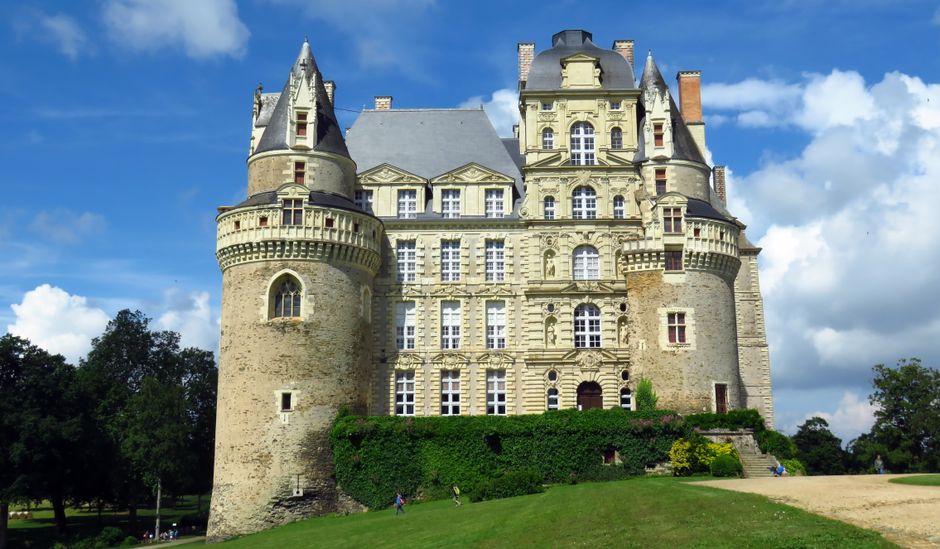
Photo by Árpád Zalavári
The cossé-brissac family and baroque influence
The castle entered the hands of the Cossé family in 1502 when René de Cossé, governor of Maine and Anjou, purchased it. This acquisition initiated centuries of ownership by the Cossé-Brissac family. During the turbulent French Wars of Religion, Charles II de Cossé supported the Catholic League, leading to a siege by King Henry IV. After reconciling with the king in 1594, Charles found the castle heavily damaged and undertook reconstruction efforts.
These efforts, led by architects Jacques Corbineau and Jacques d’Angluze, aimed to modernize the castle with a tall structure of seven to eight stories, blending medieval and Renaissance elements. The resulting architecture reflects a mix of Italian Renaissance and 17th-century Baroque styles, visible in the richly decorated façades and asymmetrical window pediments. The central pavilion reaches a height of 37 meters and originally featured a lantern topped by a bronze statue of Mercury, removed during the French Revolution.
Notable architectural features
- The Salon Doré (Golden Salon) boasts a gilded coffered ceiling from the 17th century, complemented by four Murano crystal chandeliers and a large Louis XIII style fireplace adorned with floral and fruit garlands.
- The castle contains portraits of the Brissac family by artists such as Bernard Boutet de Monvel and Mignard, alongside Gobelin tapestries from 1782 depicting scenes from Don Quixote.
- A 32-meter gallery displays Flemish 16th-century tapestries illustrating the life of Alexander the Great and pastoral scenes from the reign of Louis XIV.
- The ceiling beams painted in 1625 feature about one hundred small images portraying pastoral, biblical, and mythological subjects.
- A Louis XIII style staircase made of tuffeau stone includes a ceiling decorated with the intertwined monogram of Charles de Cossé.
- The southern Gothic tower houses the family chapel, richly furnished with pieces by André Charles Boulle, including a cabinet with copper and tortoiseshell inlays and a wall clock, as well as 18th-century Meissen and Sèvres porcelain bearing the Brissac coat of arms.
- Italian Renaissance wardrobes with secret compartments and a painted ceiling decorated with floral motifs add to the castle's artistic richness.
- A large mural measuring six by 3.5 meters depicts the Bercy estate near Paris, further enhancing the interior's historical narrative.
- The 19th-century theater, built by Jeanne Say in the style of 17th-century theaters, has two floors and seats 170 people. It was restored in 1983 and is used for cultural and musical events.
Historical events and cultural significance
In 1620, the castle was the setting for a significant reconciliation meeting between Louis XIII and his mother Marie de’ Medici. This event, held on neutral ground, included three days of celebrations organized by the Duke of Cossé, emphasizing the castle's role as a political and social hub during the early 17th century.
During the French Revolution, the castle was seized, looted, and used as a warehouse by the Vendéens, leading to its decline. Restoration began in the mid-19th century, notably in 1844, to repair the extensive damage caused by neglect and revolutionary turmoil.
In the 20th century, the castle served as a safe storage site for valuable artworks and furniture from Versailles and other French museums during World War II. In August 1944, the castle was attacked by German soldiers, resulting in the death of the guard Jean-Baptiste Faucher, a somber episode in its wartime history.
Grounds and preservation
The castle is surrounded by an English-style park created by Jeanne Say, who also had the castle's moat filled in, transforming the defensive landscape into a more ornamental setting. Since 1958, the castle has been partially protected as a historic monument, ensuring the preservation of its architectural and cultural heritage.
Today, the Castle of Brissac remains privately owned by the Dukes of Brissac and continues to host cultural events, including the annual Val de Loire festival in its luxurious gilded theater. It is also known for its occasional use as a filming location and venue for high-profile events, underscoring its ongoing relevance in French cultural life.
Frequently asked questions (FAQ)
- How do I get to the Castle of Brissac?
- The Castle of Brissac is conveniently located in Brissac-Quincé, France, approximately 10 kilometers from Angers. You can reach it by car or public transport; there are local bus services that connect to the castle from surrounding towns.
- What is the historical significance of the Castle of Brissac?
- The Castle of Brissac, known as the tallest castle in France, dates back to the 11th century and has a rich history that includes being a residence for the Counts of Brissac. Its architectural style showcases a blend of Renaissance and Gothic elements, reflecting its evolution over the centuries.
- When was the Castle of Brissac built?
- Construction of the Castle of Brissac began in the 11th century, with significant expansions and renovations occurring in the 16th century. The castle has undergone various transformations, making it a fascinating example of architectural evolution through different periods.
- Can I visit the Castle of Brissac year-round?
- Yes, the Castle of Brissac is open to visitors throughout the year, although opening hours may vary by season. It is advisable to check the official website for the most current visiting hours and any special events that may be taking place.
- Why is the Castle of Brissac considered an architectural marvel?
- The Castle of Brissac is celebrated for its unique design, featuring an impressive seven stories and intricate facades adorned with beautiful stone carvings. Its grand interiors, including opulent salons and richly decorated rooms, highlight the luxury of the French nobility.
- Is it possible to take guided tours of the castle?
- Yes, guided tours are available at the Castle of Brissac, providing visitors with in-depth information about its history, architecture, and the stories of its former inhabitants. These tours are a fantastic way to enhance your experience and learn more about the castle's fascinating past.
- What are the ticket prices for visiting the Castle of Brissac?
- Ticket prices for the Castle of Brissac vary depending on age and whether you opt for a guided tour. Generally, adult tickets are priced around €10, while discounts are available for children and groups; check the official site for detailed pricing information.
- What is the best time to visit the Castle of Brissac?
- The best time to visit the Castle of Brissac is during the spring and early autumn when the weather is mild and the gardens are in full bloom. Additionally, visiting during weekdays may help you avoid larger crowds and enjoy a more tranquil experience.
- Are there any nearby attractions to explore after visiting the castle?
- Yes, there are several nearby attractions worth exploring, including the beautiful Loire Valley vineyards and the charming town of Angers. The region is rich in history and offers various outdoor activities, making it an excellent destination for a day trip.
Photo gallery

Photo by Árpád Zalavári
Information
Website
Visit websiteSources & official resources
Verify the information above using these authoritative references.
Loading map...
Visitor reviews
No reviews yet. Been here? Write the first review and help other travelers!
Write the first reviewVisited this castle? Share your experience
Your review helps other travelers and adds first-hand knowledge to our encyclopedia.