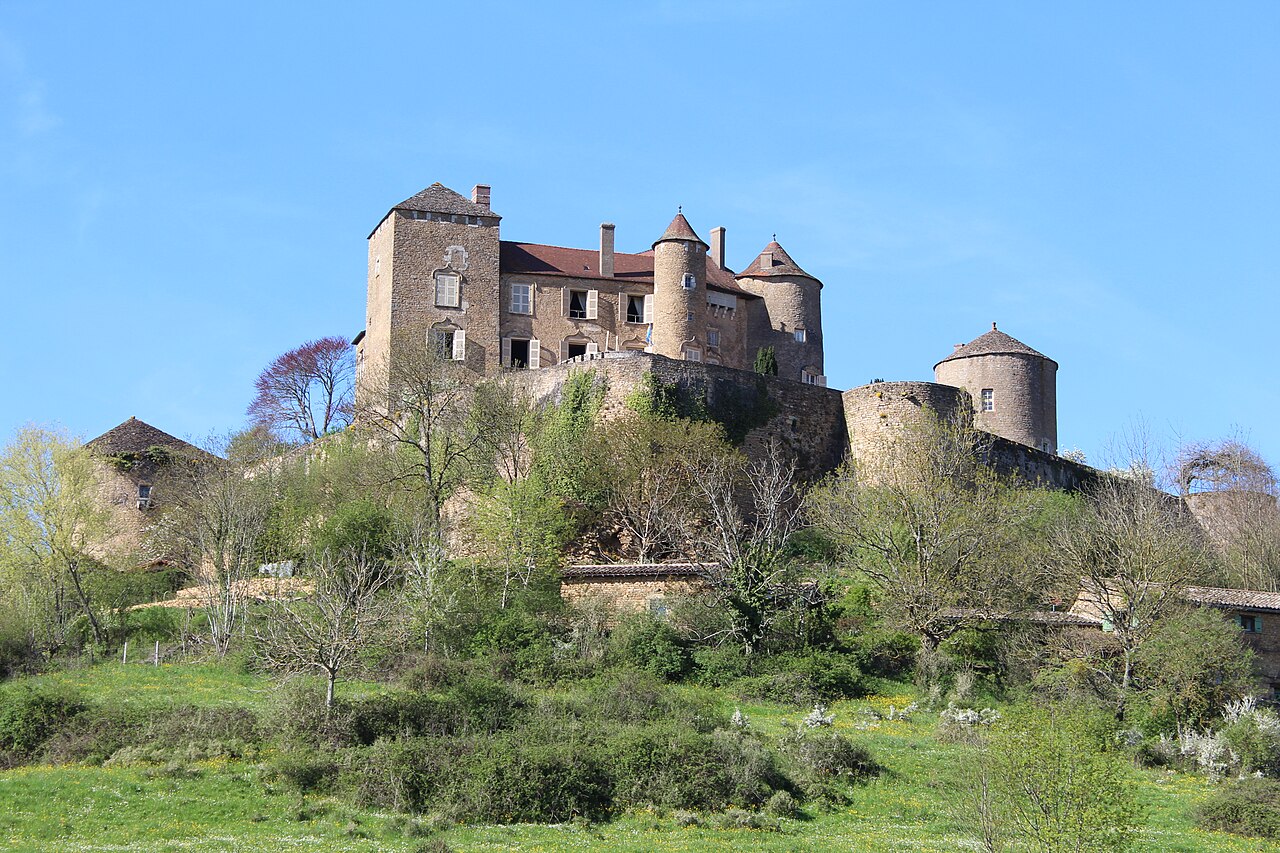
Château de Pierreclos
The Château de Pierreclos is a remarkable hill castle located in the commune of Pierreclos in the Burgundy region of France. Perched on a rocky elevation approximately 20 meters above the valley of the Petite Grosne, the château commands views over the surrounding vineyards and countryside. Its origins date back to the early medieval period, with the estate first documented in 887, making it a site of significant historical and architectural interest.
Early history and medieval origins
The site originally hosted a Roman villa during the period of Roman rule, though no physical traces remain today. The fortified manor that would become the château is first recorded in the late 9th century. By the mid-10th century, a chapel had been established on the grounds, later replaced by a Romanesque church documented in 996. This ecclesiastical building was part of a broader wave of religious construction in the region between 980 and 1040, reflecting the site's importance in medieval spiritual and feudal life.
The castle likely developed from defensive structures erected around this church. Two main theories exist regarding its initial fortifications: one suggests a donjon or central fortified tower was built by bishops or cathedral canons to assert ecclesiastical authority; the other attributes the construction to the Berzé family, who may have built a tower to protect their interests amid regional conflicts. By 1282, the Berzé family had acquired ownership, with Étienne de Berzé as the earliest known lord managing the castle alongside his brother Hugues.
Ownership transitions and conflicts
Over the centuries, the château passed through several noble families, including the Guy Chevrier family from 1366, Louis of Savoy, Prince of Morea, and from 1403, the Bletterans family. The castle endured significant turmoil during the Armagnac-Burgundian conflicts of the early 15th century. It was seized by Armagnac forces in 1422 but soon retaken by the Burgundians and restored to the Bletterans.
In 1434, the château came into the possession of the Rougemont family through marriage. The Rougemonts faced violent episodes including pillaging by mercenary bands in 1437 and partial destruction in 1471 when troops loyal to King Louis XI attacked during his campaign against Duke Charles the Bold of Burgundy.
Religious wars and later ownership
The French Wars of Religion in the 16th century also affected the château. In 1562, Protestant forces besieged and looted the castle, destroying its Catholic church. Despite these hardships, the Rougemont family retained ownership until financial difficulties forced a sale in 1671.
In 1665, Jean-Baptiste Michon, a royal financial official from Lyon, purchased the estate. He initiated extensive renovations, commemorated by his coat of arms above the main gate. The Michon family expanded the property in the early 18th century and maintained possession through the upheavals of the French Revolution.
During the revolutionary period, the château was attacked multiple times in 1789 during the Great Fear, suffering damage to buildings and property. Michon installed artillery pieces in 1790 but was later imprisoned and died in 1793. After the Bourbon Restoration, the estate was sold in 1817.
19th and 20th century restorations
The Chaland-Thiollier family acquired the château in 1829 and undertook restorations to many of its buildings. The property later passed to the Darnat family until World War II. Post-war, the château served as a holiday camp under Mr. Fouilloux until the 1970s. Since 1989, the Pidault family has been dedicated to restoration and preservation efforts, ensuring the château's historical legacy endures.
Architectural features and layout
The château's layout is a rectangular plan defined by a series of towers and buildings enclosed within a low stone wall. Notably, a square tower on the southeast side is topped with a distinctive pavilion-style roof featuring upturned eaves, characteristic of the château's silhouette.
The main residential building is a rectangular structure aligned north-south, with a smaller square tower on the west side and a larger square tower anchoring the northwest corner. This corner tower is flanked by 19th-century round turrets supported on stone corbels and also capped with pavilion roofs. The principal residence rises two stories and has undergone significant roofline alterations over time. An unfinished building adjoins its northern side.
Inside, a remarkable suspended spiral staircase connects different levels. This staircase features vaulted landings supported by columns in the Tuscan order, notable for their simple classical capitals and bases, exemplifying restrained elegance within the château's interior.
Entrance and courtyard
The approach to the château includes a paved alley leading to a gate flanked by two small pavilions with imperial-style roofs, recognized by their broad, low-pitched shapes. Beyond the gate lies a forecourt separated from the main courtyard by a vaulted passage with a rounded arch door surmounted by the Michon family coat of arms from the 17th century.
Outbuildings and gardens
Surrounding the château are numerous ancillary buildings that historically served as stables, workshops, and storage areas. These outbuildings contribute to the estate's historic character and reflect its functional complexity as a noble residence.
To the south, a small parterre garden remains, featuring decorative shrubs and flower beds arranged in traditional patterns, illustrating the château's connection to historic landscape design.
Ecclesiastical remnants and interior highlights
Nearby stand the remnants of a Romanesque church dating from the latter half of the 12th century, with only the bell tower and choir still intact. This echoes the site's long-standing ecclesiastical heritage and its role in the religious life of the region.
Inside the château, several features are protected for their historical value, including two kitchen chimneys, a guard room with a French-style ceiling and fireplace, and the "Laurence" chamber, which retains original parquet flooring. The roofs of the château vary between conical and pavilion shapes, contributing to its distinctive architectural profile.
Heritage status and significance
The Château de Pierreclos is recognized as a designated historic monument, preserving its architectural elements and embodying centuries of regional history. Its combination of medieval fortifications, classical interior details, and later renovations offers valuable insight into the evolution of noble residences in Burgundy from the early medieval period through the modern era.
Frequently asked questions (FAQ)
- What is the historical significance of Château de Pierreclos?
- Château de Pierreclos is a stunning example of medieval architecture and reflects the rich history of the Burgundy region in France. Built in the 15th century, it played a vital role in the defense and administration of the area, showcasing the evolution of castle design over the centuries.
- When is the best time to visit Château de Pierreclos?
- The best time to visit Château de Pierreclos is during the spring and early autumn months, when the weather is mild and the gardens are in full bloom. Additionally, this period is less crowded, allowing for a more enjoyable experience as you explore the castle and its surroundings.
- What are the opening hours of Château de Pierreclos?
- Château de Pierreclos is open to visitors from 10 AM to 6 PM, Tuesday through Sunday. It is closed on Mondays, so be sure to plan your visit accordingly to enjoy a guided tour of this magnificent castle.
- Can I purchase tickets online for Château de Pierreclos?
- Yes, tickets for Château de Pierreclos can be purchased online through the official website. Buying tickets in advance is recommended, especially during peak tourist seasons, to ensure entry and avoid long wait times.
- Is Château de Pierreclos accessible for visitors with mobility challenges?
- Château de Pierreclos strives to be accessible for all visitors, offering facilities for those with mobility challenges. However, due to its historical architecture, some areas may have limitations, so it is advisable to check with staff upon arrival for assistance.
- What nearby attractions can I explore while visiting Château de Pierreclos?
- While visiting Château de Pierreclos, you can explore other nearby attractions such as the picturesque vineyards of Burgundy and the historic town of Tournus. The region is renowned for its wine tours and gastronomy, making it an excellent addition to your visit.
- How do I get to Château de Pierreclos from Lyon?
- To reach Château de Pierreclos from Lyon, you can take a train to Mâcon, followed by a short taxi ride to the castle. Alternatively, driving is a convenient option, with the journey taking approximately one and a half hours via the A6 motorway.
- Why is the architecture of Château de Pierreclos unique?
- The architecture of Château de Pierreclos is unique due to its blend of medieval fortification and Renaissance elegance, showcasing both defensive and aesthetic features. The castle's towers, ramparts, and intricate stonework reflect the historical transition in design during its construction period.
Information
Website
Visit websiteSources & official resources
Verify the information above using these authoritative references.
Loading map...
Visitor reviews
No reviews yet. Been here? Write the first review and help other travelers!
Write the first reviewVisited this castle? Share your experience
Your review helps other travelers and adds first-hand knowledge to our encyclopedia.