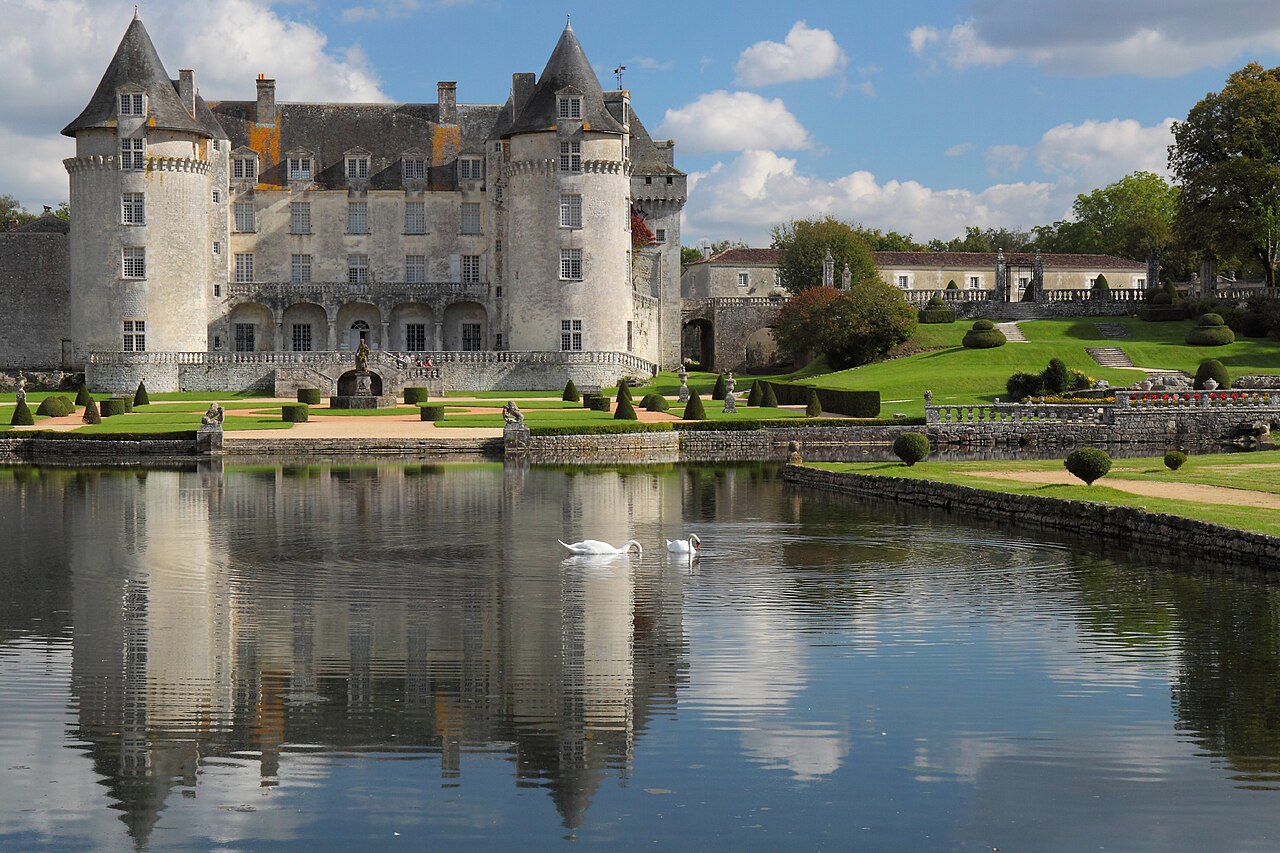
Château de Nieul-lès-Saintes
Château de Nieul-lès-Saintes is a historic medieval fortress located in the town of Nieul-lès-Saintes in southwestern France. Constructed in the 14th century, the castle exemplifies the military architecture of the late medieval period with its robust defensive features and strategic design. Originally built by Jean Chaudrier, a notable nobleman and mayor of La Rochelle, the château was both a stronghold and a residence, reflecting the dual needs of security and habitation during a turbulent era in French history.
The origins and historical significance
The construction of the château began around 1370 when Jean Chaudrier acquired the estate through his marriage to Jeanne de Parthenay, the heiress of the land. Chaudrier was an influential figure, not only in local governance but also in military affairs, notably contributing to the liberation of La Rochelle from English control. This connection to significant historical events imbues the castle with an important legacy beyond its architectural presence.
Throughout the 16th century, the château became a center of religious activity aligned with the Protestant Reformation. The lords of Nieul embraced Calvinism, and the castle hosted Protestant worship services in 1573 and 1574. This period highlights the château's role as a religious refuge and a symbol of the shifting religious landscape in France during the Reformation.
Ownership of the château became fragmented between 1630 and 1720, divided among several co-lords. This division ended when Gabriel Limousin consolidated ownership in 1720, restoring the estate's unity. However, the French Revolution brought dramatic change; in 1793, the château was confiscated as national property and subsequently sold to farmers, marking the end of its noble ownership and traditional function.
Architectural features and defensive design
The château is enclosed by a dry moat that once included two drawbridges, a common defensive feature of medieval fortifications designed to deter attackers. The layout is an irregular polygonal enclosure fortified by thick curtain walls over 12 meters high. These walls are reinforced at the corners by massive buttresses, a characteristic defensive technique from the 13th and 14th centuries that provided structural strength and resistance against siege engines.
Atop the curtain walls runs a chemin de ronde, or wall-walk, which allowed guards to patrol the perimeter and defend the castle from elevated positions. Portions of this walkway remain well-preserved, especially on two surviving square towers that punctuate the enclosure. These towers served as lookout points and defensive bastions, offering vantage points to observe the surrounding countryside and repel attackers.
Within the courtyard, residential buildings and living quarters are integrated with the defensive walls, demonstrating the castle's dual function as a fortress and a noble residence. Originally, three stair towers provided vertical access within the complex; two remain standing today, while the third, which led to vaulted basement chambers, has not survived. These basement areas likely served as storage or secure refuge during sieges.
Later history and preservation efforts
After the upheavals of the French Revolution and the sale of the property to farmers, the château gradually fell into disrepair. Its defensive importance diminished, and it became more of a historical ruin than a functional stronghold. In the 20th century, starting in 1972, dedicated restoration work began to stabilize and preserve the remaining structures. These efforts aimed to protect the château's architectural features and maintain its historical integrity for future generations.
Recognizing its cultural and historical value, French authorities added Château de Nieul-lès-Saintes to the supplementary inventory of historic monuments on July 8, 1988. This designation helps ensure ongoing protection and highlights the château's significance as a heritage site.
Architectural style and classification
The château is best classified as a hill castle due to its elevated position and strategic defensive design typical of medieval fortifications. Its architectural style reflects the late medieval period, with features such as thick stone walls, buttresses, towers, and moats characteristic of military architecture from the 14th century. Although in ruins, the surviving elements provide valuable insight into the construction techniques and defensive strategies employed during this era.
Visiting and cultural importance
Today, Château de Nieul-lès-Saintes stands as a partially preserved ruin that attracts visitors interested in medieval history and architecture. The dry moat, curtain walls, and towers offer a tangible connection to the past and the turbulent history of the region. Its association with significant historical figures and events adds depth to its appeal.
Visitors can explore the remains of the courtyard and walls, gaining an understanding of medieval castle design and the lifestyle of the nobility who once inhabited the site. The château's preservation as a listed historic monument ensures its continued role as a cultural landmark in the region.
Frequently asked questions (FAQ)
- How do I get to Château de Nieul-lès-Saintes?
- Château de Nieul-lès-Saintes is easily accessible by car and public transportation. If you are driving, it is located just off the D137 road, and there is parking available nearby. For those using public transport, local buses connect the castle with nearby towns and cities.
- What is the historical significance of Château de Nieul-lès-Saintes?
- Château de Nieul-lès-Saintes dates back to the 12th century and has served various roles throughout its history, including a fortress during regional conflicts. It is notable for its well-preserved architecture and its role in the defense strategies of the region. The castle offers insights into medieval life and the evolution of fortifications in France.
- When was Château de Nieul-lès-Saintes built?
- Construction of Château de Nieul-lès-Saintes began in the 12th century, with significant modifications and expansions occurring in subsequent centuries. The castle reflects various architectural styles, showcasing the historical transitions from medieval to Renaissance design. Its enduring structure highlights the craftsmanship and defensive needs of its time.
- Can I take guided tours of the castle?
- Yes, guided tours are available at Château de Nieul-lès-Saintes, providing visitors with an in-depth understanding of its history and architecture. Tours are typically conducted by knowledgeable guides who share fascinating stories and insights. It is advisable to check the schedule and book in advance, especially during peak tourist seasons.
- Why is Château de Nieul-lès-Saintes a popular tourist destination?
- Château de Nieul-lès-Saintes attracts visitors due to its rich history, stunning architecture, and picturesque surroundings. The castle's strategic location near other historical sites makes it a convenient stop for those exploring the region. Additionally, its well-preserved state allows visitors to experience a slice of medieval life firsthand.
- Is it possible to visit Château de Nieul-lès-Saintes year-round?
- Yes, Château de Nieul-lès-Saintes is open to visitors throughout the year, although hours may vary by season. It is recommended to check the official website for the most current opening times and any seasonal events. Visiting during the spring and fall can provide a more pleasant experience with fewer crowds.
- What are the ticket prices for Château de Nieul-lès-Saintes?
- Ticket prices for Château de Nieul-lès-Saintes are generally affordable, with discounts available for students, seniors, and groups. Children under a certain age may enter for free. Be sure to check the official website for the latest pricing information and any special deals or family packages.
- What are the best times to visit Château de Nieul-lès-Saintes?
- The best times to visit Château de Nieul-lès-Saintes are during the spring and fall when the weather is mild and the crowds are smaller. Summer can be busy, but it also offers vibrant garden displays and special events. Early mornings or late afternoons are ideal for a quieter experience.
- Are there any nearby attractions to visit?
- Yes, there are several attractions near Château de Nieul-lès-Saintes, including other historical castles and charming villages. The beautiful landscape of the surrounding region offers opportunities for hiking and exploring nature. Visitors can also enjoy local cuisine in nearby restaurants, enhancing their experience in the area.
Information
Website
Visit websiteSources & official resources
Verify the information above using these authoritative references.
Loading map...
Visitor reviews
No reviews yet. Been here? Write the first review and help other travelers!
Write the first reviewVisited this castle? Share your experience
Your review helps other travelers and adds first-hand knowledge to our encyclopedia.